Author: admin

  • Types of Prediction Markets: Every Category of Event You Can Trade in 2026

    Types of Prediction Markets: Every Category of Event You Can Trade in 2026

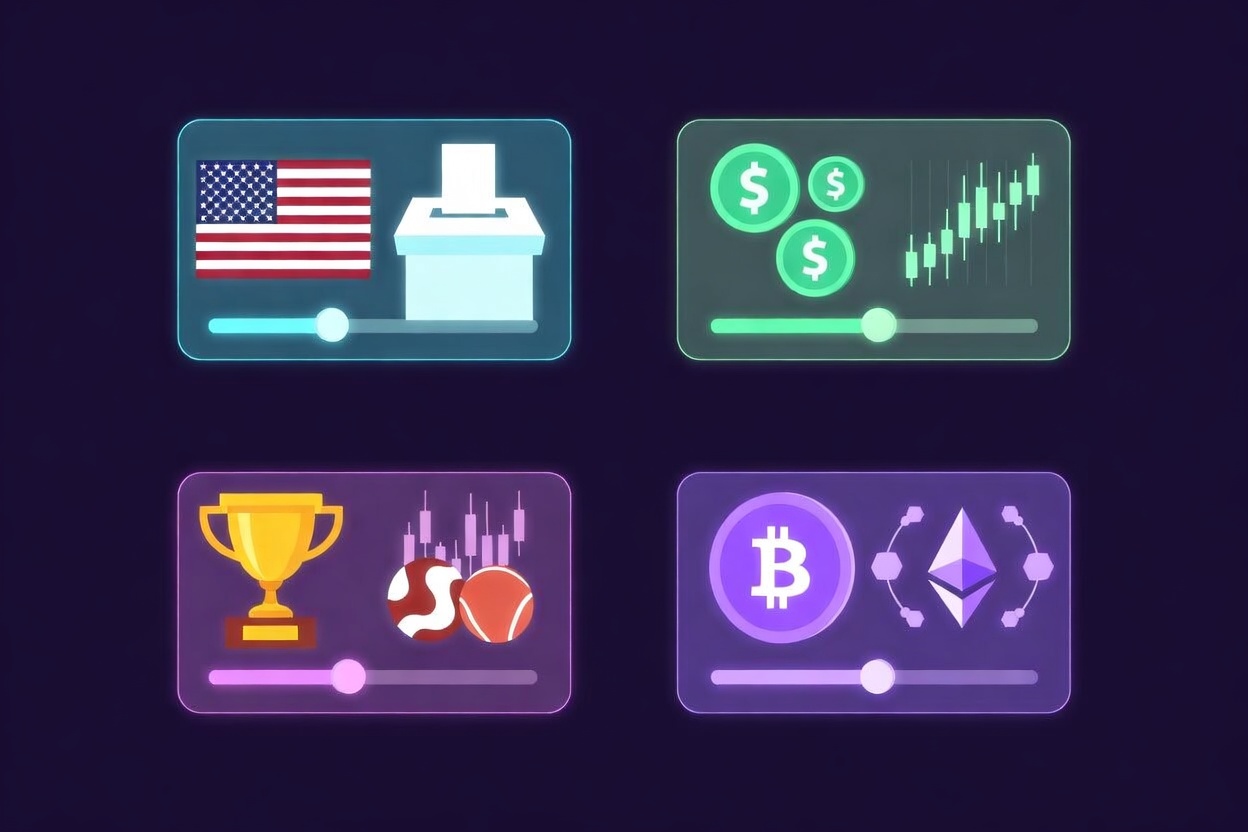
    Most people discover prediction markets through one headline: an election. But the types of prediction markets available in 2026 extend far beyond politics, covering everything from Fed rate decisions and Super Bowl outcomes to hurricane paths and Oscar winners.

    Prediction markets now span at least nine distinct event categories across platforms like Kalshi, Polymarket, and FanDuel Predicts. The industry surpassed $21 billion in monthly trading volume in early 2026,1TRM Labs, “How Prediction Markets Scaled to $21B,” trmlabs.com, March 2026 driven by geopolitical events, sports, and economic data. Whether you are a sports bettor looking for longer-term futures, a finance professional wanting to trade economic data releases, or a crypto trader seeking defined-risk positions on token prices, there is a market category built for your background.

    This guide breaks down every major prediction market category available today: what each one covers, which platforms dominate each category, when they peak in activity, and how to match your experience to the right market type. Think of it as the menu before you pick the restaurant.

    If you are new to how prediction markets function, start with our guide on how prediction markets actually work for the mechanics, then come back here to explore the full landscape.

    What Types of Prediction Markets Exist?

    Prediction market categories have expanded rapidly since Kalshi’s landmark CFTC court victory in October 2024 opened the door to political event contracts. Today, at least nine distinct categories of events are tradeable across major platforms.

    Here is the full taxonomy of prediction market types available in 2026:

    CategoryWhat You Can TradeExample ContractPrimary Platform(s)

    Politics/Elections

    Presidential, congressional, gubernatorial races; policy outcomes; regulatory decisions

    “Will the Republican win the 2026 PA Senate seat?”

    Kalshi, Polymarket

    Economics/Finance

    Fed rate decisions, CPI, GDP, employment data, recession probability, gas prices

    “Will the Fed cut rates at the June 2026 meeting?”
    Kalshi

    Sports
    Game outcomes, season futures, player awards, coaching changes, draft picks
    “Will the Eagles win Super Bowl LXI?”

    Kalshi, FanDuel, DraftKings

    Crypto

    Token price targets, ETF decisions, protocol events, regulatory milestones

    “Will Bitcoin exceed $150K by Dec 2026?”

    Polymarket
    Entertainment
    Award shows (Oscars, Grammys), box office, Billboard, viral moments

    “Best Picture winner at the 2027 Oscars”

    Kalshi, Polymarket
    Weather
    Hurricane strength, daily temperatures, tornado counts, extreme weather

    “Cat 5 hurricane US landfall in 2026?”

    Kalshi, Polymarket

    Science & Tech

    SpaceX launches, AI regulation, space events, tech policy

    “Will OpenAI release GPT-5 before Jul 2026?”

    Polymarket, Kalshi

    News/Current Events

    Government shutdowns, international affairs, geopolitical events

    “US government shutdown in Q3 2026?”

    Kalshi, Polymarket

    Stocks/Indices

    Daily S&P 500 closes, Nasdaq-100 levels, WTI oil price targets

    “S&P 500 close above 6,000 today?”

    Kalshi

    The sheer breadth surprises most newcomers. If you arrived here thinking prediction markets are just about elections, that is the single biggest misconception in the space. Kalshi alone operates 10,000+ open markets across 17 named categories.2Kalshi, “Public API Series Data,” kalshi.com, March 2026 Polymarket adds thousands more, with particular depth in crypto and global political events.

    Each category carries a different risk profile, liquidity level, and seasonal cycle. The sections below break down which platforms lead where, when each category is most active, and which type fits your background.

    Which Platforms Are Strongest in Each Category?

    Not all platforms cover all categories equally. Some excel in specific niches while offering only token coverage in others. This matrix shows verified platform strength by category based on market count, liquidity depth, and breadth of contract types.

    CategoryKalshiPolymarketFanDuel PredictsDraftKingsRobinhood
    Politics★★★★★★★★★★
    Economics★★★★★★★★★★★
    Sports★★★★★★
    ★★ (18 st.)
    ★★★★
    Crypto★★★★★★★
    Entertainment★★★★★★
    Weather★★★★NoneNone
    Science/Tech★★★★NoneNone
    News/Events★★★★★None
    Stocks/Indices★★★★★★★

    ★★★ = Deep liquidity, broad selection | ★★ = Available, moderate depth | ★ = Limited | None = Not offered. This matrix covers US-facing platforms. UK and EU traders can also access Smarkets (FCA-regulated) and Betfair Exchange (UKGC-licensed) for sports and political markets.

    Kalshi is the broadest regulated platform, covering all nine categories with particularly deep liquidity in politics, economics, and daily index markets. Polymarket leads globally in political markets (the 2024 US election alone generated $3.3 billion in trading volume3Sacra, “Polymarket Company Report,” sacra.com, 2025) and set a $478 million single-day volume record in March 2026.4CoinDesk, “Polymarket Attracts Record Trading Volumes,” coindesk.com, March 2026 It is the clear leader in crypto prediction markets with unique 15-minute and 5-minute price contracts. FanDuel Predicts reaches all 50 US states5SBC Americas, “FanDuel Predicts All 50 States,” sbcamericas.com, January 2026 but sports contracts are available in only 18 states where FanDuel does not operate a sportsbook.6Apple App Store, “FanDuel Predicts Listing,” apps.apple.com, March 2026

    After trading across every major category, here is what I have found: political markets have the deepest liquidity but the most efficient pricing, especially on headline races. Economic indicator markets are where I have found the most consistent edge, because most prediction market participants do not have a background in reading Fed statements or interpreting CPI data.

    Sports PMs are growing fast but sportsbooks still offer better liquidity on most individual game events. The PM advantage in sports is longer-term futures and props that sportsbooks do not offer. Crypto PMs on Polymarket solve a real problem: you can trade a nuanced view on Bitcoin’s price without full directional exposure.

    Robert C.

    The Big Four: Politics, Economics, Sports, and Crypto

    Four categories account for the vast majority of prediction market volume. Here is what each covers and where the real opportunities sit.

    Political Markets

    Political prediction markets cover elections (presidential, congressional, gubernatorial), policy outcomes, regulatory decisions, and international political events. Kalshi and Polymarket are the two dominant platforms. Political markets attract the deepest liquidity of any category, but that depth also means efficient pricing on headline races. The mispricing tends to show up in lower-profile contests: state primaries, policy contracts, and regulatory decision markets where fewer traders participate.

    The 2024 US presidential election was the watershed moment for the entire industry. Polymarket processed over $3.3 billion in volume on that single event.7Sacra, “Polymarket Company Report,” sacra.com, 2025 By February 2026, monthly trading volume exceeded $7 billion across all categories, a 7.5x year-over-year increase.8Phemex, “Polymarket Record Trading Volumes February 2026,” phemex.com, March 2026 The 2026 midterm elections are the next major catalyst.

    Economic Indicator MarketsEconomics markets let you trade the outcomes of scheduled data releases: Fed rate decisions, CPI readings, employment reports, GDP figures, and commodity prices. Kalshi is the leader here, with “Flash Markets” that settle the same day on S&P 500 closes and gas prices.9Kalshi, “Flash Markets Product Page,” kalshi.com, 2026 These contracts give retail traders access to instruments that previously required futures or swaps accounts.

    Pro Tip

    Economic data release calendars are public. The Fed publishes its meeting schedule a year in advance. Eight Fed meetings per year, twelve CPI releases, and twelve employment reports create a predictable trading calendar most PM participants overlook.

    Sports Markets

    Sports prediction markets cover game outcomes, season futures, player awards, coaching changes, and draft predictions across US and international leagues, including Premier League, Serie A, and F1. The critical distinction from sportsbooks: you can trade out of positions before the event resolves. If your “Will the Eagles win the Super Bowl?” contract rises from $0.15 to $0.45 mid-season, you can sell for a profit without waiting for the game.

    FanDuel Predicts offers sports contracts in 18 states where it does not operate a sportsbook.10Apple App Store, “FanDuel Predicts Listing,” apps.apple.com, March 2026 Both Kalshi and Polymarket hold official NHL licensing agreements, making the NHL the first major US sports league to partner with prediction market platforms.11NHL.com, “NHL Announces Landmark Partnerships with Kalshi, Polymarket,” nhl.com, October 2025 For a detailed breakdown of how sports PMs compare to sportsbooks, see our guide to sports prediction markets.

    Crypto MarketsCrypto prediction markets let you trade views on token prices, ETF decisions, protocol milestones, and regulatory actions without holding the underlying asset. Polymarket dominates this category with unique 15-minute and 5-minute crypto price markets.12Polymarket, “Crypto Markets Documentation,” docs.polymarket.com, 2026 A $0.55 contract on “Will Bitcoin be above $100,000 at 3:00 PM?” costs $0.55, with a maximum loss of $0.55. No liquidation risk, no exchange counterparty risk, no leverage blowup.

    Warning

    Crypto prediction markets are not a substitute for spot crypto exposure. They are defined-risk instruments for expressing specific, time-bound views. Treat them as trades, not investments.

    Emerging Categories: Weather, Entertainment, Science, and Beyond

    The fastest-growing prediction market categories are the ones most people do not know exist. Weather, entertainment, science, and technology markets are expanding across platforms with some of the least efficient pricing in the entire space.

    Weather Markets

    Kalshi offers hurricane strength predictions, daily city temperature contracts, and tornado count markets. Polymarket launched weather markets for Shanghai and Hong Kong temperatures in March 2026.13Polymarket, “Weather Markets Launch,” polymarket.com, March 2026 Weather contracts attract thin liquidity because few traders have meteorological expertise, which creates opportunity for those who do.

    Entertainment and Culture

    Award show predictions (Oscars, Grammys, Golden Globes) are available on both Kalshi and Polymarket. Kalshi extends into Billboard chart rankings, box office revenue, app store rankings, and viral social media moments. These markets peak during awards season from January through March. FanDuel Predicts offers “Mentions” markets that track cultural conversations.

    Science and Technology

    Space launch outcomes (SpaceX missions), AI regulation milestones, and technology policy decisions are tradeable on Polymarket and Kalshi. These are genuinely novel markets with no sportsbook or traditional finance equivalent. The contracts tend to be longer duration and lower volume.

    Expert Tip

    Emerging categories have the widest spreads and thinnest order books, but that is exactly why they offer the most potential edge. In political markets, you are competing against professional forecasters and media-informed crowds. In weather or science markets, you might be one of a few hundred participants. If you have domain expertise in meteorology, space technology, or economic modeling, niche categories are where that knowledge pays.

    When to Trade: The Prediction Market Seasonality Calendar

    Unlike stock markets, prediction market activity is driven by event calendars. Knowing when each category peaks helps you plan where to allocate attention and capital.

    CategoryPeak SeasonKey Dates/Triggers
    Politics
    Election years; primaries (Feb-Jun), general (Sep-Nov)

    2026 midterm primaries spring; general Nov 2026
    Economics
    Year-round, following data calendar

    8 Fed meetings/yr, monthly CPI + jobs, quarterly GDP
    Sports
    Sep-Feb (NFL), Oct-Jun (NBA/NHL), Apr-Oct (MLB)

    Super Bowl, March Madness, NBA Finals, World Series
    Crypto
    Event-driven; 24/7 activity
    Halving cycles, ETF decisions, protocol upgrades
    Entertainment
    Jan-Mar (awards); product launches year-round

    Golden Globes, Oscars, Grammys (Jan-Mar)
    Weather
    Jun-Nov (hurricane season); year-round extremes

    Atlantic hurricane season Jun 1 to Nov 30
    Science/Tech
    Launch schedules; regulatory calendars

    SpaceX manifests; congressional AI hearings
    News/Events
    Unpredictable; spikes around crises

    Shutdown deadlines, international flashpoints

    Economics markets offer the most predictable rhythm. The Federal Reserve publishes its meeting schedule a full year in advance,14Federal Reserve, “FOMC Meeting Calendar,” federalreserve.gov, 2026 and CPI, employment, and GDP release dates are all publicly available through the Bureau of Labor Statistics and Bureau of Economic Analysis. International traders can apply the same calendar approach to ECB meetings and UK data releases. You can plan your trading calendar in January for the entire year.

    Sports and political markets are cyclical but less predictable in intensity. A contested primary or an unexpected playoff run can spike volume overnight. Crypto is the outlier: 24/7 activity with volume driven by news cycles and market sentiment rather than a fixed calendar.

    The strategic implication is straightforward: spread your attention across categories with different seasonal patterns. When political markets are quiet between elections, economic data releases keep the calendar full. When major sports leagues are in their offseason, crypto and entertainment fill the gap.

    Find Your Market: Matching Your Background to the Right Category

    Your existing knowledge is an edge in prediction markets. The category where you have the deepest understanding is the category where you are most likely to identify mispriced contracts.

    Your Background
    Best Category to Start
    WhyRecommended Next Step
    Sports bettor / fantasy player
    Sports PMs

    You already understand odds, lines, and player performance. PM futures extend your skill set.
    Read our sports prediction market guide

    Finance / economics professional

    Economics/Finance

    You can read Fed statements and interpret CPI data. Most PM traders cannot.

    Explore Kalshi economic indicator markets
    Crypto trader
    Crypto PMs

    You understand token dynamics and protocol events. Polymarket’s 15-min markets offer defined risk.

    Start with Polymarket crypto category

    Political news follower

    Political PMs

    You follow races, polling, and policy. Political PMs let you express informed views.

    Read our political prediction markets guide

    Data scientist / researcher

    Emerging (weather, science, tech)

    Thin markets with few participants mean your analytical skills face less competition.

    Browse Kalshi science and weather categories in Market Scanner

    Complete newcomer

    Whatever interests you most

    Interest sustains attention, and attention is what finds edge. Pick the category you follow.

    Start with how prediction markets work

    The common mistake is starting with the most popular category instead of the one where you have genuine knowledge. Political markets attract the most attention, which means they are also the most efficiently priced. A meteorologist trading weather contracts or an economist trading Fed rate decisions faces far less competition than a casual news follower trading the presidential race.

    Our practical takeaway: match your background to a category before chasing the most popular markets. A finance professional has genuine edge in economic indicator markets. A sports bettor translates naturally into sports PMs. A crypto native belongs on Polymarket. And if you have niche expertise in weather or technology, the thinnest markets are where mispricing lives.

    Check your local regulations before trading on any prediction market platform. Laws vary by jurisdiction.

    Sources & References

    • 1
      TRM Labs, “How Prediction Markets Scaled to $21B,” trmlabs.com, March 2026
    • 2
      Kalshi, “Public API Series Data,” kalshi.com, March 2026
    • 3
      Sacra, “Polymarket Company Report,” sacra.com, 2025
    • 4
      CoinDesk, “Polymarket Attracts Record Trading Volumes,” coindesk.com, March 2026
    • 5
      SBC Americas, “FanDuel Predicts All 50 States,” sbcamericas.com, January 2026
    • 6
      Apple App Store, “FanDuel Predicts Listing,” apps.apple.com, March 2026
    • 7
      Sacra, “Polymarket Company Report,” sacra.com, 2025
    • 8
      Phemex, “Polymarket Record Trading Volumes February 2026,” phemex.com, March 2026
    • 9
      Kalshi, “Flash Markets Product Page,” kalshi.com, 2026
    • 10
      Apple App Store, “FanDuel Predicts Listing,” apps.apple.com, March 2026
    • 11
      NHL.com, “NHL Announces Landmark Partnerships with Kalshi, Polymarket,” nhl.com, October 2025
    • 12
      Polymarket, “Crypto Markets Documentation,” docs.polymarket.com, 2026
    • 13
      Polymarket, “Weather Markets Launch,” polymarket.com, March 2026
    • 14
      Federal Reserve, “FOMC Meeting Calendar,” federalreserve.gov, 2026
  • Are Prediction Markets Legal? US Federal Law, State Rules, and Global Regulation Explained

    Are Prediction Markets Legal? US Federal Law, State Rules, and Global Regulation Explained

    Are prediction markets legal? In the US, the short answer is yes, with significant caveats that depend on which platform you use and which state you live in.

    At the federal level, prediction markets operating on CFTC-regulated exchanges are legal. The Commodity Futures Trading Commission classifies event contracts as commodity derivatives under the Commodity Exchange Act, and in February 2026, the agency filed a federal court brief asserting its exclusive jurisdiction over these markets. 1CFTC, “CFTC Reaffirms Exclusive Jurisdiction over Prediction Markets,” cftc.gov, February 17, 2026

    Platforms like Kalshi hold full CFTC designation. Polymarket acquired a CFTC-regulated exchange in 2025 to gain the same status.

    But states see it differently. As of late March 2026, nearly 50 active lawsuits span 14 or more states. Arizona filed the first-ever criminal charges against a prediction market platform. Federal courts are split on who is right.

    Internationally, the picture is even more complex: most countries classify prediction markets as gambling, and enforcement is escalating.

    This guide breaks down prediction market legality across three layers: US federal law, state-level regulation, and international rules.

    Are Prediction Markets Legal in the United States?

    Under US federal law, prediction markets are legal when they operate on exchanges regulated by the Commodity Futures Trading Commission. The CFTC classifies event contracts as commodity derivatives under the Commodity Exchange Act (CEA), placing them alongside futures and options.

    The CFTC first recognized event contracts in 1992 when it issued a no-action letter allowing the Iowa Electronic Markets to operate at the University of Iowa. The modern regulatory era began in November 2020, when KalshiEX LLC received an Order of Designation as a Designated Contract Market (DCM), making it the first exchange built exclusively for event contracts. 2CFTC, “Order of Designation: KalshiEX LLC,” cftc.gov, November 2020

    In July 2025, Polymarket acquired QCX LLC, an existing DCM, for $112 million, and the CFTC issued an Amended Order of Designation in November 2025. 3The Block, “Polymarket Acquires QCX for $112M,” theblock.co, July 2025

    In February 2026, the CFTC filed an amicus brief in the Ninth Circuit Court of Appeals stating that it holds “exclusive jurisdiction” over event contracts. CFTC Chair Michael Selig put it directly: these products are commodity derivatives, and the CFTC will defend its regulatory authority over them.

    The Trump administration’s CFTC has taken a strongly pro-prediction-market posture. In January 2026, Chairman Selig withdrew the Biden-era proposed rule that would have banned political and sports event contracts. 4CNBC, “CFTC Scraps Proposed Ban on Sports Contracts,” cnbc.com, January 29, 2026 In March 2026, the agency issued an Advance Notice of Proposed Rulemaking and a Division of Market Oversight advisory outlining how existing rules apply to prediction markets. 5CFTC, “ANPRM on Event Contracts,” 91 Fed. Reg. 12516, March 16, 2026

    Not all prediction market platforms carry the same legal status. The platform type determines your level of federal regulatory protection:

    Platform TypeExampleLegal BasisProtection Level

    CFTC Designated Contract Market (DCM)

    Kalshi, Polymarket US

    Full CFTC registration, CEA preemption

    Highest: segregated funds, audited settlement, clearinghouse backing

    CFTC No-Action Letter
    PredictIt
    CFTC letter permitting operation with conditions

    Moderate: investment caps, academic framework, no clearinghouse

    CFTC FCM/Intermediary
    FanDuel Predicts (via CME Group)
    Registered Futures Commission Merchant
    High: operates through established DCM, CFTC and NFA oversight

    Crypto-Native / Unregulated

    Global Polymarket, Opinion

    None (or offshore only)

    Lowest: no US regulatory oversight, no fund segregation, no recourse

    Expert Tip

    The legal distinction between “CFTC-regulated” and “unregulated” is not a marketing label. CFTC-regulated DCMs must hold customer funds in segregated accounts, maintain audited settlement sources, and operate a clearinghouse. If the platform goes bankrupt, your funds are protected. On an unregulated crypto platform, none of those protections exist.

    The federal legal foundation is real and strengthening. But federal regulation only answers half the question. The harder problem is what happens at the state level.

    The State-by-State Problem: Where Courts and Regulators Disagree

    While the CFTC claims exclusive federal jurisdiction, state regulators and attorneys general in more than a dozen states disagree. The core legal fight centers on one question: does the Commodity Exchange Act preempt state gambling laws for sports event contracts traded on federally regulated exchanges?

    Federal courts have split on the answer. Some have sided with prediction market platforms, ruling that CFTC designation preempts state authority. Others have ruled that sports event contracts are gambling subject to state regulation, regardless of federal registration.

    Courts favoring platforms (federal preemption):

    Nevada: Federal district court granted Kalshi a preliminary injunction in 2025. State appealed to the Ninth Circuit. New Jersey: Federal district court granted preliminary injunction. NJ Division of Gaming appealed to Third Circuit. Tennessee: Federal court granted Kalshi a preliminary injunction on February 19, 2026, finding sports event contracts likely qualify as “swaps” under the CEA. 6Holland & Knight, “Prediction Markets at a Crossroads,” hklaw.com, February 2026

    Courts favoring state regulators:

    Maryland: Federal court denied Kalshi’s preliminary injunction, ruling state gaming authority applies. Massachusetts: Suffolk County Superior Court ruled in January 2026 that Kalshi’s sports contracts are subject to state gaming laws. The Supreme Judicial Court accepted the case for direct review. Ohio: Federal court denied Kalshi’s preliminary injunction on March 9, 2026, ruling sports event contracts are “gambling,” not “swaps.” 7NBC News, “Ohio Judge Rules Kalshi Sports Betting Must Adhere to State Law,” nbcnews.com, March 2026 Kalshi immediately appealed to the Sixth Circuit.

    The enforcement is escalating beyond civil suits. On March 17, 2026, Arizona filed the first-ever criminal charges against a prediction market, bringing 20 misdemeanor counts against Kalshi for operating an illegal gambling business and accepting election wagers. 8NPR, “Arizona AG Files Criminal Charges Against Prediction Market Kalshi,” npr.org, March 17, 2026 CFTC Chairman Selig called the criminal prosecution “entirely inappropriate” and a “jurisdictional dispute.”

    On March 20, 2026, a Nevada state court issued a temporary restraining order blocking Kalshi from offering sports, election, and entertainment contracts in the state. The Nevada Gaming Control Board declared it had “successfully restricted the operation of all unlicensed prediction markets” in Nevada, alongside earlier restrictions on Polymarket, Robinhood, Coinbase, and Crypto.com. 9Covers, “Kalshi Shuts Down Sports Trading in Nevada After Legal Loss,” covers.com, March 21, 2026 Washington state sued Kalshi on March 28, 2026. 10CoinDesk, “Washington Sues Kalshi,” coindesk.com, March 28, 2026

    The American Gaming Association estimates states have lost over $600 million in tax revenue from wagers placed on prediction markets instead of licensed sportsbooks. 11MultiState, “Prediction Market Regulation Heats Up,” multistate.us, March 19, 2026 CFTC Chairman Selig cited “nearly 50 active cases” across the country in his February 2026 op-ed. At least 11 states have introduced prediction market legislation in 2026. Hawaii passed a bill through its House to classify prediction markets as gambling. Kentucky advanced a 17.25% tax on operator fees.

    Warning

    If you are in a state with active enforcement (particularly Arizona, Ohio, Maryland, Massachusetts, Nevada, Washington, Illinois, Michigan, Iowa, or Utah), understand that sports and election event contracts face serious legal challenges. Arizona has escalated to criminal charges. Non-sports contracts (economics, weather, crypto) generally face less state scrutiny.

    The practical takeaway: your ability to trade depends not just on whether prediction markets are legal federally, but on which state you are in and which contract types you are trading.

    How Your Platform Choice Affects Your Legal Exposure

    The platform you choose directly determines your legal risk. Not all prediction markets operate under the same regulatory framework, and the differences matter when enforcement actions escalate or a platform faces financial trouble.

    CFTC-Regulated DCMs (Kalshi, Polymarket US): These platforms hold full CFTC registration as Designated Contract Markets. Customer funds sit in segregated accounts. Trades clear through a regulated clearinghouse. If the platform goes bankrupt, your deposits are protected. The CEA’s preemption language gives these platforms the strongest legal argument against state enforcement. Kalshi has been the most aggressive in asserting federal preemption, filing lawsuits in multiple states.

    CFTC FCM/Intermediary Model (FanDuel Predicts): FanDuel operates as a registered Futures Commission Merchant through CME Group’s DCM. This gives users CFTC and NFA oversight without FanDuel itself holding a DCM designation. FanDuel’s approach to state conflict has been different from Kalshi’s: it voluntarily pulls sports contracts from states with legal sports betting, avoiding direct regulatory confrontation. The result is that FanDuel Predicts is available in all 50 states, though sports contracts are limited to 18 states without licensed sportsbooks. 12SBC Americas, “FanDuel Predicts Available in All 50 States,” sbcamericas.com, January 2026

    CFTC No-Action Letter (PredictIt): PredictIt operates under a CFTC no-action letter, not a full DCM registration. 13CFTC, “No-Action Letter 25-20,” cftc.gov, July 2025 The letter permits operation with conditions, including a $3,500 investment cap per contract. Because PredictIt offers only political markets (no sports contracts), it has avoided the state enforcement actions hitting Kalshi and Polymarket. It has lower volume and liquidity but also lower legal risk.

    Crypto-Native/Unregulated (Global Polymarket, Opinion): If you are accessing Polymarket’s global platform (not the US-regulated version) or trading on platforms like Opinion, you are operating without US federal regulatory protection. No fund segregation, no clearinghouse, no CFTC recourse. International enforcement is increasing: Australia blocked Polymarket in 2025, 14Polymarket Platform Intelligence, verified March 18, 2026 the Netherlands ordered it to cease operations in January 2026, 15NL Times, “Dutch Regulators Block Access to US Betting Site,” nltimes.nl, February 20, 2026 and Argentina banned it nationwide in March 2026. 16Decrypt, “Buenos Aires Court Orders Polymarket Blocked in Argentina,” decrypt.co, March 2026

    The legal distinction between platform types matters more than most people realize. A CFTC-regulated DCM like Kalshi operates under the Commodity Exchange Act, which contains explicit preemption language superseding state gambling laws. That is the legal theory, and federal courts in Tennessee and New Jersey have agreed. But courts in Maryland and Ohio have rejected it, ruling that sports event contracts are gambling subject to state law. Arizona went further: criminal charges, not just civil enforcement. That is a meaningful escalation. The legal question is not settled, and the answer you get depends on which federal circuit you are in. If you want the strongest legal footing, CFTC-regulated platforms are the clear choice. If you are using an unregulated crypto platform, you are operating with no federal protections and increasing international enforcement.

    Robert C.

    International Prediction Market Regulation: UK, EU, and Beyond

    Outside the United States, prediction markets face a fundamentally different legal framework. Most countries classify them as gambling, not financial instruments, and the regulatory consequences are significant.

    United Kingdom: The UK treats prediction markets as gambling. In a February 4, 2026 blog post, UKGC Director of Strategy Brad Enright stated that prediction markets would be classified as “betting intermediaries” under existing UK gambling law, requiring a UKGC license. 17UKGC, Brad Enright blog post, “Prediction Markets,” gamblingcommission.gov.uk, February 4, 2026 Neither Kalshi nor Polymarket holds a UKGC license, and both are unavailable in the UK. Matchbook became the first UK-licensed platform to launch a dedicated prediction markets product in January 2026 under its existing UKGC betting exchange license. Betfair Exchange also operates under UKGC licensing. The FCA separately regulates financial spread betting, but this does not extend to event contracts on politics, sports, or entertainment.

    European Union: There is no unified EU framework for prediction markets. Individual member states apply their own gambling regulations. France’s National Gaming Authority (ANJ) investigated Polymarket and secured a geoblock in November 2024. The Netherlands’ Kansspelautoriteit (KSA) ordered Polymarket to cease operations in January 2026, imposing penalties of EUR 420,000 per week. Germany’s Joint Gambling Authority (GGL) has classified prediction markets as illegal gambling under the Interstate Treaty on Gambling 2021 and issued public warnings. 18Taylor Wessing, “Prediction Markets in Germany and Europe,” taylorwessing.com, March 26, 2026 Belgium, Italy, and Poland have all blacklisted major platforms. The EU’s Markets in Crypto-Assets Regulation (MiCA), entering full implementation in July 2026, may apply to crypto-based prediction markets, though event contracts more likely fall under national gambling laws.

    Asia-Pacific: Australia’s ACMA determined Polymarket was an illegal gambling service in August 2025 and ordered ISP-level blocking. New Zealand’s Department of Internal Affairs ruled in February 2026 that prediction markets are prohibited under the Gambling Act 2003. Singapore’s Gambling Regulatory Authority mandated geoblocking of Polymarket in January 2025. Japan and South Korea remain accessible for most platforms but lack specific regulatory frameworks.

    Latin America: Argentina ordered a nationwide block of Polymarket in March 2026 after suspicious trading on inflation data. Colombia blocked Polymarket in October 2025. Brazil and Mexico remain accessible but have no specific prediction market regulation.

    India: India passed the Promotion and Regulation of Online Gaming Act 2025 (PROGA) in August 2025, imposing a blanket ban on all real-money online games including prediction markets. The domestic platform Probo shut down its real-money operations immediately. 19Storyboard18, “Breaking: Opinion Trading Platform Probo Shuts Operations in India,” storyboard18.com, August 2025 The Enforcement Directorate raided Probo offices and attached over 400 crore (approximately $47 million) in assets. Polymarket is also banned under PROGA. India’s 1.4 billion population represents the largest single-country market where prediction markets are now explicitly illegal.

    Canada: Prediction markets are largely banned in Canada. The Canadian Securities Administrators’ 2017 ban on binary options applies to event contracts. Ontario’s Securities Commission fined Polymarket $200,000 in 2025 and banned it from the province. Kalshi lists Canada as a restricted jurisdiction. 20Casino.org, “Will Prediction Markets Ever Become Legal in Canada?” casino.org, February 11, 2026 However, in March 2026, Canada’s Investment Regulatory Organization (CIRO) approved Wealthsimple to offer limited event contracts on economic and financial topics. Sports and election contracts remain prohibited. 21Covers, “Wealthsimple to Offer Prediction Markets in Canada Without Sports,” covers.com, March 25, 2026

    Pro Tip

    If you are outside the US, check your country’s gambling regulator for current guidance before using any prediction market platform. The enforcement landscape is shifting rapidly, with new country-level actions happening monthly in 2026.

    What’s Coming Next: Legislation, Court Rulings, and the CFTC’s 2026 Agenda

    The legal status of prediction markets is not settled. Multiple simultaneous legal battles, legislative proposals, and regulatory initiatives will reshape this space over the next 12 to 24 months.

    Federal courts will determine preemption.

    The split between circuit courts is unsustainable. The Ninth Circuit is hearing consolidated Nevada arguments on April 16, 2026. The Fourth Circuit’s Maryland oral arguments are scheduled for May 7, 2026. The Sixth Circuit is hearing Kalshi’s appeal of the Ohio ruling. If these circuits reach opposite conclusions, the US Supreme Court will likely take the case to resolve the federal-state jurisdiction question.

    The CFTC is writing new rules.

    On March 16, 2026, the CFTC published an Advance Notice of Proposed Rulemaking (ANPRM) in the Federal Register soliciting public input on how event contracts should be regulated. 22CFTC, “ANPRM on Event Contracts,” 91 Fed. Reg. 12516, March 16, 2026 Four days earlier, the Division of Market Oversight issued Staff Advisory 26-08 outlining how DCM Core Principles apply to prediction markets, including contract design, surveillance, and insider trading prevention. 23Crowell & Moring, “CFTC Takes Additional Steps Toward Prediction Market Regulation,” crowell.com, March 2026

    The CFTC is also working with the SEC on a joint interpretation to draw clearer lines between commodity swaps and security-based swaps for event contracts. The US Attorney for the Southern District of New York has publicly stated that insider trading enforcement actions targeting prediction markets are coming. 24Congressional Research Service, “Prediction Markets and Insider Trading Law,” congress.gov, March 2026

    Congress is engaged, aggressively.

    At least seven bills targeting prediction markets were introduced in Congress by late March 2026. The Prediction Markets Are Gambling Act (Senators Schiff and Curtis, bipartisan) would ban sports event contracts entirely. 25Sen. Schiff, Press Release, schiff.senate.gov, March 24, 2026 The DEATH BETS Act (Senator Schiff, Rep. Levin) would prohibit contracts involving war, terrorism, assassination, or death. 26CoinDesk, “Schiff Pushes Ban on Prediction Market Bets Tied to War and Death,” coindesk.com, March 11, 2026

    The STOP Corrupt Bets Act (Senator Merkley, Rep. Raskin) would ban contracts on elections, sports, government actions, and military operations. The PREDICT Act (Rep. Budzinski, Rep. Smith, bipartisan) would bar members of Congress from insider trading on prediction markets. The Prediction Markets Security and Integrity Act (Senators Blumenthal and Kim) targets fraud and insider trading. Suspiciously timed trades on Iran military strikes and the Venezuelan regime change are driving much of this legislative urgency.

    States continue legislating.

    Eleven states introduced prediction market legislation in 2026, with approaches ranging from Hawaii’s proposed outright ban to Kentucky’s 17.25% tax framework on operator fees. The range of approaches, combined with the volume of federal litigation and Congressional activity, suggests that the legal landscape will look fundamentally different by the end of 2026.

    From a business perspective, the state-level pushback makes perfect sense. States collected over $600 million in sports betting tax revenue last year. Prediction markets are pulling handle away from licensed sportsbooks without paying state taxes. That is the real fight. The insider trading scandals (the Iran trades, the Venezuela trades) gave Congress the political cover to act. But the money fight between states and platforms was always going to happen.

    The resolution will come through one of two paths: a Supreme Court ruling on federal preemption, or Congressional legislation creating a tax and licensing framework. Either way, expect platforms to eventually pay state-level fees. The only question is whether that happens through litigation or legislation, and right now, both are happening simultaneously.

    Ben L.

    The Bottom Line

    Prediction markets are legal in the United States under federal law when operated on CFTC-regulated exchanges. That federal foundation is real, growing stronger, and backed by the CFTC’s public assertion of exclusive jurisdiction in 2026.

    But “legal federally” does not mean “legal everywhere.” State enforcement has escalated to criminal charges. Nearly 50 active lawsuits span 14 or more states. Courts are split. At least seven Congressional bills are targeting the industry. Internationally, most countries classify prediction markets as gambling, and enforcement is accelerating. India banned them entirely in 2025.

    If you are a US resident looking for the strongest legal protection, CFTC-regulated platforms are the clear starting point. Kalshi holds full DCM designation. Polymarket US operates through its acquired DCM. FanDuel Predicts routes through CME Group. Each carries meaningful federal regulatory oversight.

    Check your state’s current enforcement posture before trading sports event contracts. Bookmark this article: we update it quarterly as court rulings, legislation, and CFTC rulemaking reshape the regulatory landscape.

    Sources & References

    • 1
      CFTC, “CFTC Reaffirms Exclusive Jurisdiction over Prediction Markets,” cftc.gov, February 17, 2026
    • 2
      CFTC, “Order of Designation: KalshiEX LLC,” cftc.gov, November 2020
    • 3
      The Block, “Polymarket Acquires QCX for $112M,” theblock.co, July 2025
    • 4
      CNBC, “CFTC Scraps Proposed Ban on Sports Contracts,” cnbc.com, January 29, 2026
    • 5
      CFTC, “ANPRM on Event Contracts,” 91 Fed. Reg. 12516, March 16, 2026
    • 6
      Holland & Knight, “Prediction Markets at a Crossroads,” hklaw.com, February 2026
    • 7
      NBC News, “Ohio Judge Rules Kalshi Sports Betting Must Adhere to State Law,” nbcnews.com, March 2026
    • 8
      NPR, “Arizona AG Files Criminal Charges Against Prediction Market Kalshi,” npr.org, March 17, 2026
    • 9
      Covers, “Kalshi Shuts Down Sports Trading in Nevada After Legal Loss,” covers.com, March 21, 2026
    • 10
      CoinDesk, “Washington Sues Kalshi,” coindesk.com, March 28, 2026
    • 11
      MultiState, “Prediction Market Regulation Heats Up,” multistate.us, March 19, 2026
    • 12
      SBC Americas, “FanDuel Predicts Available in All 50 States,” sbcamericas.com, January 2026
    • 13
      CFTC, “No-Action Letter 25-20,” cftc.gov, July 2025
    • 14
      Polymarket Platform Intelligence, verified March 18, 2026
    • 15
      NL Times, “Dutch Regulators Block Access to US Betting Site,” nltimes.nl, February 20, 2026
    • 16
      Decrypt, “Buenos Aires Court Orders Polymarket Blocked in Argentina,” decrypt.co, March 2026
    • 17
      UKGC, Brad Enright blog post, “Prediction Markets,” gamblingcommission.gov.uk, February 4, 2026
    • 18
      Taylor Wessing, “Prediction Markets in Germany and Europe,” taylorwessing.com, March 26, 2026
    • 19
      Storyboard18, “Breaking: Opinion Trading Platform Probo Shuts Operations in India,” storyboard18.com, August 2025
    • 20
      Casino.org, “Will Prediction Markets Ever Become Legal in Canada?” casino.org, February 11, 2026
    • 21
      Covers, “Wealthsimple to Offer Prediction Markets in Canada Without Sports,” covers.com, March 25, 2026
    • 22
      CFTC, “ANPRM on Event Contracts,” 91 Fed. Reg. 12516, March 16, 2026
    • 23
      Crowell & Moring, “CFTC Takes Additional Steps Toward Prediction Market Regulation,” crowell.com, March 2026
    • 24
      Congressional Research Service, “Prediction Markets and Insider Trading Law,” congress.gov, March 2026
    • 25
      Sen. Schiff, Press Release, schiff.senate.gov, March 24, 2026
    • 26
      CoinDesk, “Schiff Pushes Ban on Prediction Market Bets Tied to War and Death,” coindesk.com, March 11, 2026
  • The Sports Bettor’s Guide to Prediction Markets: How to Use What You Already Know to Trade Smarter

    The Sports Bettor’s Guide to Prediction Markets: How to Use What You Already Know to Trade Smarter

    Your sports betting skills are more valuable than you think in prediction markets. The odds reading, EV calculation, and bankroll discipline you’ve built translate directly to a market that’s still young enough to reward sharp thinking.

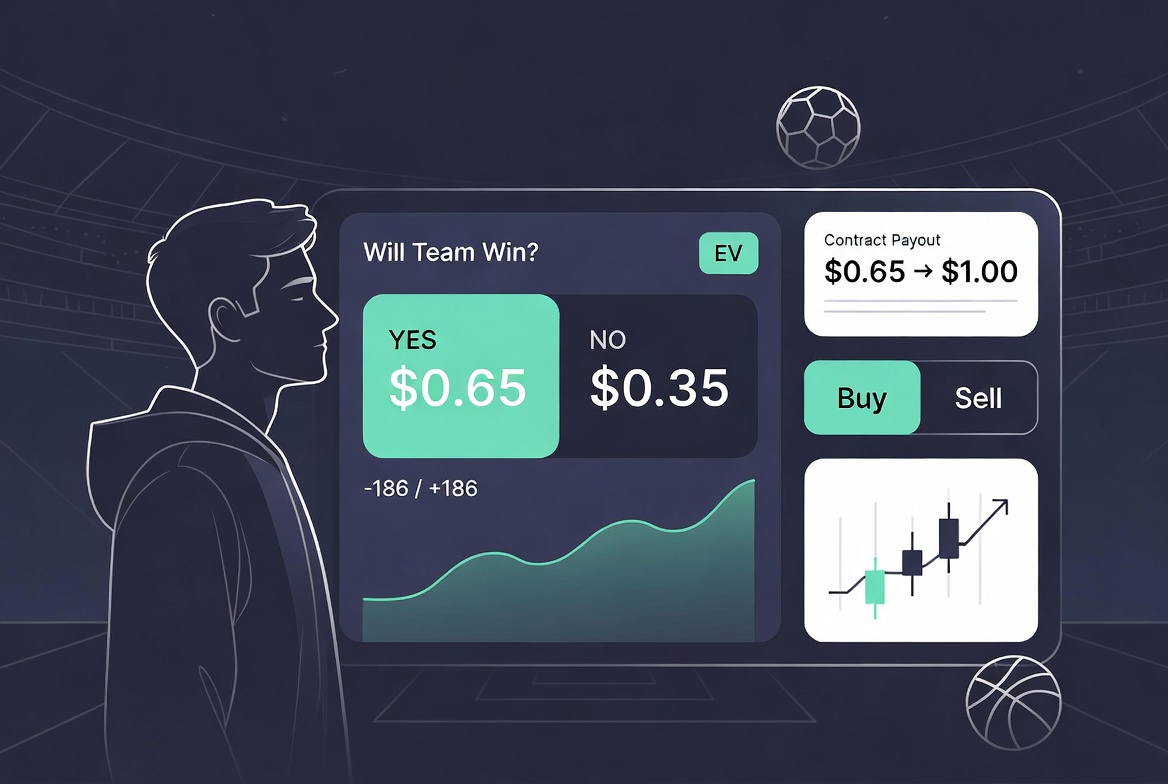
    Prediction markets are exchange-based platforms where you buy and sell contracts on the outcomes of real-world events. Instead of betting against a bookmaker’s line, you’re trading against other participants at prices that reflect crowd-sourced probability. A contract priced at $0.65 means the market estimates a 65% chance of that outcome occurring. If you’re right and the event happens, the contract pays $1.00. If not, it pays $0.00.

    For sports bettors, the mechanics feel familiar but the structure is fundamentally different. There’s no vig baked into every line. You can sell your position before the event resolves. And nobody limits your account for winning too much.

    This guide translates every core sports betting concept into prediction market language, walks you through your first trade using the terminology you already know, and identifies where your analytical edge is strongest.

    Prediction markets involve financial risk. Only trade with money you can afford to lose.

    What Sports Bettors Need to Know About Prediction Markets

    The single biggest difference between sports betting and prediction markets is who you’re trading against. At a sportsbook, you’re betting against the house. The bookmaker sets odds, takes your wager, and profits from the built-in margin (the vig). On a prediction market exchange, you’re trading against other participants. The exchange is just the venue.

    This distinction matters more than anything else in this guide. When you place a $100 bet at -110 on DraftKings, the sportsbook is your counterparty. They’ve built roughly 4.5% margin into that line. On a prediction market like Kalshi or Polymarket, your counterparty is another person who disagrees with you. The platform charges a small trading fee, but the price itself is set entirely by supply and demand.

    Think of it like the difference between selling your car to a dealership versus listing it on an open marketplace. The dealership builds in their margin. The marketplace just connects buyers and sellers.

    This peer-to-peer structure creates three advantages sports bettors notice immediately. First, no vig means your break-even point is lower. Second, the exchange doesn’t care if you win consistently, so nobody limits your account. Third, prices on liquid markets can be tighter than sportsbook lines, because there’s no bookmaker margin to cover.

    Prediction market exchanges are federally regulated. Kalshi operates as a CFTC-designated contract market. 1CFTC, “Order of Designation: KalshiEX LLC,” cftc.gov, November 2020 FanDuel Predicts partners with CME Group. 2CME Group, “FanDuel and CME Group Launch FanDuel Predicts,” cmegroup.com, December 2025 Polymarket’s US platform runs through a separate CFTC-regulated entity. 3Polymarket, “CFTC Approval of Amended Order of Designation,” prnewswire.com, November 2025 These aren’t offshore operations. They’re regulated exchanges operating under federal oversight.

    For a deeper comparison of prediction markets vs. sports betting, see our dedicated guide. If you’re new to the concept entirely, our guide to how prediction markets work covers the fundamentals.

    Having spent years on the operator side of sportsbooks, I can tell you the margin is built into every line from the moment it opens. A typical sportsbook targets 4–6% margin on each market. That’s your guaranteed cost for participating. On a prediction market exchange, there’s no built-in margin. Your cost is the current spread between the best bid and ask. On liquid markets, that spread can be 1–2 cents. On thin markets, 10 cents or more. The exchange gives you the chance to trade at lower cost, but there’s no guaranteed price.

    Ben L.

    The Translation Table: Sports Betting Concepts in Prediction Market Language

    If you’ve been sports betting for any length of time, you already understand 80% of prediction market mechanics. The concepts are the same. The vocabulary changes.

    This table maps every sports betting concept you know to its prediction market equivalent.


    Sports Betting Term

    Prediction Market Term
    What Changes

    Moneyline odds (-150, +200)

    Contract price ($0.60, $0.33)

    Price = implied probability in cents

    Vig / juice
    Spread + trading fee
    Set by traders, not the house

    Line movement

    Price movement

    Driven by trader activity, not oddsmaker

    Sharp money / steam moves

    Smart money / volume spikes

    Visible in order book depth or on-chain

    Closing line value (CLV)

    Final price before resolution

    Same concept: were you on the right side?

    Bankroll management

    Position sizing

    Adds capital lockup as a variable

    Parlay

    Multi-leg position / Kalshi Combos

    Positions can be correlated without formal parlay

    Cash out / early payout

    Sell position on exchange

    Available anytime at current market price

    The house (bookmaker)

    Other traders (peer-to-peer)

    Fundamental structural change

    Betting limits / getting limited

    Order book liquidity

    Exchanges don’t limit winners

    Futures bet

    Long-dated contract

    PM contracts are liquid throughout

    Props / exotics

    Non-sports markets

    PM covers politics, economics, culture, weather

    Here’s the translation in action. A sportsbook lists the Kansas City Chiefs to win the Super Bowl at +350. That’s implied probability of 22.2%. On Kalshi, the same outcome is a contract priced at $0.22 (YES) and $0.78 (NO). Same probability, different format.

    If you buy 100 YES contracts at $0.22, you spend $22. If the Chiefs win, each contract pays $1.00. Your payout is $100, and your profit is $78 (minus any trading fees). If they lose, your contracts are worth $0.00.

    The critical difference: you can sell those contracts at any time before the Super Bowl. If the Chiefs go on a winning streak and the contract price moves to $0.40, you can sell for $40, locking in an $18 profit without waiting for the championship game. At a sportsbook, your futures bet is locked until the season ends.

    For the full breakdown of how prediction market odds work, including YES/NO pair pricing and spread mechanics, see our dedicated odds guide.

    Pro Tip

    Kalshi’s mobile app lets you toggle between contract prices and American odds in your display settings. 4Kalshi, App Store listing and help documentation, kalshi.com, March 2026 If $0.22 contracts feel unfamiliar, switch to the +350 view until the format clicks.

    Your First Prediction Market Trade (in Sports Betting Language)

    Here’s what your first prediction market trade looks like, narrated in the language you already think in.

    Step 1: Pick your market. Open Kalshi or FanDuel Predicts and browse sports markets. You’ll see events listed as questions: “Will the Lakers win tonight?” or “Will the NFL MVP be Josh Allen?” These are your moneylines and futures, repackaged.

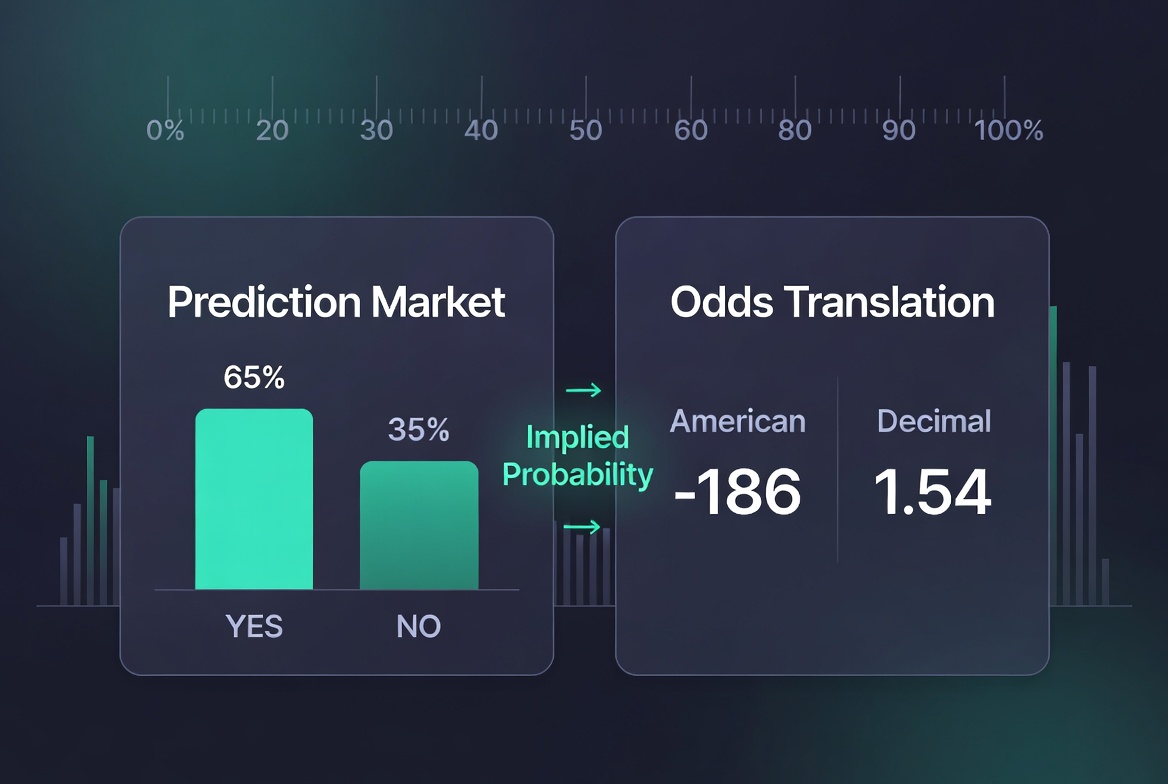
    Step 2: Read the price. A YES contract at $0.65 means the market gives the outcome a 65% chance. In sportsbook terms, that’s approximately -186. A YES at $0.35 is roughly +186. If you disagree with that probability, you’ve found potential value.

    Step 3: Size your position. Decide how many contracts to buy. At $0.65 per contract, 100 contracts costs $65. If the outcome happens, you collect $100 (profit: $35 minus fees). If it doesn’t, you lose your $65. Same risk/reward calculation you’d make sizing a sportsbook bet.

    Step 4: Place the order. On Kalshi, you can place a market order (filled immediately at best available price) or a limit order (you set your price and wait for a match). Limit orders are like getting a better line: you name your price and wait for someone to take the other side.

    Step 5: Manage or hold. Here’s where prediction markets diverge from sportsbooks. You don’t have to wait for the game to end. If the price moves in your favor (from $0.65 to $0.82), you can sell your contracts and take profit immediately. If the price moves against you ($0.65 drops to $0.45), you can cut your loss and free up capital for other trades. Or you can hold to resolution, just like a standard sports bet.

    This sell-anytime feature is the single most powerful tool prediction markets give sports bettors. It transforms a locked bet into a liquid position. Think of it as a cash-out button that’s always available at the true market price, not a discounted sportsbook cash-out offer.

    For a detailed walkthrough of contract anatomy, see our guide to your first prediction market trade.

    Skills That Transfer and Skills That Don’t

    Skills that transfer directly

    Probability assessment. You already think in terms of “is this line right?” That instinct is the core skill in prediction markets. If a contract is priced at $0.45 and your analysis puts the true probability at 60%, you’ve found a value play. Same thought process as spotting a mispriced spread.

    EV calculation. Expected value math is identical. Buy at $0.40, win probability is 55%: EV = (0.55 × $0.60) − (0.45 × $0.40) = $0.33 − $0.18 = +$0.15 per contract. Positive EV is positive EV regardless of format.

    Bankroll discipline. Unit-based thinking translates. If you bet 2% of your bankroll per sportsbook wager, you can apply the same principle to prediction market position sizing. For position sizing specifics, see our bankroll management for prediction markets guide.

    Contrarian thinking. Fading the public works in both markets. When the crowd overreacts to headlines, prices move away from fundamental value. Disciplined bettors who wait for overreactions profit in both arenas.

    I spent years at poker tables and sportsbooks before I touched a prediction market. The first thing I noticed: prediction markets reward the same analytical thinking as poker. You’re trading against other people who think they know more than you. The edge comes from the same place: better research, correct sizing, discipline to wait for spots where the price is wrong. The biggest adjustment was timeline. Sports bets resolve in hours. Prediction market positions can last months. That requires different patience.

    Robert C.

    Skills that need recalibration

    Timeline patience. Sports bets resolve in hours. Many prediction market contracts take weeks or months. Buying a political contract in March that settles in November requires a different emotional toolkit. Your capital is locked (unless you sell early), and you’ll watch the position value fluctuate for months.

    Unrealized P&L management. At a sportsbook, your bet is either pending or settled. On a prediction market, your position has a live market value that changes constantly. Watching a $0.70 position drop to $0.55 on news before recovering to $0.80 requires stomach most sports bettors haven’t developed.Overtrade risk. The ability to sell anytime is a feature, not a license to trade every fluctuation. Sports bettors accustomed to immediate action sometimes overtrade prediction market positions, eroding profits through fees and poor timing.

    Warning

    The most common mistake sports bettors make in prediction markets is treating the sell button like a sportsbook cash-out. Sportsbook cash-outs are designed to favor the house. Prediction market sell prices are true market prices. Don’t panic-sell at fair value just because the habit says “take the cash-out.”

    Where Sports Bettors Have an Edge in Prediction Markets

    Sports bettors bring a genuine analytical advantage to prediction markets because most prediction market participants don’t think in probability. They trade on gut feeling, headline reactions, and tribal loyalty. Disciplined sports bettors, who are trained to calculate EV and spot mispriced lines, enter a market where the competition is softer than what they’re used to.

    Political and economic markets. These categories attract the most gut-feeling traders. People who are emotionally invested in political outcomes consistently overpay for contracts aligned with their beliefs. The result: persistent mispricings that disciplined bettors can exploit. The same “fade the public” approach that works on Sunday NFL games works on Tuesday night political markets.

    Longer-dated futures. Sports bettors who trade NFL futures and championship markets understand the patience required for long-dated positions. Most prediction market participants avoid contracts that settle months out because they want fast resolution. That reduced demand creates value for patient capital.

    Cross-category diversification. A sports bettor’s instinct to spread action across multiple games translates naturally to prediction market portfolio thinking. Instead of five NFL bets on Sunday, you can hold positions across politics, economics, sports, and entertainment, with genuinely uncorrelated outcomes.

    Sports markets on prediction exchanges. Kalshi, FanDuel Predicts, and Polymarket all offer sports contracts. For sports bettors, these are the most familiar entry point. The advantage here is that prediction market sports pricing sometimes lags sportsbook line movement, creating brief windows where the PM price hasn’t caught up to the sharp sportsbook line. A Wharton analysis confirmed that prediction market pricing rewards sophisticated participants who apply disciplined analytical frameworks. 5Wharton School, “Prediction Markets and the Future of Sports Betting Analytics,” knowledge.wharton.upenn.edu, January 2026

    I found a political contract on Kalshi trading at $0.40 when my research put the true probability closer to 60%. In sports betting terms, that’s getting +150 on what should be a -150 favorite. That kind of mispricing barely exists in mature sports markets anymore, where sharps have squeezed the value out of most lines. It exists in prediction markets because the market is young, and a significant percentage of participants are trading on gut feeling rather than analysis.

    Robert C.

    Getting Started: Which Platform Fits Your Sports Betting Background

    The right prediction market platform depends on what you’re coming from and what you want to trade.

    If you’re a sportsbook regular (DraftKings, FanDuel, BetMGM users): Start with FanDuel Predicts. It’s available in all 50 states, the interface feels like a sportsbook, and you can fund your account with a debit card or ACH transfer. 6FanDuel, App Store listing, apps.apple.com, March 2026 The tradeoff: market selection is narrower than dedicated exchanges, and sports contracts are only available in 18 states where FanDuel doesn’t operate a sportsbook. Minimum deposit is $10. Trading fees include a CME exchange fee of $0.01 per contract per side plus FanDuel’s 2% fee on potential payouts. 7CME Group, “Event Contracts Fee Schedule,” cmegroup.com, February 2026 Our FanDuel Predicts guide covers the full platform walkthrough.

    If you’re comfortable with exchanges and want the widest selection: Choose Kalshi. It offers 10,000+ markets across sports, politics, economics, entertainment, and more. 8Kalshi, Public API series data, api.elections.kalshi.com, March 2026 The mobile app includes an American odds display toggle for sports bettors. Kalshi is CFTC-regulated, accepts deposits from $1 via ACH (free), debit card (2%), or USDC. Trading fees are capped at $0.02 per contract for takers, with 75% lower fees for limit orders. 9Kalshi, “Fee Schedule,” kalshi.com/docs/kalshi-fee-schedule.pdf, February 2026

    If you’re crypto-comfortable and want deep liquidity on political markets: Consider Polymarket. The global platform runs on USDC (Polygon network) with probability-based trading fees across most market categories. Sports markets carry a 0.75% peak effective rate, while politics and finance markets peak at 1.00%. Geopolitical and world events markets remain fee-free. 10Polymarket, “Trading Fees,” docs.polymarket.com/trading/fees, March 2026 The US platform charges 0.30% taker fees (with 0.20% maker rebates) and requires full KYC. 11Polymarket US, “Trading Fee Schedule,” polymarketexchange.com/fees-hours.html, March 2026 Polymarket’s political and economic markets consistently have the deepest liquidity in the industry.

    Start with one platform, make 5 to 10 small trades across different market categories, and get comfortable with the contract format before sizing up. Your sports betting instincts will translate faster than you expect. International readers can explore exchange-based alternatives like Betfair Exchange or Smarkets, which offer similar peer-to-peer mechanics for sports and other events.

    Bottom Line

    Sports betting and prediction markets share the same analytical DNA. The odds formats are different. The vocabulary changes. But the core skill set (probability assessment, EV calculation, bankroll discipline, and contrarian thinking) transfers directly.

    The structural advantage prediction markets offer over sportsbooks is clear: lower cost of participation (no vig), the ability to exit positions before resolution, and a peer-to-peer model that doesn’t penalize consistent winners. The tradeoff is longer resolution timescales and the emotional discipline required to manage live positions over weeks or months.

    If you’re a sports bettor looking to expand your edge, start with a familiar sports market on Kalshi or FanDuel Predicts. Make a few small trades using the translation table in this guide. Then explore political and economic markets, where the competition is softer and the mispricings are more pronounced.

    Your sports betting experience isn’t a liability here. It’s your biggest asset.

    Sources & References

    • 1
      CFTC, “Order of Designation: KalshiEX LLC,” cftc.gov, November 2020
    • 2
      CME Group, “FanDuel and CME Group Launch FanDuel Predicts,” cmegroup.com, December 2025
    • 3
      Polymarket, “CFTC Approval of Amended Order of Designation,” prnewswire.com, November 2025
    • 4
      Kalshi, App Store listing and help documentation, kalshi.com, March 2026
    • 5
      Wharton School, “Prediction Markets and the Future of Sports Betting Analytics,” knowledge.wharton.upenn.edu, January 2026
    • 6
      FanDuel, App Store listing, apps.apple.com, March 2026
    • 7
      CME Group, “Event Contracts Fee Schedule,” cmegroup.com, February 2026
    • 8
      Kalshi, Public API series data, api.elections.kalshi.com, March 2026
    • 9
      Kalshi, “Fee Schedule,” kalshi.com/docs/kalshi-fee-schedule.pdf, February 2026
    • 10
      Polymarket, “Trading Fees,” docs.polymarket.com/trading/fees, March 2026
    • 11
      Polymarket US, “Trading Fee Schedule,” polymarketexchange.com/fees-hours.html, March 2026
  • Your First Prediction Market Trade: What a Contract Actually Is and How Every Piece Works

    Your First Prediction Market Trade: What a Contract Actually Is and How Every Piece Works

    A prediction market contract is the simplest financial instrument you’ve never been taught. You pick a real-world event, choose YES or NO, and pay somewhere between $0.01 and $0.99 for that position. If you’re right, the contract pays $1.00. If you’re wrong, it pays $0.00. That’s the entire instrument.

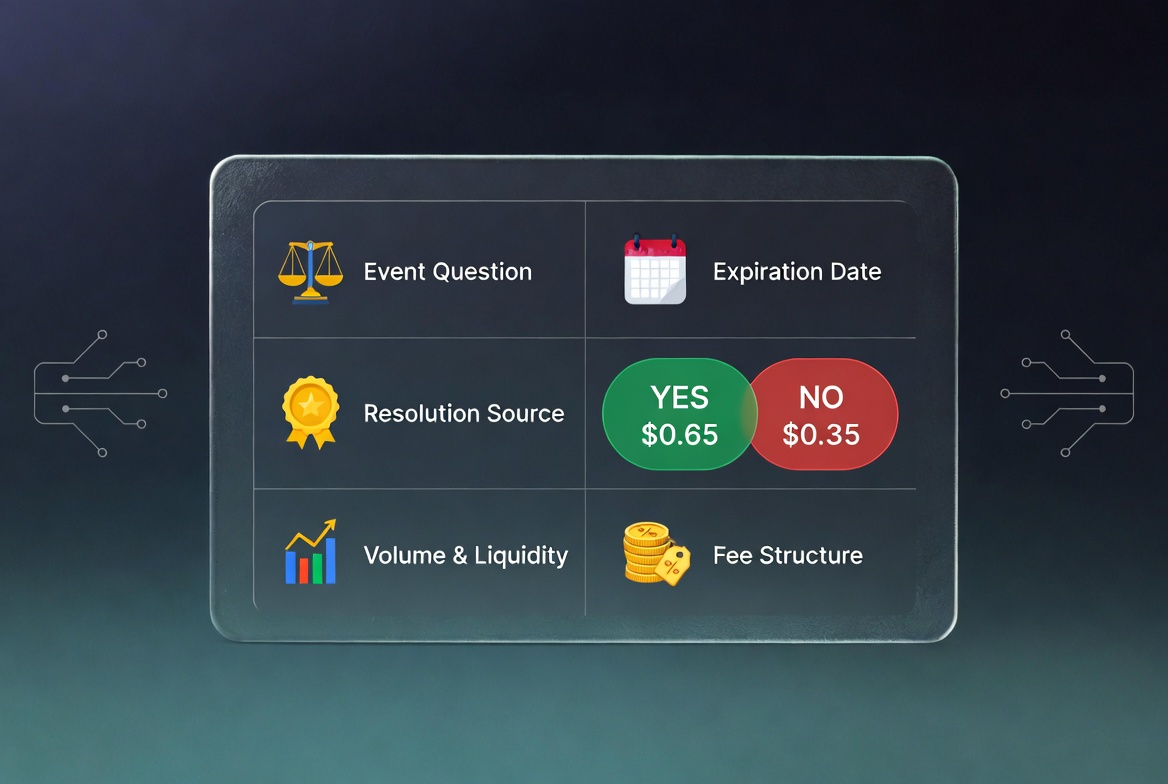
    But “simple” doesn’t mean there’s nothing to learn. Every contract has components that determine whether you’re making a smart trade or a blind guess: the event question, the expiration date, the resolution source, the current price, trading volume, and fees. Knowing what each piece does (and what to check before you buy) is what separates informed traders from everyone else.

    This guide breaks down the anatomy of a prediction market contract field by field, compares how the same event is structured across Kalshi, Polymarket, and FanDuel Predicts, and gives you a 5-point checklist to run before placing any trade. By the end, you’ll understand exactly what you’re buying and how prediction markets work at the contract level.

    What Is a Prediction Market Contract?

    A prediction market contract is a YES or NO position on a specific real-world event that trades between $0.01 and $0.99 and settles at either $1.00 or $0.00. If the event happens, YES pays $1.00 and NO pays nothing. If it doesn’t, the reverse applies.

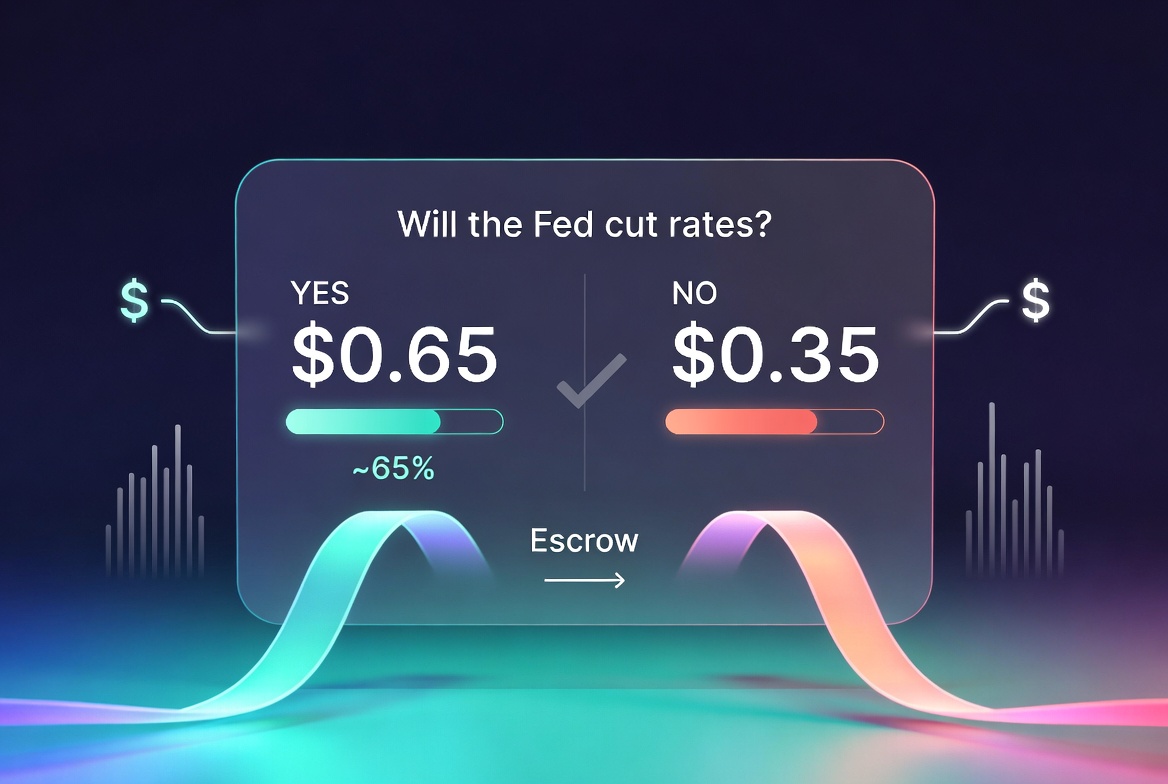
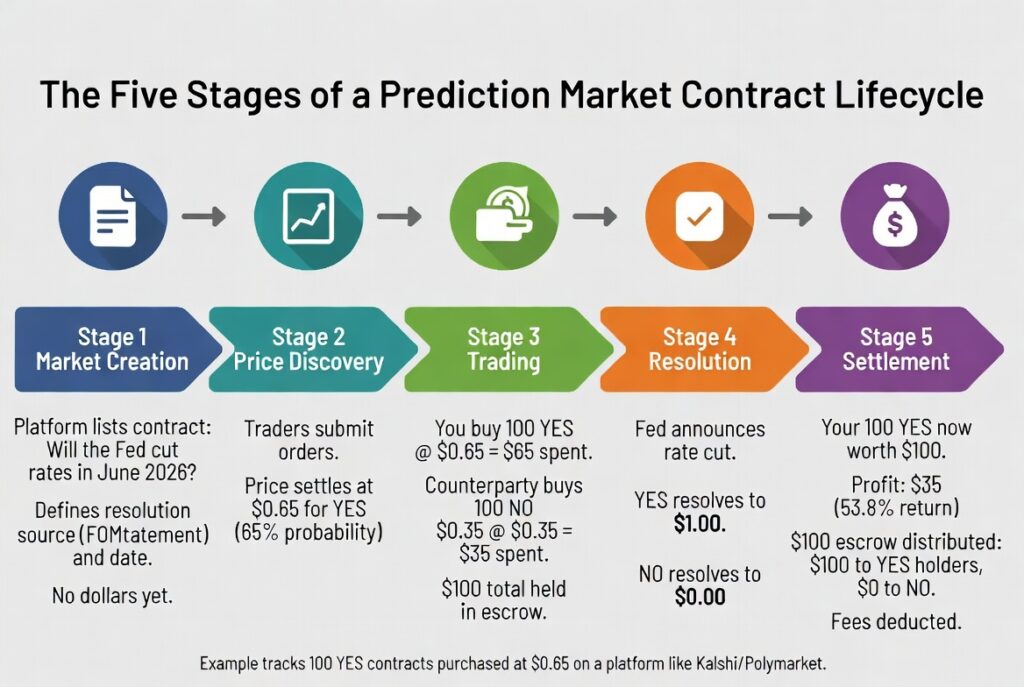
    Here’s a concrete example. Say the question is: “Will the Federal Reserve cut interest rates by June 2026?” The YES contract is trading at $0.65 and the NO contract at $0.35. If you buy 100 YES contracts at $0.65 each, you spend $65. If the Fed does cut rates, you receive $100 (a $35 profit before fees). If it doesn’t, you lose your $65.

    The price reflects what the market collectively believes the probability is. A $0.65 YES contract means traders estimate roughly a 65% chance the event will occur. That price isn’t set by the platform. It’s determined by the buying and selling activity of every trader in that market.

    Legally, these instruments are classified as event contracts under the Commodity Exchange Act. 1CFTC, “Order of Designation: KalshiEX LLC,” cftc.gov, November 2020 On CFTC-regulated platforms like Kalshi, they’re cleared through a regulated clearinghouse. On crypto-native platforms like Polymarket’s global exchange, settlement runs through smart contracts on the Polygon blockchain. 2Polymarket, “How to Sign Up,” docs.polymarket.com, March 2026 The structure looks similar from the outside, but the regulatory and counterparty frameworks behind each contract are fundamentally different.

    Anatomy of a Contract: The Six Fields That Matter

    Every prediction market contract has six components. Understanding them takes two minutes. Ignoring them can cost you money.

    1. The Event Question

    This defines exactly what you’re trading. A well-written question is specific and binary: “Will the BLS report U.S. CPI above 3.0% for March 2026?” A poorly written question leaves room for interpretation: “Will inflation be high this year?” The quality of this question determines whether resolution will be clean or contested.

    2. Expiration Date

    This is when the contract stops trading and enters resolution. Some contracts expire within hours (Kalshi’s Flash Markets on the S&P 500). Others run for months (presidential election contracts). As expiration approaches, contracts near certainty compress toward $1.00 or $0.00, while contracts near $0.50 can experience sharp volatility. If you’ve traded options, think of this as a simplified version of theta decay.

    3. Resolution SourceThis is the most important field most beginners overlook. The resolution source is the specific data provider or authority the platform uses to determine the outcome. Kalshi uses the Associated Press for election results, ESPN for sports outcomes, government agencies like the Bureau of Labor Statistics for economic data, and CF Benchmarks for crypto markets. 3Kalshi, “Platform Features & UX,” kalshi.com, March 2026 Polymarket’s global platform uses the UMA Optimistic Oracle, a decentralized system where outcomes are proposed and can be disputed within a set window. 4Polymarket, “Trading Fees,” docs.polymarket.com, March 2026 FanDuel Predicts relies on CME Group’s determination based on third-party reported event results. 5CME Group and FanDuel, “FanDuel Predicts Launch,” cmegroup.com, December 2025

    Platforms invest significant effort in resolution criteria design. The resolution source is the single most important field on any contract. Ambiguous criteria create disputes and erode trust. Before buying any contract, look for questions that cite specific, verifiable data sources: “Will the BLS report CPI above 3.0% for March 2026?” is a well-designed contract. “Will inflation be high this year?” is not. The difference between these two questions is the difference between a tradable instrument and a coin flip with extra steps.

    Ben L.

    4. Current Price (YES and NO)

    The YES and NO prices should roughly sum to $1.00 (the small gap is the spread, which represents the market’s friction cost). If YES is $0.65, NO should be near $0.35. A wide gap between the two (say, YES at $0.65 and NO at $0.40) signals thin liquidity. You’re paying more in that spread than you might realize. For a deeper breakdown of how prices translate to probability, see how prediction market odds work.

    5. Volume and Liquidity

    Volume tells you how many contracts have traded. Higher volume means tighter spreads and easier execution. On Kalshi, major political and economic markets show spreads of 2 to 5 cents. 6Kalshi, “Liquidity Assessment,” InsidePredictions Platform Intelligence, March 2026 Lower-volume markets on any platform can have spreads of 10 cents or more, which directly eats into your potential profit.

    6. Fee Structure

    Fees vary dramatically between platforms. Kalshi charges a variable fee based on expected earnings (capped at roughly $0.02 per contract for takers). 7Kalshi, “Fee Schedule,” kalshi.com, February 2026 Polymarket’s global exchange uses a dynamic taker fee that varies by probability: fees peak near $0.50 contracts and decrease toward the extremes, with some categories (geopolitics, world events) remaining fee-free. 8Polymarket, “Trading Fees,” docs.polymarket.com, March 2026; Parameter.io, “Polymarket Introduces New Trading Fees,” March 25, 2026 FanDuel Predicts charges $0.01 per contract per side (CME exchange fee) plus a 2% fee on your potential payout. 9CME Group, “Event Contracts Fee Schedule,” cmegroup.com, February 2026; bonus.com, “FanDuel Predicts Review,” February 2026 On a 100-contract trade at $0.65, Kalshi costs approximately $1.60 in taker fees. Polymarket’s US exchange charges $0.20 (0.30% of $65 premium); global platform fees vary by market category and probability. FanDuel Predicts costs $1.00 (CME) plus $2.00 (2% of $100 payout) for $3.00 total.

    Expert Tip

    The resolution source is your contract’s source of truth. If you can’t find the resolution source on a contract’s detail page, or if the source is vague, skip that contract. Ambiguous resolution criteria are the number one cause of disputed outcomes and delayed payouts.

    How the Same Event Looks on Three Different Platforms

    The same question, “Will the Fed cut rates?”, produces a different contract on each platform. The underlying event is identical. Everything else changes.

    FeatureKalshi
    Polymarket (Global)

    FanDuel Predicts

    Regulatory Framework

    CFTC-regulated DCM

    Crypto-native (Polygon blockchain)

    CFTC-regulated via CME Group

    Resolution

    Third-party data (BLS, AP, ESPN)

    UMA Optimistic Oracle (decentralized)

    CME Group determination

    Fee Model

    Variable (~$0.02/contract max)

    Dynamic taker fee (varies by probability and category)

    $0.01/side + 2% of payout

    Order Types

    Market, Limit, Combos

    Market, Limit

    IOC, GTD (limit)

    Min Deposit
    $1
    ~$1 (crypto transfer)

    $10

    Funding

    ACH, debit, crypto, PayPal, Venmo, Apple Pay, Google Pay, Cash App

    USDC on Polygon, Coinbase Pay, MoonPay

    Debit card, ACH only

    Access

    Web + mobile app (US); web (intl)

    Web + mobile (global); invite app (US)

    Mobile app only (all 50 states)

    Max Order

    No published cap


    No position limits (global)
    250 contracts per order

    The differences matter most in three areas. 10Kalshi, “Fee Schedule,” kalshi.com, February 2026; Polymarket, “Trading Fees,” docs.polymarket.com, March 2026; FanDuel, “Risk Disclosures,” fanduel.com, December 2025 First, regulation: Kalshi and FanDuel Predicts offer CFTC clearing protections, meaning your funds are held by a regulated entity. Polymarket’s global platform settles through smart contracts, which removes intermediary risk but introduces smart contract risk.

    Second, fees: a 100-contract trade on an identical event costs roughly $1.60 on Kalshi, varies on Polymarket depending on market category and probability (the US exchange charges $0.20 on this trade), and $3.00 on FanDuel Predicts. Over dozens of trades, these differences compound. Polymarket’s fee structure is dynamic and evolving: check the fee status of any specific market before trading.

    Third, resolution speed: Kalshi resolves contracts within hours using official data sources. 11Kalshi, “Withdrawal Methods,” help.kalshi.com, March 2026 Polymarket’s UMA Oracle includes a dispute window that can extend resolution. FanDuel Predicts relies on CME’s timeline, with pending payouts taking 1 to 2 business days before becoming withdrawable.

    What Happens After You Buy (and Before the Event Resolves)

    Once you own a contract, you have three options: hold to resolution, sell early for a profit, or sell early to cut your losses. This flexibility is what separates prediction markets from a traditional bet, where you’re locked in until the outcome.

    Back to our running example. You bought 100 YES contracts at $0.65 on “Will the Fed cut rates by June 2026?” Three days later, an inflation report comes in lower than expected. The market reprices: YES jumps to $0.82. You now have an unrealized profit of $17 (100 contracts × $0.17 price increase).

    You can sell at $0.82, lock in that $17 profit (minus fees), and free your capital for other trades. Or you can hold, hoping the contract resolves YES at $1.00 for a $35 total profit, but accepting the risk that new data could push the price back down before expiration.

    The first time I bought a YES contract at $0.65 and watched it climb to $0.82 over three days, my instinct was to hold for the full $1.00 payout. But that meant locking capital for another six weeks until resolution. I sold at $0.82, pocketed a 26% return in three days, and redeployed the funds into two other positions. You don’t have to hold until the final whistle. The ability to sell early is what separates prediction markets from a straight bet.

    Robert C.

    As expiration approaches, contract prices tend to move toward extremes. A contract trading at $0.82 with two months left has room to swing. That same contract at $0.82 with two hours left is pricing near-certainty. This compression is similar to time decay in options trading: uncertainty decreases as the clock runs out, and the contract’s price reflects that decreasing uncertainty.

    Pro Tip

    If you’ve captured 70% or more of a contract’s potential profit and resolution is weeks away, selling early and redeploying capital often generates better returns than waiting. The last 20 to 30 cents of potential profit carry the most time risk.

    Before You Trade: The 5-Point Contract Checklist

    Run these five checks before buying any prediction market contract. They take under a minute and can save you from the most common beginner mistakes.

    1. Is the resolution source specific and verifiable?

    Look for contracts that cite named data providers: “per the BLS,” “per the Associated Press,” “per ESPN.” Avoid contracts with vague or subjective resolution criteria. If you can’t find the resolution source on the contract’s detail page, that’s a red flag.

    2. When does the contract expire?

    Check whether the timeline fits your trading plan. A contract that expires in six months locks your capital for six months (unless you sell early). Short-duration contracts (daily, weekly) free capital faster but require more active monitoring.

    3. What’s the spread?

    Add the YES price and the NO price. If they sum close to $1.00 (say, $0.65 YES + $0.36 NO = $1.01), the market is liquid. If the sum is $1.05 or higher, the spread is wide and you’re paying a hidden cost to enter. On Kalshi, major markets show spreads of 2 to 5 cents. Thinner markets on any platform can run 10 cents or more. For a complete breakdown of how spreads and order books and liquidity affect your trades, see our dedicated guide.

    4. What fees will you pay?

    Calculate fees before you trade, not after. On a 100-contract position at $0.50, Kalshi charges roughly $1.75 in taker fees. Polymarket’s fee depends on the market category and probability (check the trade confirmation screen for the exact amount). FanDuel Predicts charges $1.00 (CME) plus $2.00 (2% of $100 payout). 12Kalshi, “Fee Schedule,” kalshi.com, February 2026; Polymarket, “Trading Fees,” docs.polymarket.com, March 2026; CME Group, “Event Contracts Fee Schedule,” cmegroup.com, February 2026 Fees matter more on small positions and high-probability contracts.

    5. Does the platform’s regulatory framework fit your needs?

    Kalshi and FanDuel Predicts offer CFTC-regulated clearing. Polymarket’s global platform is crypto-native with on-chain settlement. If you prioritize regulatory protection, choose a CFTC-regulated platform. If you prioritize deep liquidity and global access, Polymarket may fit better. For UK and EU traders, platforms like Betfair Exchange and Smarkets offer exchange-style trading under their own regulatory frameworks. Check your jurisdiction’s current legal status before depositing funds.

    Warning

    Thin liquidity kills more beginner trades than bad predictions. If a contract shows fewer than 100 contracts traded in the last 24 hours and a spread wider than 8 cents, your execution price will likely be worse than the displayed price. Start with high-volume markets until you understand how order books work.

    Placing Your First Trade with Confidence

    A prediction market contract is a bounded-risk position on a real-world event. It pays $1.00 if you’re right and $0.00 if you’re wrong. The price you pay reflects the market’s probability estimate, and you can sell your position anytime before the event resolves.

    The six fields covered here (event question, expiration, resolution source, price, volume, and fees) are everything you need to evaluate before placing a trade. Run the 5-point checklist on your first few contracts until it becomes automatic.If you’re ready to place your first trade, start with a high-volume market on a platform that fits your situation. Kalshi and FanDuel Predicts offer CFTC-regulated protections for US traders. Polymarket offers the deepest global liquidity. Our platform reviews cover the full details for each. For more on how prediction markets settle after you’ve placed a trade, see our resolution guide.

    Sources & References

    • 1
      CFTC, “Order of Designation: KalshiEX LLC,” cftc.gov, November 2020
    • 2
      Polymarket, “How to Sign Up,” docs.polymarket.com, March 2026
    • 3
      Kalshi, “Platform Features & UX,” kalshi.com, March 2026
    • 4
      Polymarket, “Trading Fees,” docs.polymarket.com, March 2026
    • 5
      CME Group and FanDuel, “FanDuel Predicts Launch,” cmegroup.com, December 2025
    • 6
      Kalshi, “Liquidity Assessment,” InsidePredictions Platform Intelligence, March 2026
    • 7
      Kalshi, “Fee Schedule,” kalshi.com, February 2026
    • 8
      Polymarket, “Trading Fees,” docs.polymarket.com, March 2026; Parameter.io, “Polymarket Introduces New Trading Fees,” March 25, 2026
    • 9
      CME Group, “Event Contracts Fee Schedule,” cmegroup.com, February 2026; bonus.com, “FanDuel Predicts Review,” February 2026
    • 10
      Kalshi, “Fee Schedule,” kalshi.com, February 2026; Polymarket, “Trading Fees,” docs.polymarket.com, March 2026; FanDuel, “Risk Disclosures,” fanduel.com, December 2025
    • 11
      Kalshi, “Withdrawal Methods,” help.kalshi.com, March 2026
    • 12
      Kalshi, “Fee Schedule,” kalshi.com, February 2026; Polymarket, “Trading Fees,” docs.polymarket.com, March 2026; CME Group, “Event Contracts Fee Schedule,” cmegroup.com, February 2026
  • Prediction Market Odds, Pair Pricing, and Probability: How to Read the Numbers That Drive Every Trade

    Prediction Market Odds, Pair Pricing, and Probability: How to Read the Numbers That Drive Every Trade

    A prediction market contract priced at 65 cents is telling you something specific: the crowd puts the probability at exactly 65%. That single number is the entire pricing system. 1Polymarket Help Center, “What is a Prediction Market,” help.polymarket.com, March 2026

    If you have traded stocks, placed a sports bet, or even checked an election forecast, you already understand the core mechanic. Prediction markets express probability as a price between $0.01 and $0.99, where every cent equals one percentage point of likelihood. A contract at $0.80 means an 80% chance. A contract at $0.25 means 25%. No conversion needed.

    The challenge is that sports bettors think in American odds, traders think in decimals, and prediction markets speak in cents. This guide bridges those languages. You will see how YES/NO pair pricing works, how to translate PM prices into any odds format you already use, and how that translation skill helps you spot value across platforms.

    Price Equals Probability: The One Rule That Unlocks Everything

    Prediction market odds work through a simple mechanism: the contract price is the implied probability. 2Kalshi, “How Kalshi Works,” kalshi.com, March 2026 A contract trading at $0.65 on the question “Will the Fed cut rates in June 2026?” means the collective market assigns a 65% chance to that rate cut happening. If the Fed does cut rates, the contract pays $1.00. If it does not, the contract pays $0.00.

    The math is transparent. Buy that contract at $0.65, and you stand to gain $0.35 if you are right (the $1.00 payout minus your $0.65 cost). Your maximum loss is $0.65, the exact amount you paid. That $1.00 ceiling and $0.00 floor mean your risk is bounded on both sides, with no margin calls, no hidden leverage, and no scenario where you owe more than your initial stake.This bounded structure is one of the key differences between prediction markets and other trading instruments.

    For a full explanation of contract mechanics, see our guide to how prediction markets work.

    Pro Tip:

    If a prediction market contract costs $0.70, the market is saying there is a 70% chance this event happens. Your job is to decide whether you agree with that number.

    YES, NO, and the Spread: How Pair Pricing Works

    Every prediction market question creates two contracts: YES and NO. These are two sides of the same coin, and understanding how they pair together is central to reading prediction market contracts. If YES costs $0.65, the NO contract for that same question costs approximately $0.35. The two prices sum to roughly $1.00, because exactly one outcome will pay out. 3Polymarket Documentation, “What is a Prediction Market,” docs.polymarket.com, March 2026

    The word “roughly” matters. In practice, YES + NO usually adds up to slightly more than $1.00. That difference is the spread. It represents the cost of trading on that platform, similar to the vig or juice at a sportsbook. A $0.65 YES paired with a $0.36 NO totals $1.01. That extra cent is the platform’s built-in margin.


    Market Question

    YES Price

    NO Price

    Combined

    Fed cuts rates in June 2026?

    $0.65

    $0.36

    $1.01

    Lakers win NBA Championship?

    $0.12

    $0.89

    $1.01

    Bitcoin above $100K by Dec 2026?

    $0.55

    $0.46

    $1.01

    The spread varies by platform and by market. High-volume markets on Polymarket can have spreads as tight as 1 to 2 cents ($1.01 combined). 4DeFi Rate, “The Hidden Tax Inside Your Prediction Market App: March Madness Odds Compared,” defirate.com, March 2026 Lower-volume markets on smaller platforms can see spreads of 5 to 8 cents ($1.05 to $1.08 combined). Checking the YES + NO combined price before you trade tells you exactly how much the platform is extracting.

    Expert Tip:

    Before buying a contract, add the YES price and the NO price together. If they sum to $1.05 or higher, you are paying a 5%+ spread. Compare that to another platform offering the same market at $1.01 combined. On high-volume trades, the spread difference adds up fast.

    The Odds Translation Table: PM Prices in Every Format You Already Know

    Prediction market prices are just another way of expressing odds. If you have placed a moneyline bet at a sportsbook, you have already done this math in reverse. The table below translates prediction market contract prices into implied probability, American odds, and decimal odds, with the corresponding NO price for each. 5OddsJam, “Prediction Market to Betting Odds Converter,” oddsjam.com, March 2026


    PM Price (YES)

    Implied Probability

    American Odds

    Decimal Odds

    PM Price (NO)
    $0.9090%-9001.11$0.10
    $0.7575%-3001.33$0.25
    $0.6565%-1861.54$0.35
    $0.5050%+1002.00$0.50
    $0.3535%+1862.86$0.65
    $0.2020%+4005.00$0.80

    The conversion formulas are straightforward. For contracts priced above $0.50 (favorites), American odds equal the negative of (price times 100) divided by (1 minus the price). For contracts below $0.50 (underdogs), American odds equal (1 minus the price) divided by the price, times 100. 6Prediction Hunt, “Prediction Market Odds Converter,” predictionhunt.com, March 2026 Decimal odds are simply 1 divided by the contract price.

    The practical takeaway: a $0.65 PM contract is equivalent to -186 American odds. If a sportsbook is offering -150 on the same event, the sportsbook is giving you a better price (it implies only 60% probability versus the PM’s 65%). That gap is your signal to compare platforms before placing a trade.

    For Sports Bettors: Quick Translation Cheat Sheet

    Think of PM contract prices as the “implied probability” you already calculate from moneylines. A $0.50 contract = +100 (even money). Above $0.50 = a favorite (negative American odds). Below $0.50 = an underdog (positive American odds). The deeper below $0.50, the bigger the potential payout and the bigger the longshot. If you are comfortable evaluating -200 versus -180 at different sportsbooks, you already have the skill to compare $0.67 versus $0.64 on different prediction markets.For more on applying your sports betting background to prediction markets, see our sports bettor’s guide to prediction markets.

    Why Prediction Market Prices Move (and How That Differs From a Sportsbook)

    At a traditional sportsbook, a team of oddsmakers sets the opening line. They adjust it based on where the money flows, but the house controls the starting point and the magnitude of changes. Prediction markets work differently. There is no bookmaker. Prices form entirely through supply and demand on an order book, similar to how stock prices form on an exchange. Platforms like Kalshi operate as CFTC-regulated designated contract markets, meaning the exchange infrastructure meets federal standards for transparency and oversight. 7Kalshi, “Trading on Kalshi,” help.kalshi.com, March 2026

    When more traders buy YES contracts, the YES price rises. When sellers dominate, the price falls. Both Kalshi and Polymarket use central limit order books (CLOBs) where buyers post bids and sellers post asks. 8Polymarket Documentation, “How Trading Works,” docs.polymarket.com, March 2026 When a bid matches an ask, a trade executes. The spread between the highest bid and lowest ask reflects market liquidity. Tight spreads (one or two cents between the best bid and best ask) mean you can enter and exit positions cheaply.

    This structure has a practical consequence: prediction market prices update in seconds when new information emerges. During live events, contract prices swing in real time as traders react to each development. Traditional polls take days to reflect new information. Sportsbooks adjust lines within minutes but often lag behind sharp bettors. Prediction markets close that gap because every participant is incentivized to act on new information immediately.

    Warning:

    Fast-moving prices during live events can mean wider spreads and more slippage. If you are trading a contract while news is breaking, use limit orders instead of market orders to control the price you pay.

    How Sports Bettors Can Spot Value Using Odds Translation

    The skill that makes a profitable sports bettor transfers directly to prediction markets: finding prices that do not reflect the true probability. 9DeFi Rate, “The Hidden Tax Inside Your Prediction Market App: March Madness Odds Compared,” defirate.com, March 2026 On a sportsbook, you look for a +150 underdog you believe should be +120. On a prediction market, you look for a $0.40 contract on an event you believe has a 55% chance of occurring.

    The translation table from the previous section is your tool for cross-platform comparison. If a contract on Kalshi is priced at $0.65 and a sportsbook lists the same event at -150 (implied 60% probability), the prediction market is pricing the event 5 percentage points higher. Your job is to determine which price is closer to reality. If your research supports the 60% number, the sportsbook offers better value. If you believe 65% or higher is accurate, the PM price is fair. 10Kalshi Fee Schedule, effective February 5, 2026, kalshi.com/docs/kalshi-fee-schedule.pdf

    One additional factor to consider: prediction markets also host multiple-outcome markets. Instead of a binary YES/NO, a question like “Who will win the 2028 Presidential Election?” might have 8 to 10 candidates, each priced individually. All outcome prices should sum to approximately $1.00 (plus the platform’s overround). If you spot individual candidates mispriced within that structure, the same value-identification logic applies, just across more options.

     I spotted a political contract trading at $0.40 (equivalent to +150 in sports betting terms). My research suggested the true probability was closer to 55%. In sports betting language, that is like getting +150 odds on what should be a -122 favorite. That gap is where the edge lives. The key was translating between formats so I could recognize the mispricing immediately, rather than treating the PM price as an unfamiliar number.

    Robert C.

    Reading the Numbers, Finding the Edge

    Prediction market odds are simpler than they first appear. Price equals probability. YES and NO form a pair that sums to approximately $1.00. Every PM price has a direct equivalent in American odds, decimal odds, and implied probability. Once you internalize these translations, you can compare prices across prediction markets and sportsbooks with the same speed you compare lines at DraftKings versus FanDuel.

    The edge comes from applying what you already know. If you are a sports bettor, you have spent years identifying mispriced lines. That skill works identically here, with the added advantage that prediction markets cover politics, economics, entertainment, and dozens of other categories where sportsbooks do not operate. Start by reading prices in the format you know best, then build fluency in the PM-native format as you gain experience.

    Risk Warning:

    Prediction markets involve financial risk. Only trade with money you can afford to lose. Past performance does not guarantee future results. Check your local regulations before trading on any prediction market platform.

    New to prediction markets entirely? Start with our complete guide to how prediction markets work for the full foundation.

    Sources & References

    • 1
      Polymarket Help Center, “What is a Prediction Market,” help.polymarket.com, March 2026
    • 2
      Kalshi, “How Kalshi Works,” kalshi.com, March 2026
    • 3
      Polymarket Documentation, “What is a Prediction Market,” docs.polymarket.com, March 2026
    • 4
      DeFi Rate, “The Hidden Tax Inside Your Prediction Market App: March Madness Odds Compared,” defirate.com, March 2026
    • 5
      OddsJam, “Prediction Market to Betting Odds Converter,” oddsjam.com, March 2026
    • 6
      Prediction Hunt, “Prediction Market Odds Converter,” predictionhunt.com, March 2026
    • 7
      Kalshi, “Trading on Kalshi,” help.kalshi.com, March 2026
    • 8
      Polymarket Documentation, “How Trading Works,” docs.polymarket.com, March 2026
    • 9
      DeFi Rate, “The Hidden Tax Inside Your Prediction Market App: March Madness Odds Compared,” defirate.com, March 2026
    • 10
      Kalshi Fee Schedule, effective February 5, 2026, kalshi.com/docs/kalshi-fee-schedule.pdf
  • How Prediction Markets Actually Work: A Complete Guide to Buying and Selling Event Contracts

    How Prediction Markets Actually Work: A Complete Guide to Buying and Selling Event Contracts

    Prediction markets let you buy a contract on any future event for less than a dollar and collect a dollar if you are right. That single mechanic powers a $44-billion-per-year industry that correctly called the 2024 presidential election when polls could not.

    Understanding how prediction markets work starts with one concept: a contract priced at $0.65 means the market collectively estimates a 65% chance that event happens. If you buy that contract and the event occurs, you collect $1.00. If it does not, you lose your $0.65. Every trade on every platform, from Kalshi to Polymarket, runs on that principle.

    This guide walks you through the complete lifecycle of a prediction market contract, from listing to resolution, using a single running example with real dollar amounts. You will see exactly how prices form, what happens to your money at each stage, why you can sell before an event resolves, and how platforms decide which markets to offer.

    Risk Warning:

    Prediction markets involve financial risk. Only trade with money you can afford to lose. Past performance does not guarantee future results. Check your local regulations before trading on any prediction market platform.

    What Is a Prediction Market?

    A prediction market is an exchange where you buy and sell contracts tied to the outcomes of real-world events. Each contract is a simple binary question with a YES or NO answer, and its price reflects the crowd’s estimate of how likely that outcome is.

    Here is the example we will carry through this entire guide. On a platform like Kalshi, you see the contract: “Will the Federal Reserve cut interest rates in June 2026?” The YES contract is currently priced at $0.65. That price tells you the market collectively believes there is a 65% chance the Fed cuts rates. The NO contract, by definition, is priced at $0.35 (because YES + NO always equals $1.00, minus a small spread for fees).

    If you believe the probability is higher than 65%, you buy YES contracts. If you think the Fed will hold steady, you buy NO contracts at $0.35. When the Fed announces its decision, the contract resolves: YES pays $1.00, NO pays $0.00 (or vice versa). The difference between your purchase price and the $1.00 payout is your profit.

    The concept is not new. The Iowa Electronic Markets at the University of Iowa launched in 1988, making it one of the first modern electronic prediction markets.1University of Iowa, “Iowa Electronic Markets,” tippie.uiowa.edu/iem, March 2026 In 2020, Kalshi received CFTC approval as a designated contract market, the first federally regulated exchange dedicated exclusively to event contracts.2CFTC, “CFTC Approves KalshiEX LLC as Designated Contract Market,” cftc.gov, November 2020 By 2025, the prediction market industry recorded over $44 billion in total notional trading volume, with monthly active users surpassing 600,000.3Keyrock and Dune Analytics, “Prediction Markets 2025 Report,” via Gambling Insider, February 2026

    The theory behind prediction markets traces back to Friedrich Hayek’s 1945 insight that markets aggregate dispersed information more efficiently than any single individual or committee. When hundreds of thousands of traders put real money behind their beliefs, the resulting price becomes a remarkably accurate probability estimate. A CEPR study analyzing over 300,000 Kalshi contracts found that contract prices broadly reflect actual outcome frequencies, and accuracy improves as events approach.4Burgi, Deng, and Whelan, “Makers and Takers: The Economics of the Kalshi Prediction Market,” CEPR Discussion Paper No. 20631, 2026

    The Lifecycle of a Prediction Market Contract

    Five stages diagram of a prediction market contract lifecycle

    Every prediction market contract follows the same five stages: creation, price discovery, trading, resolution, and settlement. Here is what that looks like with our Fed rate cut example, tracked dollar by dollar.

    Stage 1: Market Creation. The platform lists the contract: “Will the Federal Reserve cut interest rates in June 2026?” It defines a clear resolution source (the official FOMC statement), a resolution date (after the June 2026 meeting), and the binary outcomes (YES or NO).

    Stage 2: Price Discovery. Traders begin submitting orders. Early buyers and sellers establish the initial price. On Kalshi, this happens through an order book where buyers post bid prices and sellers post ask prices, similar to a stock exchange. Polymarket uses a hybrid model combining automated market makers with order books. The price settles at $0.65 for YES, meaning the collective market estimates a 65% probability.

    Stage 3: Trading. You decide the market is underpricing the likelihood of a rate cut. You buy 100 YES contracts at $0.65 each, spending $65.00 total. That $65.00 moves from your account balance into your open position. Meanwhile, someone on the other side buys 100 NO contracts at $0.35 each, spending $35.00. Combined, that is $100.00 held in escrow (100 contracts multiplied by $1.00 each), guaranteeing that the winning side gets paid.

    Stage 4: Resolution. The Fed announces a 25 basis point rate cut. The platform’s resolution process confirms the outcome against the official FOMC statement. The YES contract resolves to $1.00. The NO contract resolves to $0.00.

    Stage 5: Settlement. Your 100 YES contracts are now worth $100.00. You paid $65.00, so your profit is $35.00 (a 53.8% return on your investment). The $100.00 in escrow is distributed: $100.00 to you, $0.00 to the NO holders. Platform fees (which vary by provider) are deducted from your proceeds.

    When I bought YES on a political contract at $0.45, the market was pricing the event at 45% likely. Within two weeks, news broke that shifted the odds, and the contract moved to $0.78. I sold for a 73% return without waiting for resolution. That is the core mechanic: you are trading probability, not waiting for outcomes.

    Robert C.

    How Prices Form (and Why This Is Not Sports Betting)

    Prediction market prices are not set by a bookmaker. They form through buyer-seller matching on an exchange, exactly the way stock prices form on the NYSE or Nasdaq. When you buy YES at $0.65 on our Fed rate cut contract, a seller on the opposite side is simultaneously selling YES at $0.65 (or equivalently, buying NO at $0.35). The platform facilitates the match and earns a transaction fee. It has no stake in the outcome.

    This is a fundamental structural difference from sports betting. At DraftKings or FanDuel, the sportsbook sets the odds, takes the other side of your bet, and profits when you lose. The house has a direct financial interest in outcomes. Prediction market platforms are neutral exchanges that earn revenue from fees regardless of which side wins.5Kalshi, “Kalshi Fee Schedule,” kalshi.com, effective February 5, 2026

    How It Compares: Prediction Markets vs. Sports Betting vs. Stock Trading

    FeaturePrediction MarketsSports BettingStock Trading
    Price FormationOrder book matching between buyers and sellersBookmaker sets the lineExchange-based order book
    CounterpartyAnother traderThe sportsbook (the house)Another investor
    Settlement$1.00 or $0.00 per contractFixed odds payoutDividends, appreciation, sale
    Can You Exit Early?Yes, sell anytime before resolutionRarely (limited cash-out options)Yes, sell shares anytime
    Platform Profits FromTransaction fees
    Your losses (house edge)

    Commissions, payment for order flow

    Penalized for Winning?

    No

    Yes (accounts may be limited or banned)
    No

    Expert Tip:

    Because prediction markets are neutral exchanges, you will never be throttled or banned for being too profitable. In sports betting, winning consistently gets your account limited. In prediction markets, consistent winners improve price accuracy and are good for the marketplace.

    The practical result of this structure: prediction market prices tend to be more accurate probability estimates than polling data or expert forecasts. A 2025 industry analysis found average Brier scores (a standard accuracy measure where lower is better) near 0.09 across major platforms, indicating high calibration between predicted probabilities and actual outcomes.6Keyrock and Dune Analytics, “Prediction Markets 2025 Report,” via Gambling Insider, February 2026

    You Do Not Have to Wait: Selling Before Resolution

    The most common misconception about prediction markets: that you buy a contract and sit on it until the event happens. In reality, you can sell your position at any time the market is open, exactly the way you sell a stock.

    Return to our running example. You bought 100 YES contracts on the Fed rate cut at $0.65 each ($65.00 total). Two weeks later, a weak jobs report hits and the market now prices the rate cut at 82% likely. Your YES contracts are trading at $0.82.

    You have two choices. First, you can hold to resolution and collect $100.00 if the Fed cuts (a $35.00 profit, or 53.8% return). But you wait months with your $65.00 locked up. Second, you can sell now at $0.82 each and collect $82.00 (a $17.00 profit, or 26.2% return). You free your capital in minutes and can redeploy it into other positions.

    Warning:

    Selling before resolution means you can also lock in losses. If your $0.65 YES contracts drop to $0.40 on bad news, selling means accepting a $0.25 per contract loss ($25.00 on 100 contracts). The alternative is holding and hoping the event still occurs, but that carries the risk of a total loss. Know your risk tolerance before entering any position.

    This ability to exit early is the single biggest structural advantage prediction markets have over traditional sports betting. Once you place a bet at a sportsbook, your money is locked until the game ends. On a prediction market, you are trading a liquid position that you control. The decision to hold, sell for profit, or sell at a loss to cut exposure is entirely yours.

    I held a YES position on a Polymarket contract I bought at $0.38. After a few weeks, new polling data pushed the price to $0.71. So, I took the 87% return, freed up the capital, and redeployed. The contract eventually resolved YES, which means I left $0.29 per share on the table. But I had already redeployed that capital into two other positions. You do not maximize individual trades. You maximize total capital return across your portfolio.

    Robert C.

    How Platforms Decide Which Markets to List

    Not every question becomes a prediction market. Platforms curate their market offerings based on regulatory requirements, resolution clarity, and expected trader interest. Understanding this process helps you evaluate the quality of the markets you trade on.

    On Kalshi, every market must be self-certified with the CFTC before it goes live.7CFTC, “CFTC Approves KalshiEX LLC as Designated Contract Market,” cftc.gov, November 2020 That process involves legal review, compliance documentation, and defining a verifiable resolution source (such as an official government report or a recognized data provider). It is expensive and time-consuming, which is why Kalshi’s market catalog, while spanning over 10,000 active markets across nine categories, still covers fewer event types than less-regulated competitors.8Kalshi, “Kalshi Public API,” kalshi.com, verified March 2026

    Polymarket’s global platform takes a different approach. Markets can be proposed by the community, and resolution relies on the UMA Optimistic Oracle, a decentralized system where outcomes are verified on-chain.9Polymarket, “Resolution Sources,” docs.polymarket.com, March 2026 This allows Polymarket to list markets on nearly any topic that generates interest, from presidential elections to whether a specific celebrity will tweet on a given day. The tradeoff: faster market creation, but without the legal protections of CFTC oversight.

    Three factors determine whether a market is worth trading on. First, resolution criteria: is the outcome clearly defined and verifiable? A contract that resolves based on an official FOMC statement is more reliable than one that depends on a subjective judgment. Second, liquidity: are enough people trading to let you enter and exit at fair prices? Low-liquidity markets have wide spreads that eat into your returns. Third, time horizon: longer-dated contracts lock your capital for extended periods, which has an opportunity cost even if you end up right.

    From an operator perspective, every market on a regulated platform like Kalshi lists has to be self-certified with the CFTC. That process involves legal review, compliance documentation, and regulator scrutiny. It is expensive and time-consuming, which is exactly why Kalshi has fewer markets than Polymarket. Polymarket’s global platform does not face that bottleneck, so they can spin up markets on almost anything that generates interest. The tradeoff is clear: regulatory certainty means slower market creation, but stronger legal protections for traders. It is the same dynamic I saw in casino operations: heavily regulated venues offer fewer games but better consumer protections. Offshore operators offer everything, but you are on your own if something goes wrong.

    Ben L.

    Start Trading on Prediction Markets

    Prediction markets give you a way to trade your knowledge of real-world events through a simple mechanic: buy a contract below $1.00, collect $1.00 if you are right. The exchange-based structure means no bookmaker is working against you, and the ability to sell before resolution gives you control that traditional betting never has.

    If you already understand odds, probability, and risk from sports betting, stock trading, or poker, you have the foundation to trade prediction markets effectively. The learning curve is about platform mechanics and market evaluation, not the underlying concepts.For US traders who prioritize regulatory certainty, Kalshi is the only CFTC-regulated prediction market exchange. For traders comfortable with crypto wallets who want maximum market variety, Polymarket offers the deepest liquidity across the widest range of event types.

    Pro Tip: Evaluating Market Quality Before You Trade

    Before entering any prediction market position, check three things: (1) Read the resolution criteria carefully. Ambiguous resolution language is the number one source of disputes. (2) Check the order book depth. If only a few hundred dollars are on each side, you may not be able to exit at a fair price. (3) Confirm the resolution source. Markets tied to official government data, verified sports results, or auditable on-chain data are more reliable than markets resolved by a single entity’s judgment.

    Sources & References

    • 1
      University of Iowa, “Iowa Electronic Markets,” tippie.uiowa.edu/iem, March 2026
    • 2
      CFTC, “CFTC Approves KalshiEX LLC as Designated Contract Market,” cftc.gov, November 2020
    • 3
      Keyrock and Dune Analytics, “Prediction Markets 2025 Report,” via Gambling Insider, February 2026
    • 4
      Burgi, Deng, and Whelan, “Makers and Takers: The Economics of the Kalshi Prediction Market,” CEPR Discussion Paper No. 20631, 2026
    • 5
      Kalshi, “Kalshi Fee Schedule,” kalshi.com, effective February 5, 2026
    • 6
      Keyrock and Dune Analytics, “Prediction Markets 2025 Report,” via Gambling Insider, February 2026
    • 7
      CFTC, “CFTC Approves KalshiEX LLC as Designated Contract Market,” cftc.gov, November 2020
    • 8
      Kalshi, “Kalshi Public API,” kalshi.com, verified March 2026
    • 9
      Polymarket, “Resolution Sources,” docs.polymarket.com, March 2026
  • How Prediction Market Fees Actually Work: Trading Costs, Withdrawal Charges, and the Fees Platforms Don’t Advertise

    How Prediction Market Fees Actually Work: Trading Costs, Withdrawal Charges, and the Fees Platforms Don’t Advertise

    Prediction market fees vary by more than 1,000x between the cheapest and most expensive platforms, and the stated trading fee is only part of what you’ll actually pay.

    That gap matters because the prediction market industry has no standard fee structure. Kalshi uses a variable formula tied to contract probability. Polymarket charges nothing on most global trades but applies a 0.10% taker fee on its US exchange. FanDuel Predicts layers a CME exchange fee on top of a 2% payout fee. Every platform prices differently, and none of them make the full picture easy to find.

    This guide breaks prediction market fees into six categories so you can calculate the real cost of any trade, on any platform, before you place it. We walk through a $100 trade from deposit to withdrawal and show exactly where your money goes at each step. If you’re coming from sports betting, you’ll also find a direct translation between PM fees and the vig you already understand.

    What Are Prediction Market Fees? The Six Cost Categories

    Prediction market fees fall into six categories. Most platforms only advertise one (their trading fee), leaving the other five for you to discover through experience, or through your account statement.

    Fee CategoryWhat It IsWho Charges It
    Trading FeePer-contract or percentage charge when you buy or sell a positionKalshi (variable formula), Robinhood ($0.02 flat), FanDuel ($0.01/side CME + 2% payout)
    Spread CostThe gap between the best buy and sell price. You pay this implicitly every time you enter or exit a positionAll platforms. Wider on illiquid markets. Typically 1 to 5 cents per contract
    Settlement FeeCharge applied when a contract resolves (your position pays out or expires worthless)
    Most platforms charge $0. PredictIt charges 10% of gross profit
    Deposit FeeCost to move money onto the platformFree for ACH/bank transfers on most platforms. Debit cards: 2% on Kalshi. Card via MoonPay on Polymarket: 3.5 to 4.5%
    Withdrawal FeeCost to move money off the platform and back to your bank or walletFree (ACH) on Kalshi and FanDuel. $2 for debit withdrawals on Kalshi. Free (USDC on Polygon) on Polymarket
    Inactivity FeeCharge for leaving an account dormantNone on major platforms (Kalshi, Polymarket, FanDuel Predicts). Some legacy platforms charge after 6 to 12 months

    Trading fees get the most attention, but they’re often the smallest line item. The spread, deposit method, and withdrawal path together can cost more than the trading fee itself. The next section puts exact dollar amounts on each category. 1Kalshi, “Fee Schedule,” kalshi.com, February 2026 2Polymarket, “Trading Fees,” docs.polymarket.com, March 2026 3CME Group, “Clearing Fees,” cmegroup.com, February 2026

    How a $100 Trade Actually Costs You: A Step-by-Step Fee Breakdown

    The best way to understand prediction market fees is to follow a single trade from start to finish. Here’s what happens to $100 when you buy, hold, win, and withdraw on two major platforms.

    Scenario: You deposit $100, buy YES contracts at $0.50 on a political market (200 contracts), the event resolves in your favor, and you withdraw your winnings.

    Stage
    Kalshi (ACH deposit)

    Polymarket US (USDC deposit)

    1. Deposit $100

    Free (ACH). Full $100 available after 3 to 5 business days

    Free (USDC on Polygon). Available in minutes if you already hold USDC. Card via MoonPay: $3.50 to $4.50 fee

    2. Buy 200 contracts at $0.50

    Taker fee: round_up(0.07 x 200 x 0.50 x 0.50) = $3.50. You now hold 200 contracts, total outlay: $103.50

    Taker fee: 0.10% on premium = 200 x $0.50 x 0.001 = $0.10. Total outlay: $100.10

    3. Spread cost (est. 3c)

    If mid-market is $0.50 and you buy at $0.515 (half the 3c spread), implicit cost: 200 x $0.015 = $3.00

    Tighter spread (est. 1.5c). Implicit cost: 200 x $0.0075 = $1.50

    4. Event resolves YES. 200 contracts pay $1.00 each

    Settlement fee: $0. Gross payout: $200.00

    Settlement fee: $0. Gross payout: $200.00

    5. Withdraw winnings

    Free (ACH). Processed in approximately 4 hours to 2 business days

    Free (USDC on Polygon). Processed in 2 to 5 minutes. Converting USDC to USD via exchange may add $1 to $3

    Total Cost

    Trading fee: $3.50 + Spread: ~$3.00 = approximately $6.50 total. Net profit: $93.50 on a $100 outlay (6.5% cost)

    Trading fee: $0.10 + Spread: ~$1.50 + USDC conversion: ~$2.00 = approximately $3.60 total. Net profit: $96.40 on a $100 outlay (3.6% cost)

    The same winning trade costs $6.50 on one platform and $3.60 on another. The difference isn’t the trading fee (which is the number each platform advertises). It’s the spread and deposit method doing most of the work.

    These are calculated examples based on published fee schedules and typical spread data. Actual costs vary by market liquidity, time of day, and position size. 4Kalshi, “Fee Schedule,” kalshi.com, February 2026. Fee formula: round_up(0.07 x C x P x (1-P)), capped at $0.02 per contract 5Polymarket US, “Fees & Hours,” polymarketexchange.com, March 2026. US taker fee: 0.10% on contract premium

    Robert C. 

    On a recent $200 trade on Kalshi, my total costs broke down like this: $3.50 in taker fees on entry (buying 400 contracts at $0.50 on a general market), roughly $4.00 in spread cost (the order book was showing a 2-cent spread, but my market order pushed through an extra cent of slippage), and $0 in settlement and withdrawal fees via ACH. Total cost on a winning trade: about $7.50, or 3.75% of my position size. On a comparable Polymarket US trade, the taker fee was $0.20, the spread was tighter at about $2.00, but converting my USDC back to USD through Coinbase cost another $2.50 in exchange spread. Similar total cost, different composition. The platform that’s cheapest depends entirely on how you fund your account and how tightly your target market is quoted.

    The Spread: The Biggest Fee That Never Appears on a Fee Schedule

    The bid-ask spread is what you lose simply by entering and exiting a position. If the best buy price is $0.52 and the best sell price is $0.48, the spread is 4 cents. You pay half of it going in and half coming out.

    On a 100-contract position, a 4-cent spread costs $4.00 round-trip. That’s more than Kalshi’s taker fee would be on the same trade. Spreads vary by platform and by market category. Political markets on Polymarket tend to be the tightest (1 to 2 cents) because volume is highest there. Niche markets, like weather or entertainment, can have spreads of 5 to 10 cents or more.

    Spread is the cost of liquidity. If you’re using limit orders (posting a price and waiting for a fill), you can avoid paying the spread entirely and instead earn it. This is the maker/taker distinction: makers add liquidity to the order book and pay lower fees or earn rebates. Takers remove liquidity by accepting existing prices and pay the full spread plus the platform’s trading fee.

    Expert Tip: Check the Spread Before the Fee

    Before placing any trade, look at the order book depth, not just the headline price. A “0% fee” platform with a 5-cent spread costs more than a platform charging 2% with penny-wide quotes. The spread is visible on every platform’s order book. If you can’t see an order book, the platform is likely building the spread into its displayed price, and you’re paying it without knowing the exact amount. For more on reading order books, see our guide to order books and liquidity in prediction markets.

    Prediction Market Fees vs. Sports Betting Vig: A Translation Guide

    If you’re crossing over from sports betting, prediction market fees will feel familiar once you see them in the right frame. The vig (or juice) on a sportsbook line serves the same function as the total cost on a prediction market trade: it’s the house’s cut for facilitating the market.

    A standard -110/-110 sportsbook line carries a built-in hold of about 4.55%. That’s the cost of participation baked into the odds. Prediction markets break that cost into visible components (trading fee, spread, deposit/withdrawal fees), which makes the total more transparent but harder to calculate at a glance.

    At a GlanceSportsbook (-110 line)Prediction Market ($0.50 contract)

    What you pay to participate

    ~4.55% hold (built into the odds you see)

    2 to 6% total (trading fee + spread, varies by platform)

    Where the cost hides

    In the odds. You bet $110 to win $100

    Split across fee categories. Some visible, some (spread) implicit

    Can you reduce it?

    Line shopping across sportsbooks

    Yes. Use limit orders to avoid spread. Choose free deposit methods. Compare platforms

    Key difference

    Fixed per bet. Same vig on $10 or $10,000

    Variable. Fees shift based on contract probability, platform, and how you fund your account

    The key advantage for prediction market traders: you can reduce your fees. Sports bettors can line-shop, but the vig is structurally embedded. On prediction markets, switching from market orders to limit orders, choosing ACH over debit card deposits, and selecting the right platform for your trade size can cut your total cost by half or more. For a deeper dive into how sports betting skills transfer, see our sports bettor’s guide to prediction markets.

    When Fees Matter Most (and When They Don’t)

    Fees affect every trade, but their impact on your returns depends on two variables: position size and hold time. A $20 position on a casual political market and a $2,000 position on a high-conviction economic trade have completely different fee economics.


    Position Size
    Fee Sensitivity
    What to Prioritize

    Platform Choice Impact

    Under $50
    Low
    Convenience. Use whatever deposit method and platform is easiest

    Minimal. $1 to $3 difference between platforms

    $50 to $500

    Moderate

    Spread and deposit method. Avoid debit card deposit fees (2%) on larger amounts

    Noticeable. $5 to $20 difference. Worth checking

    $500 to $5,000
    High
    All fee categories. Use limit orders. Choose free deposit/withdrawal methods. Compare platform fee structures for your trade type

    Significant. $20 to $80+. Platform choice matters

    Over $5,000

    Critical

    Total cost modeling before entry. Consider slippage on large orders. Factor in capital lockup opportunity cost
    Hundreds of dollars at stake. Full fee analysis required

    Hold time matters too. A contract you buy and sell within a day incurs fees twice (entry and exit) with minimal time for your position to generate returns. A contract you hold to resolution incurs entry fees once and avoids exit spread costs entirely, since settlement pays the full $1.00 or $0.00 with no spread.

    Pro Tip: The Two-Trade Rule

    If you plan to trade actively (buying and selling before resolution), double your fee estimate. You pay the spread and trading fee on entry, then again on exit. A contract that costs 3% to enter costs 6% round-trip. For active trading, platform fee structure matters more than it does for buy-and-hold positions. For a complete comparison of which platform is cheapest for your trading style, see our fees comparison across platforms.

    Robert C.

    I hedge platforms for different position sizes, and fees are the reason. For anything under $100, I’ll trade on whatever platform has the market I want and not think twice about fees. Above $500, I start paying attention. I ran a $1,500 position on a Fed rate contract last month and the platform choice saved me roughly $35 in total costs (Polymarket US vs. Kalshi for that specific trade size and contract probability). That’s not life-changing money, but across 20 trades a month, the savings compound. From poker: the players who track their rake exposure over thousands of hands are the ones still playing five years later.

    Making Prediction Market Fees Work for You

    Prediction market fees aren’t complicated once you see all six categories. Trading fees get the headlines, but the spread, deposit method, and withdrawal path often add more to your total cost. The $100 walkthrough above shows how the same winning trade can cost $6.50 on one platform and $3.60 on another, not because of the fee you see at checkout, but because of the fees you don’t.

    Three steps to minimize what you pay: use ACH or crypto transfers instead of debit cards for deposits, place limit orders instead of market orders to avoid paying the spread, and match your platform to your position size. Casual traders under $50 can ignore most of this. Anyone trading $500 or more should calculate total cost before entry.

    For a platform-by-platform fee comparison with tested data, see our complete fee comparison across all major platforms. To understand the costs that don’t appear on any fee schedule (slippage, capital lockup, tax implications), read our guide to the hidden costs of prediction market trading.

    Sources & References

    • 1
      Kalshi, “Fee Schedule,” kalshi.com, February 2026
    • 2
      Polymarket, “Trading Fees,” docs.polymarket.com, March 2026
    • 3
      CME Group, “Clearing Fees,” cmegroup.com, February 2026
    • 4
      Kalshi, “Fee Schedule,” kalshi.com, February 2026. Fee formula: round_up(0.07 x C x P x (1-P)), capped at $0.02 per contract
    • 5
      Polymarket US, “Fees & Hours,” polymarketexchange.com, March 2026. US taker fee: 0.10% on contract premium
  • Prediction Markets vs. Sports Betting: What Every Bettor Needs to Know in 2026

    Prediction Markets vs. Sports Betting: What Every Bettor Needs to Know in 2026

    Prediction markets vs. sports betting comes down to one question: do you want to bet against the house, or trade against the crowd?

    If you’ve been placing bets on DraftKings or FanDuel, prediction markets like Kalshi and Polymarket are built on a completely different model. Instead of wagering against a sportsbook that sets the odds and takes a cut through the vig, you’re buying and selling contracts on an exchange where other traders set the price.

    The practical differences go beyond structure. Prediction markets typically charge lower fees, let you sell your position before an event settles, and cover everything from elections to economic data, not just sports. But sports betting offers simplicity, established regulation in 38+ states, and an experience most bettors already understand.

    To make this concrete, we’ll track the same $100 on an NFL championship market through both systems, comparing what you pay, what you can do with your position, and what you take home. By the end, you’ll know exactly which model fits your goals and where your existing skills give you an edge.

    How Prediction Markets and Sports Betting Actually Work

    At a sportsbook, you bet against the house. The operator sets the odds, builds in a margin (the vig), and pays you if you win. At a prediction market, you trade contracts against other users on an exchange. The price reflects what the crowd believes, and it moves in real time as money flows in.

    Here’s the practical difference with a concrete example. Say you want to back the Kansas City Chiefs to win the NFL championship.

    FeatureSportsbook (e.g., FanDuel)Prediction Market (e.g., Kalshi)
    What you’re doingPlacing a bet against the bookmakerBuying contracts on an exchange
    Pricing formatOdds (e.g., +250)Contract price ($0.00 to $1.00)
    Who sets the priceSportsbook oddsmakersOther traders (supply and demand)
    Built-in house edgeYes (the vig, typically 4-5%)No vig; exchange charges trading fees
    Can you exit early?Limited (cash-out at reduced value)Yes, sell your position anytime
    Payout if you winFixed at the odds you locked in$1.00 per contract, minus purchase price
    RegulationState-by-state gambling licensesFederal CFTC oversight

    At a sportsbook, you’d see the Chiefs listed at, say, +250. A $100 bet returns $350 if they win ($250 profit plus your $100 stake). The odds are fixed at the moment you place the bet.

    On Kalshi, you’d buy “Chiefs to win” contracts priced at, say, $0.28 each (implying a 28% probability). Your $100 buys approximately 357 contracts. If the Chiefs win, each contract pays $1.00. Your return: $357, with profit of roughly $255 after the initial $100 investment and trading fees.

    The numbers are close in this example, but the mechanics underneath are fundamentally different. At the sportsbook, the house controls the line. On the exchange, the market does.

    Pricing, Fees, and the Real Cost of Each

    The vig is the single biggest cost in sports betting, and most bettors never calculate it. On a standard -110/-110 two-way market, the vig is approximately 4.55%. That means for every $100 you risk at -110 odds, you’re paying roughly $4.55 in built-in margin to the sportsbook, whether you win or lose.

    Prediction market fees work differently. Kalshi charges a variable fee based on expected earnings, capped at roughly $0.02 per contract for taker orders. On 100 contracts at $0.50 (a $50 position), the taker fee is $1.75. Maker orders (limit orders that add liquidity) pay 75% less. Polymarket’s US exchange charges 0.10% on the contract premium, so the same $50 position costs $0.05 in fees.

    Expert Tip

    The vig is invisible because it’s built into the odds. Prediction market fees are explicit. This transparency is one reason the exchange model appeals to bettors who already understand that line shopping saves money. The same instinct applies: compare fees across prediction market platforms the way you’d compare lines across sportsbooks.

    Let’s continue our running example. You put $100 on the Chiefs at +250 on FanDuel. The implied probability is 28.6%, but the true probability after removing the vig is closer to 27.1%. The sportsbook pockets the difference across thousands of bets. On Kalshi, you buy 357 contracts at $0.28. Your taker fee is approximately $1.77. The contract price directly reflects market probability with no hidden margin. Your total cost is $100 plus $1.77 in fees.

    For bettors placing $50 to $500 per position, prediction markets are consistently cheaper on equivalent risk. The gap narrows on high-volume or promotional sportsbook bets where operators discount the vig to attract action.

    What You Can Trade (and Where)

    Sports betting covers athletic competition and the markets surrounding it: moneylines, spreads, totals, player props, futures, and parlays. A top-tier sportsbook like DraftKings or FanDuel lists 20+ sports with thousands of markets daily. For pure sports coverage depth, sportsbooks still win.

    Prediction markets cover sports plus everything else. On Kalshi, you can trade on Fed rate decisions, Bitcoin price targets, hurricane forecasts, Oscar winners, and whether the government shuts down, alongside NFL, NBA, and MLB markets. Polymarket offers a similar breadth with particularly deep political and crypto markets. The trade-off is that prediction market sports coverage is narrower in prop and in-game variety compared to a full sportsbook.

    The regulatory picture is where things get interesting. Sports betting is legal in 38+ states, but each state licenses operators individually. If you’re in a state without legal sports betting, you’re locked out. Prediction markets operate under federal CFTC regulation, which means platforms like FanDuel Predicts can offer contracts in all 50 states, including states without legal sports betting. In fact, FanDuel Predicts restricts sports contracts to the 18 states where it doesn’t already run a sportsbook, specifically to avoid regulatory conflict.

    Warning

    Prediction market availability is changing fast. Multiple states have issued cease-and-desist orders to prediction market platforms for sports contracts, arguing they constitute unlicensed gambling. Ohio, Massachusetts, Nevada, and several other states have active legal challenges as of early 2026. Check current availability before depositing on any platform.

    If you want to bet on sports and nothing else, a licensed sportsbook in your state is the straightforward choice. If you want broader event coverage or live in a state without legal sports betting, prediction markets open doors that sportsbooks can’t.

    Selling Positions, Cashing Out, and Tax Differences

    Here’s something sportsbooks can’t match: on a prediction market, you can sell your position before the event settles.

    Back to our running example. You bought 357 Chiefs contracts at $0.28 each. It’s halftime, and the Chiefs are up 21-7. The contract price has climbed to $0.72. You can sell all 357 contracts on the exchange for approximately $257, locking in a profit of roughly $155 (minus fees) without waiting for the final whistle. If you think the lead is safe, you hold. If you want to secure profit, you sell. The choice is yours, in real time.

    At a sportsbook, your +250 futures bet is locked. Some operators offer a cash-out feature, but the offered amount is typically 15-30% below fair value because the sportsbook prices in its own margin on the exit, too. Prediction market exits happen at the current market price, with transparent fees.

    This ability to trade in and out creates strategic possibilities that don’t exist with fixed-odds betting. You can scale into a position as your conviction grows, cut losses early if new information changes the picture, or take partial profits along the way.

    Warning: Tax Treatment Differences

    Tax treatment is a genuinely important difference, and it’s evolving. Sports betting winnings are taxed as gambling income. Sportsbooks issue W-2G forms for qualifying wins. Gambling losses are deductible only if you itemize, and only against gambling winnings. Prediction market earnings may be treated as capital gains, reported on 1099-B forms.

    Capital losses can offset other capital gains and, in some cases, up to $3,000 per year in ordinary income. The IRS has not issued definitive guidance specific to prediction market contracts, so rules may change. Consult a qualified tax professional before making decisions based on tax treatment.

    The position management flexibility and potentially more favorable tax treatment are two of the biggest structural reasons prediction markets appeal to active sports bettors.

    Skills That Transfer (and What’s New to Learn)

    If you’re a sports bettor considering prediction markets, you’re not starting from scratch. Several core skills carry over directly.

    SkillsSports BettingPrediction MarketsTransfers?

    Calculating EV

    Finding +EV lines vs. true probability

    Finding contracts priced below your estimated probability
    Yes

    Bankroll management

    Fixed percentage per bet (1-5%)

    Fixed percentage per position (same principles)
    Yes

    Line shopping

    Comparing odds across sportsbooks

    Comparing prices across Kalshi, Polymarket, FanDuel Predicts
    Yes

    Reading probability
    Converting odds to implied probability
    Contract prices are direct probability (no conversion)
    Yes, simpler

    Emotional discipline

    Avoiding tilt, chasing losses

    Same; market volatility adds a new dimension
    Yes

    What’s new: prediction markets require you to learn order book mechanics (limit orders vs. market orders), position sizing in contracts rather than dollar amounts, and the decision of when to sell a winning position versus holding to settlement. These aren’t difficult concepts, but they’re unfamiliar if you’ve only ever placed fixed-odds bets.

    Robert C.

    The first time I bought a contract on Kalshi after years of betting on DraftKings, the ‘aha’ moment was realizing I could sell my position. I had a futures bet mentality: pick it and forget it. But prediction markets reward active management. If you’ve ever calculated EV on a prop bet or managed a poker bankroll, you already think the right way. The learning curve is the interface, not the concepts.

    Why Sportsbooks Are Launching Prediction Markets

    In December 2025, both DraftKings and FanDuel launched prediction market apps within three days of each other. Robinhood had already enabled event contracts, trading over 500 million presidential election contracts in 2024. Crypto.com partnered with DraftKings in February 2026 to expand into player-specific sports contracts and entertainment markets.

    This isn’t coincidence. It’s a land grab.

    Pro Tip

    The biggest adjustment for sports bettors is shifting from “I placed my bet, now I watch” to “I have an open position I can manage.” Start with small positions and practice selling before settlement to build the habit.

    Prediction markets let these companies reach customers in states where sports betting isn’t legal. FanDuel Predicts launched in all 50 states on day one, offering sports contracts specifically in the 18 states where its sportsbook doesn’t operate. That’s millions of potential users who were previously unreachable.

    The financial stakes are enormous. Kalshi reported over $1 billion in trading volume on Super Bowl Sunday 2026, a 2,700% increase from the year before. Meanwhile, a Citizens analyst estimated prediction markets would attract $630 million in Super Bowl wagering and account for 80% of the year-over-year growth in total Super Bowl betting volume.

    Ben L.

    From an operator’s perspective, this convergence was inevitable. Sportsbooks saturated the states that legalized betting and ran out of new territory. Prediction markets, regulated federally, bypass the state-by-state licensing process entirely. The economics look familiar to anyone who’s watched the sports betting launch playbook: spend aggressively on customer acquisition, accept near-term losses, and build market share before regulation catches up. Flutter’s projected $200 to $300 million in EBITDA losses from prediction markets in 2026 tells you everything about how they’re approaching this.

    For bettors, this convergence is good news. More competition means better pricing, lower fees, and more platforms fighting for your business. For the industry, it signals that prediction markets and sports betting are heading toward a blurred middle ground.

    The Bottom Line

    Prediction markets and sports betting overlap in what they let you do (put money on future outcomes) but differ in how they do it. Sportsbooks offer simplicity, deep sports coverage, and familiar regulation. Prediction markets offer lower explicit fees, the ability to sell positions before settlement, broader event coverage, and potentially more favorable tax treatment.

    Choose sports betting if you want a straightforward experience, stick primarily to athletic events, and prefer the regulatory clarity of a state-licensed operator.

    Choose prediction markets if you want lower trading costs, the ability to manage positions actively, access to non-sports markets, or live in a state without legal sports betting.

    Many experienced bettors use both. The tools complement each other, and the skills transfer in both directions.

    Interested in finding the right prediction market platform? Explore our best prediction market apps guide for hands-on reviews and comparisons.