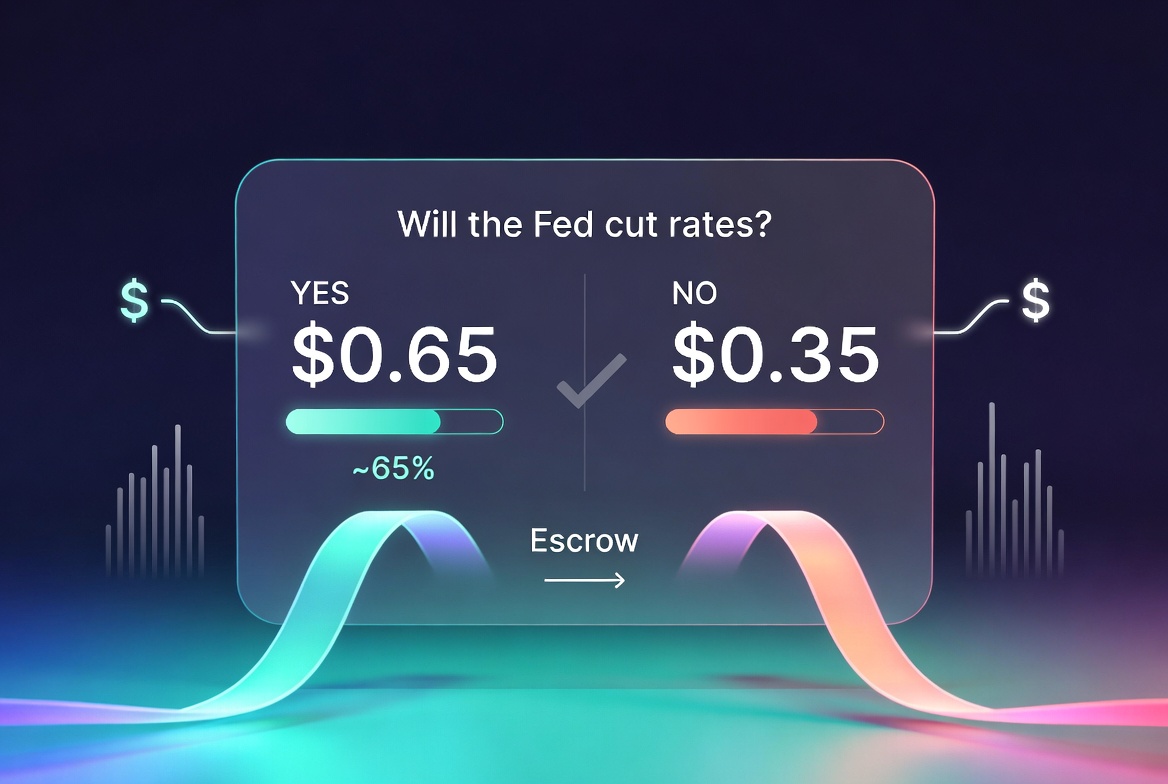
Prediction markets let you buy a contract on any future event for less than a dollar and collect a dollar if you are right. That single mechanic powers a $44-billion-per-year industry that correctly called the 2024 presidential election when polls could not.
Understanding how prediction markets work starts with one concept: a contract priced at $0.65 means the market collectively estimates a 65% chance that event happens. If you buy that contract and the event occurs, you collect $1.00. If it does not, you lose your $0.65. Every trade on every platform, from Kalshi to Polymarket, runs on that principle.
This guide walks you through the complete lifecycle of a prediction market contract, from listing to resolution, using a single running example with real dollar amounts. You will see exactly how prices form, what happens to your money at each stage, why you can sell before an event resolves, and how platforms decide which markets to offer.
Risk Warning:
Prediction markets involve financial risk. Only trade with money you can afford to lose. Past performance does not guarantee future results. Check your local regulations before trading on any prediction market platform.
What Is a Prediction Market?
A prediction market is an exchange where you buy and sell contracts tied to the outcomes of real-world events. Each contract is a simple binary question with a YES or NO answer, and its price reflects the crowd’s estimate of how likely that outcome is.
Here is the example we will carry through this entire guide. On a platform like Kalshi, you see the contract: “Will the Federal Reserve cut interest rates in June 2026?” The YES contract is currently priced at $0.65. That price tells you the market collectively believes there is a 65% chance the Fed cuts rates. The NO contract, by definition, is priced at $0.35 (because YES + NO always equals $1.00, minus a small spread for fees).
If you believe the probability is higher than 65%, you buy YES contracts. If you think the Fed will hold steady, you buy NO contracts at $0.35. When the Fed announces its decision, the contract resolves: YES pays $1.00, NO pays $0.00 (or vice versa). The difference between your purchase price and the $1.00 payout is your profit.
The concept is not new. The Iowa Electronic Markets at the University of Iowa launched in 1988, making it one of the first modern electronic prediction markets.1University of Iowa, “Iowa Electronic Markets,” tippie.uiowa.edu/iem, March 2026 In 2020, Kalshi received CFTC approval as a designated contract market, the first federally regulated exchange dedicated exclusively to event contracts.2CFTC, “CFTC Approves KalshiEX LLC as Designated Contract Market,” cftc.gov, November 2020 By 2025, the prediction market industry recorded over $44 billion in total notional trading volume, with monthly active users surpassing 600,000.3Keyrock and Dune Analytics, “Prediction Markets 2025 Report,” via Gambling Insider, February 2026
The theory behind prediction markets traces back to Friedrich Hayek’s 1945 insight that markets aggregate dispersed information more efficiently than any single individual or committee. When hundreds of thousands of traders put real money behind their beliefs, the resulting price becomes a remarkably accurate probability estimate. A CEPR study analyzing over 300,000 Kalshi contracts found that contract prices broadly reflect actual outcome frequencies, and accuracy improves as events approach.4Burgi, Deng, and Whelan, “Makers and Takers: The Economics of the Kalshi Prediction Market,” CEPR Discussion Paper No. 20631, 2026
The Lifecycle of a Prediction Market Contract
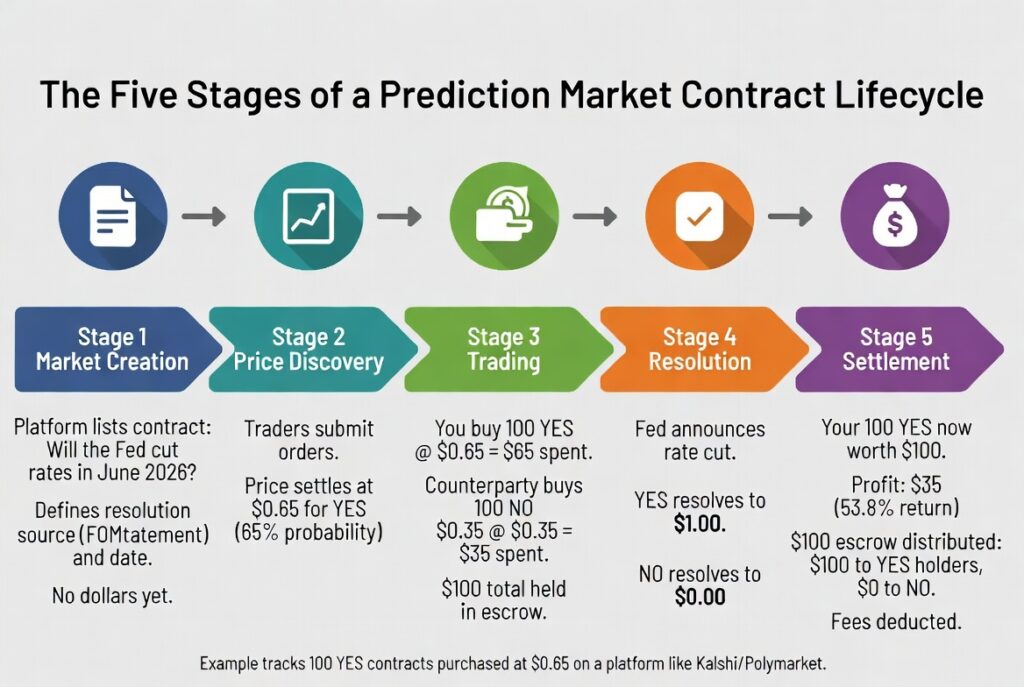
Every prediction market contract follows the same five stages: creation, price discovery, trading, resolution, and settlement. Here is what that looks like with our Fed rate cut example, tracked dollar by dollar.
Stage 1: Market Creation. The platform lists the contract: “Will the Federal Reserve cut interest rates in June 2026?” It defines a clear resolution source (the official FOMC statement), a resolution date (after the June 2026 meeting), and the binary outcomes (YES or NO).
Stage 2: Price Discovery. Traders begin submitting orders. Early buyers and sellers establish the initial price. On Kalshi, this happens through an order book where buyers post bid prices and sellers post ask prices, similar to a stock exchange. Polymarket uses a hybrid model combining automated market makers with order books. The price settles at $0.65 for YES, meaning the collective market estimates a 65% probability.
Stage 3: Trading. You decide the market is underpricing the likelihood of a rate cut. You buy 100 YES contracts at $0.65 each, spending $65.00 total. That $65.00 moves from your account balance into your open position. Meanwhile, someone on the other side buys 100 NO contracts at $0.35 each, spending $35.00. Combined, that is $100.00 held in escrow (100 contracts multiplied by $1.00 each), guaranteeing that the winning side gets paid.
Stage 4: Resolution. The Fed announces a 25 basis point rate cut. The platform’s resolution process confirms the outcome against the official FOMC statement. The YES contract resolves to $1.00. The NO contract resolves to $0.00.
Stage 5: Settlement. Your 100 YES contracts are now worth $100.00. You paid $65.00, so your profit is $35.00 (a 53.8% return on your investment). The $100.00 in escrow is distributed: $100.00 to you, $0.00 to the NO holders. Platform fees (which vary by provider) are deducted from your proceeds.
How Prices Form (and Why This Is Not Sports Betting)
Prediction market prices are not set by a bookmaker. They form through buyer-seller matching on an exchange, exactly the way stock prices form on the NYSE or Nasdaq. When you buy YES at $0.65 on our Fed rate cut contract, a seller on the opposite side is simultaneously selling YES at $0.65 (or equivalently, buying NO at $0.35). The platform facilitates the match and earns a transaction fee. It has no stake in the outcome.
This is a fundamental structural difference from sports betting. At DraftKings or FanDuel, the sportsbook sets the odds, takes the other side of your bet, and profits when you lose. The house has a direct financial interest in outcomes. Prediction market platforms are neutral exchanges that earn revenue from fees regardless of which side wins.5Kalshi, “Kalshi Fee Schedule,” kalshi.com, effective February 5, 2026
How It Compares: Prediction Markets vs. Sports Betting vs. Stock Trading
| Feature | Prediction Markets | Sports Betting | Stock Trading |
|---|---|---|---|
| Price Formation | Order book matching between buyers and sellers | Bookmaker sets the line | Exchange-based order book |
| Counterparty | Another trader | The sportsbook (the house) | Another investor |
| Settlement | $1.00 or $0.00 per contract | Fixed odds payout | Dividends, appreciation, sale |
| Can You Exit Early? | Yes, sell anytime before resolution | Rarely (limited cash-out options) | Yes, sell shares anytime |
| Platform Profits From | Transaction fees | Your losses (house edge) | Commissions, payment for order flow |
Penalized for Winning? | No | Yes (accounts may be limited or banned) | No |
Expert Tip:
Because prediction markets are neutral exchanges, you will never be throttled or banned for being too profitable. In sports betting, winning consistently gets your account limited. In prediction markets, consistent winners improve price accuracy and are good for the marketplace.
The practical result of this structure: prediction market prices tend to be more accurate probability estimates than polling data or expert forecasts. A 2025 industry analysis found average Brier scores (a standard accuracy measure where lower is better) near 0.09 across major platforms, indicating high calibration between predicted probabilities and actual outcomes.6Keyrock and Dune Analytics, “Prediction Markets 2025 Report,” via Gambling Insider, February 2026
You Do Not Have to Wait: Selling Before Resolution
The most common misconception about prediction markets: that you buy a contract and sit on it until the event happens. In reality, you can sell your position at any time the market is open, exactly the way you sell a stock.
Return to our running example. You bought 100 YES contracts on the Fed rate cut at $0.65 each ($65.00 total). Two weeks later, a weak jobs report hits and the market now prices the rate cut at 82% likely. Your YES contracts are trading at $0.82.
You have two choices. First, you can hold to resolution and collect $100.00 if the Fed cuts (a $35.00 profit, or 53.8% return). But you wait months with your $65.00 locked up. Second, you can sell now at $0.82 each and collect $82.00 (a $17.00 profit, or 26.2% return). You free your capital in minutes and can redeploy it into other positions.
Warning:
Selling before resolution means you can also lock in losses. If your $0.65 YES contracts drop to $0.40 on bad news, selling means accepting a $0.25 per contract loss ($25.00 on 100 contracts). The alternative is holding and hoping the event still occurs, but that carries the risk of a total loss. Know your risk tolerance before entering any position.
This ability to exit early is the single biggest structural advantage prediction markets have over traditional sports betting. Once you place a bet at a sportsbook, your money is locked until the game ends. On a prediction market, you are trading a liquid position that you control. The decision to hold, sell for profit, or sell at a loss to cut exposure is entirely yours.
How Platforms Decide Which Markets to List
Not every question becomes a prediction market. Platforms curate their market offerings based on regulatory requirements, resolution clarity, and expected trader interest. Understanding this process helps you evaluate the quality of the markets you trade on.
On Kalshi, every market must be self-certified with the CFTC before it goes live.7CFTC, “CFTC Approves KalshiEX LLC as Designated Contract Market,” cftc.gov, November 2020 That process involves legal review, compliance documentation, and defining a verifiable resolution source (such as an official government report or a recognized data provider). It is expensive and time-consuming, which is why Kalshi’s market catalog, while spanning a dozen-plus categories, still covers fewer event types than less-regulated competitors.8Kalshi, “Kalshi Public API,” kalshi.com, verified March 2026
Polymarket’s global platform takes a different approach. Markets can be proposed by the community, and resolution relies on the UMA Optimistic Oracle, a decentralized system where outcomes are verified on-chain.9Polymarket, “Resolution Sources,” docs.polymarket.com, March 2026 This allows Polymarket to list markets on nearly any topic that generates interest, from presidential elections to whether a specific celebrity will tweet on a given day. The tradeoff: faster market creation, but without the legal protections of CFTC oversight.
Three factors determine whether a market is worth trading on. First, resolution criteria: is the outcome clearly defined and verifiable? A contract that resolves based on an official FOMC statement is more reliable than one that depends on a subjective judgment. Second, liquidity: are enough people trading to let you enter and exit at fair prices? Low-liquidity markets have wide spreads that eat into your returns. Third, time horizon: longer-dated contracts lock your capital for extended periods, which has an opportunity cost even if you end up right.
Start Trading on Prediction Markets
Prediction markets give you a way to trade your knowledge of real-world events through a simple mechanic: buy a contract below $1.00, collect $1.00 if you are right. The exchange-based structure means no bookmaker is working against you, and the ability to sell before resolution gives you control that traditional betting never has.
If you already understand odds, probability, and risk from sports betting, stock trading, or poker, you have the foundation to trade prediction markets effectively. The learning curve is about platform mechanics and market evaluation, not the underlying concepts.For US traders who prioritize regulatory certainty, Kalshi is the only CFTC-regulated prediction market exchange. For traders comfortable with crypto wallets who want maximum market variety, Polymarket offers the deepest liquidity across the widest range of event types.
Pro Tip: Evaluating Market Quality Before You Trade
Before entering any prediction market position, check three things: (1) Read the resolution criteria carefully. Ambiguous resolution language is the number one source of disputes. (2) Check the order book depth. If only a few hundred dollars are on each side, you may not be able to exit at a fair price. (3) Confirm the resolution source. Markets tied to official government data, verified sports results, or auditable on-chain data are more reliable than markets resolved by a single entity’s judgment.