Category: Fundamentals

  • The 9 Most Expensive Mistakes New Prediction Market Traders Make

    The 9 Most Expensive Mistakes New Prediction Market Traders Make

    Most new prediction market traders lose money on mistakes, not bad predictions. The prediction itself might be right. The contract resolves in your favor. But fees ate your edge, your capital was locked for months while better opportunities passed, or you doubled down after a loss and compounded the damage.

    Prediction markets are genuinely new for most people. Even experienced sports bettors and stock traders walk in with beginner prediction market mistakes that stem from assumptions that don’t transfer cleanly. The pricing mechanics are different. The fee structures are different. The fact that you can sell a position before resolution creates decision points that don’t exist in traditional betting.

    These nine mistakes span three categories: mechanical errors (fees, resolution, liquidity), strategic errors (bankroll concentration, capital lockup, exit planning), and psychological traps (confirmation bias, revenge trading, anchoring). Each one includes a specific dollar example showing exactly how much it costs, and a concrete fix you can apply immediately.

    Mechanical Mistakes: The Structural Errors That Cost You Before You Even Start

    Mistake 1: Ignoring Fee Impact on Your Edge

    Fees in prediction markets work differently than the vig on a sportsbook. They compound against your edge in ways most beginners never calculate. On Kalshi, the taker fee formula per Kalshi’s fee schedule is round_up(0.07 × C × P × (1 – P)), capped at $0.02 per contract.1Kalshi, “Kalshi Fee Schedule,” kalshi.com/docs/kalshi-fee-schedule.pdf, February 2026 That sounds small until you do the math.

    Say you buy 100 contracts at $0.50 because you believe the true probability is 57%. Your raw edge is 7 cents per contract, or $7.00 total. The Kalshi taker fee on this trade: round_up(0.07 × 100 × 0.50 × 0.50) = $1.75.2Kalshi, “Kalshi Fee Schedule,” kalshi.com/docs/kalshi-fee-schedule.pdf, February 2026 Your $7.00 edge just became $5.25. On a thinner edge of 3 cents per contract, fees consume more than half your expected profit, which is why the fee comparison changes at different position sizes.

    If you’re coming from sports betting, think of it this way: the vig is baked into the line, so you see your payout upfront. In prediction markets, the fee is a separate calculation that eats into a profit you’ve already mentally banked. Always run the fee math before you trade, not after.

    Mistake 2: Misunderstanding Resolution Rules

    Every prediction market contract lives or dies by its resolution criteria, and “close enough” doesn’t count. A contract asking “Will GDP growth exceed 2.5%?” resolves based on a specific data source (the BEA advance estimate, for example), on a specific date. If GDP comes in at 2.49%, your YES contract pays zero regardless of rounding debates.

    Resolution mechanisms also vary by platform. Kalshi uses centralized resolution through its own team under CFTC oversight.3CFTC, “Order of Designation: KalshiEX LLC,” cftc.gov, November 2020 Polymarket’s global platform uses the UMA Optimistic Oracle, a decentralized system where resolution can take longer and, in rare cases, face disputes.4Polymarket, “How Resolution Works,” docs.polymarket.com, March 2026 Reading the resolution criteria before trading is not optional. It is the single most important step most beginners skip.

    Mistake 3: Trading in Illiquid Markets

    Liquidity determines the real cost of your trade, not just the headline price. A contract showing $0.60 with a 10-cent spread between the best bid and ask means you’re paying $0.65 to buy and can only sell at $0.55. That 10-cent gap is an invisible 15% tax on every round trip.

    In poker, you’d never sit in a thin cash game where you can’t get action on your big hands. The same logic applies here: if a market doesn’t have enough depth for you to enter and exit at reasonable prices, the edge you think you see isn’t real. Check the order book depth before committing capital. Major markets on platforms like Kalshi and Polymarket show spreads of 2 to 5 cents on active contracts.5Kalshi, “Market Data,” kalshi.com, March 2026 If you’re seeing spreads above 10 cents, the market is too thin for meaningful position sizes.

    Strategic Mistakes: How Poor Planning Turns Winning Trades Into Losing Ones

    Mistake 4: Overconcentrating Your Bankroll

    Putting 30% of your prediction market bankroll into a single contract is the fastest way to blow up an account, even with a winning edge. The math is unforgiving. If you have $1,000 and place $300 on a contract at $0.40 (true probability you estimate at 55%), your expected value per contract is positive. But there’s still a 45% chance you lose the entire $300 in one shot.

    This is where sports bettors and poker players have an advantage if they apply what they already know. In tournament poker, no professional risks more than 2 to 5% of their bankroll on a single buy-in, and the same bankroll management principle applies to prediction markets. A 5% maximum per position means your $1,000 bankroll never puts more than $50 on any single contract. You survive the inevitable losing streaks and stay in the game long enough for your edge to compound.

    Mistake 5: Ignoring Opportunity Cost and Capital Lockup

    This is the mistake that separates prediction market trading from sports betting. When you bet on a game, the result comes in hours. In prediction markets, your capital can be locked for weeks or months.

    My most expensive prediction market mistake was ignoring opportunity cost. I put a generous sum into a contract at $0.78 that resolved YES three months later. A 27% return over 90 days sounds great on paper, but that $$$ was locked the whole time, and I missed multiple short-term opportunities that would have cycled that capital three or four times. Now I always factor in resolution timeline before sizing any position.

    Robert C.

    The fix is straightforward. Before entering any position, calculate the annualized return. An $0.80 contract paying $1.00 in six months is a 25% return, which annualizes to roughly 50%. That same $0.80 contract resolving in two weeks annualizes to over 600%. Time is a cost just like fees, and most beginners never price it in.

    Mistake 6: Trading Without an Exit Plan

    Prediction markets offer something traditional sports bets don’t: you can sell your position before the contract resolves. This creates a decision point most new traders ignore entirely. They buy a contract and default to “hold until resolution” without ever considering whether selling early at a profit might be the better move.

    Define your exit criteria before you enter the trade. At what price will you take profit? At what price will you cut losses to free up capital for better opportunities? If a contract you bought at $0.40 rises to $0.75, you’ve captured most of the upside. Holding for the final $0.25 means accepting the risk that new information could reverse the price, while your capital sits locked instead of working elsewhere.

    Psychological Mistakes: The Mental Traps That Destroy More Accounts Than Bad Predictions

    Mistake 7: Confirmation Bias in Your Research

    Confirmation bias is the tendency to seek out information that supports what you already believe, and ignore everything that contradicts it. In prediction markets, this plays out when you buy a YES contract and then only read news sources, social media accounts, and analysis that reinforces your position.

    The fix is deliberate and uncomfortable: after you form your thesis, spend equal time looking for the strongest argument against it. If you bought YES on a political outcome at $0.45, go find the most credible case for NO. If that case changes your probability estimate by more than 5 percentage points, your position size is wrong or the trade shouldn’t exist. The best poker players do this instinctively. They assign ranges to opponents, not single hands, and they update those ranges with every new card. Treat your prediction market research the same way.

    Mistake 8: Chasing Losses (Revenge Trading)

    After a loss, the impulse to immediately buy into another position to “win it back” is one of the most destructive patterns in any form of trading. In poker, this is called going on tilt, and it’s responsible for more busted bankrolls than bad cards.6Survey of Professional Forecasters, “Overconfidence Bias in Trading,” Federal Reserve Bank of Philadelphia, 2024

    After my first big loss on a political contract, I immediately bought into three other positions without doing any analysis. I was trying to ‘win it back.’ Two of those three lost as well. That triple loss in 48 hours taught me more about discipline than any winning streak ever could. Now I have a hard rule: no new trades for 24 hours after any single-position loss exceeding 5% of my bankroll.

    Robert C.

    Mistake 9: Anchoring to Your Purchase Price

    You bought a contract at $0.65. It drops to $0.45. You hold because “it was worth $0.65 before, so it will come back.” This is anchoring bias, and your purchase price is irrelevant to the contract’s current value.

    The only question that matters: at the current price of $0.45, what is the true probability of this event? If your honest assessment is 45% or lower, the contract is fairly priced or overpriced, and your capital is better deployed elsewhere. Holding a losing position because you paid more for it is the prediction market equivalent of throwing good money after bad. The market doesn’t know or care what you paid. Neither should you.

    Warning

    Revenge trading after a loss reduces decision quality dramatically. The emotional state that follows a loss is the worst possible state for making probability assessments. Step away. Review what went wrong. Return only when you can evaluate the next trade on its own merits.

    The 30-Second Pre-Trade Checklist

    Every mistake in this article can be caught with a quick check before you commit capital. Save this checklist and run through it before your first 50 trades. After that, it becomes instinct.

    Before every trade, ask yourself:

    1. Have I calculated my expected value including fees? If you can’t state your edge in cents per contract after fees, you’re guessing.
    2. Have I read the full resolution criteria? Do you know the exact data source, the exact date, and the exact threshold? If not, you don’t understand what you’re buying.
    3. Is there enough liquidity to exit? Check the order book. If the spread is wider than your expected edge, the trade is not worth taking.
    4. Am I risking more than 5% of my bankroll on this single position? If yes, reduce your size. No single trade justifies concentration risk.
    5. Have I factored in the resolution timeline? Calculate your annualized return. A 10% gain over six months is different from a 10% gain over two weeks.
    6. Am I entering this trade based on analysis or emotion? If you just took a loss, stop. Come back in 24 hours.
    7. Can I state the strongest argument against my position? If you can’t, your research is incomplete.

    Pro Tip

    Screenshot this checklist and keep it on your phone. Mechanical discipline beats emotional intelligence in the first 50 trades. Once these checks become habit, your error rate drops significantly.

    This checklist catches mistakes 1 through 9 in roughly 30 seconds. It won’t guarantee profitable trades, but it will eliminate the structural errors that bleed accounts dry before strategy ever gets a chance to work.

    Avoiding These Mistakes Won’t Make You a Great Trader. But It Will Stop You From Being a Bad One.

    Every trader makes mistakes early on. Prediction markets are new enough that even experienced sports bettors and stock traders walk in with blind spots. The difference between traders who survive their first six months and those who don’t isn’t prediction accuracy. It’s structural discipline.

    The mechanical mistakes (fees, resolution, liquidity) are the easiest to fix because they’re objective. Run the numbers. Read the criteria. Check the order book. The strategic mistakes (overconcentration, capital lockup, no exit plan) require more discipline but follow clear rules. The psychological mistakes (confirmation bias, revenge trading, anchoring) are the hardest because they feel rational in the moment.

    Start with the checklist. Use it for your first 50 trades. Pay attention to which mistakes you’re most prone to, and go deeper on the strategy that addresses your specific weakness.

    Sources & References

    • 1
      Kalshi, “Kalshi Fee Schedule,” kalshi.com/docs/kalshi-fee-schedule.pdf, February 2026
    • 2
      Kalshi, “Kalshi Fee Schedule,” kalshi.com/docs/kalshi-fee-schedule.pdf, February 2026
    • 3
      CFTC, “Order of Designation: KalshiEX LLC,” cftc.gov, November 2020
    • 4
      Polymarket, “How Resolution Works,” docs.polymarket.com, March 2026
    • 5
      Kalshi, “Market Data,” kalshi.com, March 2026
    • 6
      Survey of Professional Forecasters, “Overconfidence Bias in Trading,” Federal Reserve Bank of Philadelphia, 2024
  • Political Prediction Markets in 2026: How Election and Policy Contracts Work, and Where to Trade Them

    Political Prediction Markets in 2026: How Election and Policy Contracts Work, and Where to Trade Them

    Political prediction markets generated nearly $4 billion in volume during the 2024 U.S. presidential election alone, and they have only grown since. If you heard about Polymarket on election night or saw Kalshi’s odds on cable news, you already know the basics: people put real money behind their political forecasts, and the prices reflect collective probability in real time.

    What most coverage skips is the full scope. Political prediction markets in 2026 go far beyond who wins the White House. You can trade contracts on congressional races, Supreme Court rulings, Fed policy decisions, international elections, and geopolitical events. Contract prices range from $0.01 to $0.99, where the price equals the market’s implied probability of the outcome.

    This guide covers every type of political contract available, compares the three platforms that matter for political trading, breaks down what the 2024 accuracy data actually shows, and maps the regulatory landscape shaping this category in 2026.

    Prediction markets involve financial risk. Only trade with money you can afford to lose.

    What Are Political Prediction Markets and How Do They Work?

    Political prediction markets are exchange-traded contracts that let you take a financial position on the outcome of political events. Each contract poses a yes-or-no question, like “Will the current party retain the Senate in 2026?” The price you pay reflects the market’s implied probability of that outcome occurring.

    Contracts trade between $0.01 and $0.99. If you buy a “Yes” contract at $0.35, you’re paying $35 per 100 contracts for an outcome the market prices at a 35% probability. If the event happens, each contract pays out $1.00. If it doesn’t, you lose your $0.35 per contract. On a $100 position at that price, you’d buy roughly 285 contracts and collect $285 if you’re right, or lose your $100 if you’re wrong.

    This structure is fundamentally different from traditional sports betting. There is no bookmaker setting odds and taking the other side of your wager. Instead, you trade against other participants on a prediction market with an open order book. Prices move continuously as new information arrives, which is why prediction market odds often shift faster than news headlines.

    Multi-outcome markets work slightly differently. A market like “Who will win the 2028 Democratic presidential nomination?” lists contracts for each potential nominee. Only one contract resolves to $1.00; the rest go to zero. These markets sometimes show prices that don’t sum to exactly $1.00, reflecting the bid-ask spread and trading costs on the exchange.

    Pro Tip:

    The gap between Yes and No prices on any political contract is effectively your trading cost. On a liquid presidential market, that spread might be 1 to 3 cents. On a thin state legislature contract, it could be 10 cents or more. Check the order book depth before you trade, not just the headline price.

    Every political prediction market contract includes a ruleset specifying the resolution source (AP election calls, official government records, specific agency announcements) and the exact conditions for payout. Read the rules before trading. Ambiguous resolutions have caused real disputes, particularly on geopolitical contracts where “regime change” or “military action” definitions become contested.

    Every Type of Political Contract You Can Trade in 2026

    Political trading is one of several active prediction market categories, but it extends well beyond presidential races. Here is the full taxonomy of political contract types actively trading in 2026.

    Election markets are the highest-volume category. Presidential races, party control of the Senate and House, gubernatorial elections, and individual congressional district outcomes all trade on major platforms. The 2028 Democratic presidential nomination market on Polymarket already has over 2.3 million shares traded, more than a year before anyone votes.

    Expert Tip:

    Political contract categories have distinct risk profiles. Election markets resolve on known dates with clear outcomes. Geopolitical contracts can resolve unpredictably, and their resolution rules are where disputes happen. Always check how a contract defines its outcome before committing capital.

    Policy outcome contracts price the probability of specific government actions. Will the Fed cut rates at the next FOMC meeting? Will Congress pass a particular bill by a deadline? Will tariff rates exceed a specific threshold? These markets tie directly to economic outcomes and attract a different trader profile than pure election bettors.

    Regulatory and legal contracts track government agency decisions, Supreme Court rulings, and enforcement actions. Cabinet confirmation markets, Attorney General investigations, and agency appointment timelines all generate trading interest.

    International and geopolitical contracts have surged since early 2026. Markets on leadership changes, ceasefire agreements, military operations, and diplomatic outcomes now represent a significant and growing share of political volume. Polymarket’s single-day trading volume record of $425 million (February 28, 2026) was driven by geopolitical markets.1MetaMask, “Prediction markets in 2026: Key trends,” metamask.io, April 2026

    Mention and attention markets track whether a public figure will say or do something specific. State of the Union prop markets, for example, generated $17 million in combined volume on Kalshi and Polymarket during Trump’s February 2026 address.2DeFi Rate, “Political Betting Sites,” defirate.com, April 2026

    The best opportunities weren’t the headline presidential race where pricing was efficient. They were smaller races and policy contracts where fewer participants meant less efficient pricing. A Senate race contract in a state I followed closely was mispriced by 15+ cents for weeks because the national narrative hadn’t caught up to local polling.

    Robert C.

    Where to Trade Political Prediction Markets: Platform Comparison

    Three platforms dominate political prediction market trading in 2026, each with distinct strengths.

    Kalshi is the only CFTC-regulated designated contract market (DCM) built exclusively for event contracts. It offers 10,000+ total markets across categories, with deep liquidity on political and economic contracts. Spreads on major political markets run 2 to 5 cents. The fee structure caps taker fees at $0.02 per contract, with limit orders paying 75% less.

    You can fund your account with ACH, debit card, Apple Pay, PayPal, Venmo, or crypto (USDC, BTC, ETH), and the minimum deposit is just $1. Kalshi resolves political markets using official sources including AP election calls and government agency data.3Kalshi Platform Intelligence v3, InsidePredictions.com internal research, March 2026 It is available in all 50 U.S. states, though sports contracts face restrictions in eight states.

    We may earn a commission if you sign up through our links. This doesn’t affect our editorial independence.

    Polymarket leads in global political volume, with over 1,500 active political markets and $3.3 billion in volume from the 2024 election alone.4Polymarket Platform Intelligence v3, InsidePredictions.com internal research, March 2026 The global platform charges zero fees on most markets, while the U.S. DCM (launched December 2025 via its QCX acquisition) charges a 0.10% taker fee. Spreads on headline political markets are typically 1 to 3 cents.

    Funding options include USDC on Polygon, card purchases via MoonPay (minimum around $20), and Coinbase Pay. Polymarket’s political coverage is strongest on headline U.S. elections and international events, but thinner on down-ballot races.

    PredictIt is the original U.S. political prediction market, operating under a CFTC no-action letter since 2014.5PredictIt Platform Intelligence v3, InsidePredictions.com internal research, March 2026 It offers political markets exclusively, with no sports, crypto, or economic categories. This narrow focus produces the deepest down-ballot coverage in the industry: individual House races, state legislature outcomes, primary nominations, and RealClearPolitics polling predictions that other platforms don’t list. The tradeoff is cost.

    PredictIt charges 10% on profits plus a 5% withdrawal fee, making it the most expensive platform. The $3,500 per-contract investment cap and lack of a mobile app limit its appeal for larger or mobile-first traders.

    FeatureKalshiPolymarketPredictIt
    RegulationCFTC DCMCFTC DCM (via QCX)CFTC No-Action Letter
    Political Markets10,000+ total1,500+ active political100+ (political only)
    FeesUp to $0.02/contractZero (global); 0.10% (US)10% profit + 5% withdrawal
    Min Deposit$1~$1 (crypto); ~$20 (card)$10
    Political DepthDeep on headlinesDeepest internationalDeepest US down-ballot
    Mobile AppYes (4.7 rating)YesNo
    AvailabilityAll 50 US statesGlobal (US via waitlist)US persons only

    Warning:

    Fees compound on smaller positions. On a $100 PredictIt trade that earns $20 profit, the 10% profit fee ($2) plus 5% withdrawal fee on your $118 balance (roughly $5.90) means you keep about $112 of your $120 gross payout. On Kalshi, the same trade costs $2 to $4 in taker fees total. Run your expected fees before choosing a platform.

    How Accurate Are Political Prediction Markets? The 2024 Test

    The 2024 U.S. presidential election provided the highest-stakes accuracy test for political prediction markets to date. With over $3.6 billion traded on Polymarket and $500 million on Kalshi, the data is substantial enough to evaluate.In the final days before the election, Polymarket’s implied probability for the eventual winner exceeded 60%. Major polling aggregates, by contrast, showed a near-toss-up.

    The election outcome aligned more closely with prediction market prices than with several prominent forecasting models.6MetaMask, “Prediction markets in 2026: Key trends,” metamask.io, April 2026 Markets also reacted faster on election night itself, reflecting incoming results in contract prices hours before networks issued calls.

    2024 Election Accuracy Snapshot
    1. Polymarket: Implied probability for winner exceeded 60% pre-election
    2. Major polling aggregates: Showed approximately 50/50
    3. Outcome: Aligned with market pricing, not polls
    4. Volume: $3.3B+ on Polymarket, $500M+ on Kalshi

    This does not mean prediction markets are infallible. Vanderbilt researchers Joshua Clinton and TzuFeng Huang have challenged the view that prediction markets always efficiently aggregate information about political outcomes.7Better Markets, “Predictably, Prediction Markets Are Just Casinos,” bettermarkets.org, January 2026 Several limitations are well documented.

    Where markets fall short:

    Thin markets are manipulable. A single large order on a contract with low volume can move the price significantly, creating a misleading probability signal. Down-ballot races and niche policy contracts are particularly vulnerable.

    Insider information creates unfair advantage. In early 2026, Israeli authorities accused individuals of using classified intelligence to place profitable bets on Polymarket related to military operations.8NerdWallet, “Prediction markets: How they work, risks and calculator,” nerdwallet.com, March 2026 Senator Jeff Merkley introduced legislation to ban Congressional prediction market trading after concerns surfaced about government officials’ potential access.9NPR, “With boom in prediction markets, some lawmakers worry,” npr.org, March 2026

    Resolution disputes erode trust. When Kalshi operated a market on whether Iran’s former leader would be ousted, the unexpected manner of resolution led to the platform voiding payouts, sparking a lawsuit and raising questions about contract design.10NerdWallet, “Prediction markets: How they work, risks and calculator,” nerdwallet.com, March 2026

    I watched the 2024 election night unfold on Polymarket in real time. The market called it hours before the networks did. But I’ve also seen thin contracts get manipulated by a single large order. The accuracy advantage is real on deep, liquid markets. Take away the liquidity and you’re just aggregating noise.

    Robert C.

    The Regulatory Landscape: From CFTC Approval to State Pushback

    Political prediction markets exist because of a landmark legal battle between Kalshi and the CFTC. Understanding that history helps you assess where the regulatory environment is headed.

    In 2023, Kalshi applied to list contracts on which party would control Congress. The CFTC rejected the application, arguing that political event contracts constituted illegal “gaming” under the Commodity Exchange Act. Kalshi sued, and in September 2024, the District Court for the District of Columbia ruled in Kalshi’s favor, interpreting the law narrowly.11Kalshi Platform Intelligence v3, InsidePredictions.com internal research, March 2026 The CFTC appealed but dropped the case under the Trump administration in March 2025.

    That ruling opened the floodgates. PredictIt, which had operated under a narrow CFTC no-action letter since 2014 (limited to political events with a then-$850 investment cap), received an amended letter in July 2025 raising the cap to $3,500.12CFTC, “No-Action Letter 25-20,” cftc.gov, July 2025 Polymarket acquired CFTC-designated contract market QCX for $112 million in July 2025 and launched its U.S. platform in December 2025.13Polymarket Platform Intelligence v3, InsidePredictions.com internal research, March 2026

    But the federal green light hasn’t silenced state regulators. As of April 2026, state-level enforcement actions are reshaping access:

    • Nevada filed a civil lawsuit against Polymarket (January 2026), securing a temporary restraining order.
    • Massachusetts ruled that Kalshi’s sports contracts are subject to state gaming laws (January 2026). Polymarket filed a preemptive federal lawsuit against Massachusetts in February 2026.
    • Tennessee issued cease-and-desist letters to Polymarket, Kalshi, and Crypto.com (January 2026) over sports contracts.
    • Arizona’s Department of Gaming issued cease-and-desist orders to multiple platforms (December 2025 through March 2026).
    • Illinois cited laws that ban both sports wagering and election wagering in cease-and-desist letters.

    The critical distinction: most state actions target sports event contracts specifically. Political prediction markets have faced less direct state opposition, with the notable exception of Illinois and Nevada, whose laws may cover election contracts. The CFTC has asserted exclusive federal jurisdiction, filing an amicus brief in February 2026 supporting this position.14Wikipedia, “Prediction market,” en.wikipedia.org, April 2026

    Warning:

    The regulatory landscape is shifting rapidly. Verify current platform availability in your state before depositing funds. Laws vary by jurisdiction and enforcement actions can restrict access without advance notice.

    Getting Started with Political Prediction Markets

    Political prediction markets are the fastest-growing category in the prediction market industry, and the 2026 midterm cycle will only accelerate that momentum. The combination of real-money incentives, real-time pricing, and contract variety makes this category uniquely valuable for anyone who follows politics closely enough to have informed views.

    For most U.S. traders, Kalshi is the starting point: CFTC-regulated, lowest fees, deepest liquidity, and the broadest market selection. If you want unmatched depth on down-ballot races and you accept the higher fee structure, PredictIt fills a niche no other platform covers. If you’re comfortable with crypto funding and want access to global political markets with the tightest spreads, Polymarket delivers the most volume.

    Start with one platform, one political contract you have a genuine view on, and a position size you can afford to lose. The edge in political prediction markets goes to informed participants who do their own research rather than following headline prices.

    Sources & References

    • 1
      MetaMask, “Prediction markets in 2026: Key trends,” metamask.io, April 2026
    • 2
      DeFi Rate, “Political Betting Sites,” defirate.com, April 2026
    • 3
      Kalshi Platform Intelligence v3, InsidePredictions.com internal research, March 2026
    • 4
      Polymarket Platform Intelligence v3, InsidePredictions.com internal research, March 2026
    • 5
      PredictIt Platform Intelligence v3, InsidePredictions.com internal research, March 2026
    • 6
      MetaMask, “Prediction markets in 2026: Key trends,” metamask.io, April 2026
    • 7
      Better Markets, “Predictably, Prediction Markets Are Just Casinos,” bettermarkets.org, January 2026
    • 8
      NerdWallet, “Prediction markets: How they work, risks and calculator,” nerdwallet.com, March 2026
    • 9
      NPR, “With boom in prediction markets, some lawmakers worry,” npr.org, March 2026
    • 10
      NerdWallet, “Prediction markets: How they work, risks and calculator,” nerdwallet.com, March 2026
    • 11
      Kalshi Platform Intelligence v3, InsidePredictions.com internal research, March 2026
    • 12
      CFTC, “No-Action Letter 25-20,” cftc.gov, July 2025
    • 13
      Polymarket Platform Intelligence v3, InsidePredictions.com internal research, March 2026
    • 14
      Wikipedia, “Prediction market,” en.wikipedia.org, April 2026
  • Types of Prediction Markets: Every Category of Event You Can Trade in 2026

    Types of Prediction Markets: Every Category of Event You Can Trade in 2026

    Most people discover prediction markets through one headline: an election. But the types of prediction markets available in 2026 extend far beyond politics, covering everything from Fed rate decisions and Super Bowl outcomes to hurricane paths and Oscar winners.

    Prediction markets now span at least nine distinct event categories across platforms like Kalshi, Polymarket, and FanDuel Predicts. The industry surpassed $21 billion in monthly trading volume in early 2026,1TRM Labs, “How Prediction Markets Scaled to $21B,” trmlabs.com, March 2026 driven by geopolitical events, sports, and economic data. Whether you are a sports bettor looking for longer-term futures, a finance professional wanting to trade economic data releases, or a crypto trader seeking defined-risk positions on token prices, there is a market category built for your background.

    This guide breaks down every major prediction market category available today: what each one covers, which platforms dominate each category, when they peak in activity, and how to match your experience to the right market type. Think of it as the menu before you pick the restaurant.

    If you are new to how prediction markets function, start with our guide on how prediction markets actually work for the mechanics, then come back here to explore the full landscape.

    What Types of Prediction Markets Exist?

    Prediction market categories have expanded rapidly since Kalshi’s landmark CFTC court victory in October 2024 opened the door to political event contracts. Today, at least nine distinct categories of events are tradeable across major platforms.

    Here is the full taxonomy of prediction market types available in 2026:

    CategoryWhat You Can TradeExample ContractPrimary Platform(s)

    Politics/Elections

    Presidential, congressional, gubernatorial races; policy outcomes; regulatory decisions

    “Will the Republican win the 2026 PA Senate seat?”

    Kalshi, Polymarket

    Economics/Finance

    Fed rate decisions, CPI, GDP, employment data, recession probability, gas prices

    “Will the Fed cut rates at the June 2026 meeting?”
    Kalshi

    Sports
    Game outcomes, season futures, player awards, coaching changes, draft picks
    “Will the Eagles win Super Bowl LXI?”

    Kalshi, FanDuel, DraftKings

    Crypto

    Token price targets, ETF decisions, protocol events, regulatory milestones

    “Will Bitcoin exceed $150K by Dec 2026?”

    Polymarket
    Entertainment
    Award shows (Oscars, Grammys), box office, Billboard, viral moments

    “Best Picture winner at the 2027 Oscars”

    Kalshi, Polymarket
    Weather
    Hurricane strength, daily temperatures, tornado counts, extreme weather

    “Cat 5 hurricane US landfall in 2026?”

    Kalshi, Polymarket

    Science & Tech

    SpaceX launches, AI regulation, space events, tech policy

    “Will OpenAI release GPT-5 before Jul 2026?”

    Polymarket, Kalshi

    News/Current Events

    Government shutdowns, international affairs, geopolitical events

    “US government shutdown in Q3 2026?”

    Kalshi, Polymarket

    Stocks/Indices

    Daily S&P 500 closes, Nasdaq-100 levels, WTI oil price targets

    “S&P 500 close above 6,000 today?”

    Kalshi

    The sheer breadth surprises most newcomers. If you arrived here thinking prediction markets are just about elections, that is the single biggest misconception in the space. Kalshi alone operates 10,000+ open markets across 17 named categories.2Kalshi, “Public API Series Data,” kalshi.com, March 2026 Polymarket adds thousands more, with particular depth in crypto and global political events.

    Each category carries a different risk profile, liquidity level, and seasonal cycle. The sections below break down which platforms lead where, when each category is most active, and which type fits your background.

    Which Platforms Are Strongest in Each Category?

    Not all platforms cover all categories equally. Some excel in specific niches while offering only token coverage in others. This matrix shows verified platform strength by category based on market count, liquidity depth, and breadth of contract types.

    CategoryKalshiPolymarketFanDuel PredictsDraftKingsRobinhood
    Politics★★★★★★★★★★
    Economics★★★★★★★★★★★
    Sports★★★★★★
    ★★ (18 st.)
    ★★★★
    Crypto★★★★★★★
    Entertainment★★★★★★
    Weather★★★★NoneNone
    Science/Tech★★★★NoneNone
    News/Events★★★★★None
    Stocks/Indices★★★★★★★

    ★★★ = Deep liquidity, broad selection | ★★ = Available, moderate depth | ★ = Limited | None = Not offered. This matrix covers US-facing platforms. UK and EU traders can also access Smarkets (FCA-regulated) and Betfair Exchange (UKGC-licensed) for sports and political markets.

    Kalshi is the broadest regulated platform, covering all nine categories with particularly deep liquidity in politics, economics, and daily index markets. Polymarket leads globally in political markets (the 2024 US election alone generated $3.3 billion in trading volume3Sacra, “Polymarket Company Report,” sacra.com, 2025) and set a $478 million single-day volume record in March 2026.4CoinDesk, “Polymarket Attracts Record Trading Volumes,” coindesk.com, March 2026 It is the clear leader in crypto prediction markets with unique 15-minute and 5-minute price contracts. FanDuel Predicts reaches all 50 US states5SBC Americas, “FanDuel Predicts All 50 States,” sbcamericas.com, January 2026 but sports contracts are available in only 18 states where FanDuel does not operate a sportsbook.6Apple App Store, “FanDuel Predicts Listing,” apps.apple.com, March 2026

    After trading across every major category, here is what I have found: political markets have the deepest liquidity but the most efficient pricing, especially on headline races. Economic indicator markets are where I have found the most consistent edge, because most prediction market participants do not have a background in reading Fed statements or interpreting CPI data.

    Sports PMs are growing fast but sportsbooks still offer better liquidity on most individual game events. The PM advantage in sports is longer-term futures and props that sportsbooks do not offer. Crypto PMs on Polymarket solve a real problem: you can trade a nuanced view on Bitcoin’s price without full directional exposure.

    Robert C.

    The Big Four: Politics, Economics, Sports, and Crypto

    Four categories account for the vast majority of prediction market volume. Here is what each covers and where the real opportunities sit.

    Political Markets

    Political prediction markets cover elections (presidential, congressional, gubernatorial), policy outcomes, regulatory decisions, and international political events. Kalshi and Polymarket are the two dominant platforms. Political markets attract the deepest liquidity of any category, but that depth also means efficient pricing on headline races. The mispricing tends to show up in lower-profile contests: state primaries, policy contracts, and regulatory decision markets where fewer traders participate.

    The 2024 US presidential election was the watershed moment for the entire industry. Polymarket processed over $3.3 billion in volume on that single event.7Sacra, “Polymarket Company Report,” sacra.com, 2025 By February 2026, monthly trading volume exceeded $7 billion across all categories, a 7.5x year-over-year increase.8Phemex, “Polymarket Record Trading Volumes February 2026,” phemex.com, March 2026 The 2026 midterm elections are the next major catalyst.

    Economic Indicator MarketsEconomics markets let you trade the outcomes of scheduled data releases: Fed rate decisions, CPI readings, employment reports, GDP figures, and commodity prices. Kalshi is the leader here, with “Flash Markets” that settle the same day on S&P 500 closes and gas prices.9Kalshi, “Flash Markets Product Page,” kalshi.com, 2026 These contracts give retail traders access to instruments that previously required futures or swaps accounts.

    Pro Tip

    Economic data release calendars are public. The Fed publishes its meeting schedule a year in advance. Eight Fed meetings per year, twelve CPI releases, and twelve employment reports create a predictable trading calendar most PM participants overlook.

    Sports Markets

    Sports prediction markets cover game outcomes, season futures, player awards, coaching changes, and draft predictions across US and international leagues, including Premier League, Serie A, and F1. The critical distinction from sportsbooks: you can trade out of positions before the event resolves. If your “Will the Eagles win the Super Bowl?” contract rises from $0.15 to $0.45 mid-season, you can sell for a profit without waiting for the game.

    FanDuel Predicts offers sports contracts in 18 states where it does not operate a sportsbook.10Apple App Store, “FanDuel Predicts Listing,” apps.apple.com, March 2026 Both Kalshi and Polymarket hold official NHL licensing agreements, making the NHL the first major US sports league to partner with prediction market platforms.11NHL.com, “NHL Announces Landmark Partnerships with Kalshi, Polymarket,” nhl.com, October 2025 For a detailed breakdown of how sports PMs compare to sportsbooks, see our guide to sports prediction markets.

    Crypto MarketsCrypto prediction markets let you trade views on token prices, ETF decisions, protocol milestones, and regulatory actions without holding the underlying asset. Polymarket dominates this category with unique 15-minute and 5-minute crypto price markets.12Polymarket, “Crypto Markets Documentation,” docs.polymarket.com, 2026 A $0.55 contract on “Will Bitcoin be above $100,000 at 3:00 PM?” costs $0.55, with a maximum loss of $0.55. No liquidation risk, no exchange counterparty risk, no leverage blowup.

    Warning

    Crypto prediction markets are not a substitute for spot crypto exposure. They are defined-risk instruments for expressing specific, time-bound views. Treat them as trades, not investments.

    Emerging Categories: Weather, Entertainment, Science, and Beyond

    The fastest-growing prediction market categories are the ones most people do not know exist. Weather, entertainment, science, and technology markets are expanding across platforms with some of the least efficient pricing in the entire space.

    Weather Markets

    Kalshi offers hurricane strength predictions, daily city temperature contracts, and tornado count markets. Polymarket launched weather markets for Shanghai and Hong Kong temperatures in March 2026.13Polymarket, “Weather Markets Launch,” polymarket.com, March 2026 Weather contracts attract thin liquidity because few traders have meteorological expertise, which creates opportunity for those who do.

    Entertainment and Culture

    Award show predictions (Oscars, Grammys, Golden Globes) are available on both Kalshi and Polymarket. Kalshi extends into Billboard chart rankings, box office revenue, app store rankings, and viral social media moments. These markets peak during awards season from January through March. FanDuel Predicts offers “Mentions” markets that track cultural conversations.

    Science and Technology

    Space launch outcomes (SpaceX missions), AI regulation milestones, and technology policy decisions are tradeable on Polymarket and Kalshi. These are genuinely novel markets with no sportsbook or traditional finance equivalent. The contracts tend to be longer duration and lower volume.

    Expert Tip

    Emerging categories have the widest spreads and thinnest order books, but that is exactly why they offer the most potential edge. In political markets, you are competing against professional forecasters and media-informed crowds. In weather or science markets, you might be one of a few hundred participants. If you have domain expertise in meteorology, space technology, or economic modeling, niche categories are where that knowledge pays.

    When to Trade: The Prediction Market Seasonality Calendar

    Unlike stock markets, prediction market activity is driven by event calendars. Knowing when each category peaks helps you plan where to allocate attention and capital.

    CategoryPeak SeasonKey Dates/Triggers
    Politics
    Election years; primaries (Feb-Jun), general (Sep-Nov)

    2026 midterm primaries spring; general Nov 2026
    Economics
    Year-round, following data calendar

    8 Fed meetings/yr, monthly CPI + jobs, quarterly GDP
    Sports
    Sep-Feb (NFL), Oct-Jun (NBA/NHL), Apr-Oct (MLB)

    Super Bowl, March Madness, NBA Finals, World Series
    Crypto
    Event-driven; 24/7 activity
    Halving cycles, ETF decisions, protocol upgrades
    Entertainment
    Jan-Mar (awards); product launches year-round

    Golden Globes, Oscars, Grammys (Jan-Mar)
    Weather
    Jun-Nov (hurricane season); year-round extremes

    Atlantic hurricane season Jun 1 to Nov 30
    Science/Tech
    Launch schedules; regulatory calendars

    SpaceX manifests; congressional AI hearings
    News/Events
    Unpredictable; spikes around crises

    Shutdown deadlines, international flashpoints

    Economics markets offer the most predictable rhythm. The Federal Reserve publishes its meeting schedule a full year in advance,14Federal Reserve, “FOMC Meeting Calendar,” federalreserve.gov, 2026 and CPI, employment, and GDP release dates are all publicly available through the Bureau of Labor Statistics and Bureau of Economic Analysis. International traders can apply the same calendar approach to ECB meetings and UK data releases. You can plan your trading calendar in January for the entire year.

    Sports and political markets are cyclical but less predictable in intensity. A contested primary or an unexpected playoff run can spike volume overnight. Crypto is the outlier: 24/7 activity with volume driven by news cycles and market sentiment rather than a fixed calendar.

    The strategic implication is straightforward: spread your attention across categories with different seasonal patterns. When political markets are quiet between elections, economic data releases keep the calendar full. When major sports leagues are in their offseason, crypto and entertainment fill the gap.

    Find Your Market: Matching Your Background to the Right Category

    Your existing knowledge is an edge in prediction markets. The category where you have the deepest understanding is the category where you are most likely to identify mispriced contracts.

    Your Background
    Best Category to Start
    WhyRecommended Next Step
    Sports bettor / fantasy player
    Sports PMs

    You already understand odds, lines, and player performance. PM futures extend your skill set.
    Read our sports prediction market guide

    Finance / economics professional

    Economics/Finance

    You can read Fed statements and interpret CPI data. Most PM traders cannot.

    Explore Kalshi economic indicator markets
    Crypto trader
    Crypto PMs

    You understand token dynamics and protocol events. Polymarket’s 15-min markets offer defined risk.

    Start with Polymarket crypto category

    Political news follower

    Political PMs

    You follow races, polling, and policy. Political PMs let you express informed views.

    Read our political prediction markets guide

    Data scientist / researcher

    Emerging (weather, science, tech)

    Thin markets with few participants mean your analytical skills face less competition.

    Browse Kalshi science and weather categories in Market Scanner

    Complete newcomer

    Whatever interests you most

    Interest sustains attention, and attention is what finds edge. Pick the category you follow.

    Start with how prediction markets work

    The common mistake is starting with the most popular category instead of the one where you have genuine knowledge. Political markets attract the most attention, which means they are also the most efficiently priced. A meteorologist trading weather contracts or an economist trading Fed rate decisions faces far less competition than a casual news follower trading the presidential race.

    Our practical takeaway: match your background to a category before chasing the most popular markets. A finance professional has genuine edge in economic indicator markets. A sports bettor translates naturally into sports PMs. A crypto native belongs on Polymarket. And if you have niche expertise in weather or technology, the thinnest markets are where mispricing lives.

    Check your local regulations before trading on any prediction market platform. Laws vary by jurisdiction.

    Sources & References

    • 1
      TRM Labs, “How Prediction Markets Scaled to $21B,” trmlabs.com, March 2026
    • 2
      Kalshi, “Public API Series Data,” kalshi.com, March 2026
    • 3
      Sacra, “Polymarket Company Report,” sacra.com, 2025
    • 4
      CoinDesk, “Polymarket Attracts Record Trading Volumes,” coindesk.com, March 2026
    • 5
      SBC Americas, “FanDuel Predicts All 50 States,” sbcamericas.com, January 2026
    • 6
      Apple App Store, “FanDuel Predicts Listing,” apps.apple.com, March 2026
    • 7
      Sacra, “Polymarket Company Report,” sacra.com, 2025
    • 8
      Phemex, “Polymarket Record Trading Volumes February 2026,” phemex.com, March 2026
    • 9
      Kalshi, “Flash Markets Product Page,” kalshi.com, 2026
    • 10
      Apple App Store, “FanDuel Predicts Listing,” apps.apple.com, March 2026
    • 11
      NHL.com, “NHL Announces Landmark Partnerships with Kalshi, Polymarket,” nhl.com, October 2025
    • 12
      Polymarket, “Crypto Markets Documentation,” docs.polymarket.com, 2026
    • 13
      Polymarket, “Weather Markets Launch,” polymarket.com, March 2026
    • 14
      Federal Reserve, “FOMC Meeting Calendar,” federalreserve.gov, 2026
  • Your First Prediction Market Trade: What a Contract Actually Is and How Every Piece Works

    Your First Prediction Market Trade: What a Contract Actually Is and How Every Piece Works

    A prediction market contract is the simplest financial instrument you’ve never been taught. You pick a real-world event, choose YES or NO, and pay somewhere between $0.01 and $0.99 for that position. If you’re right, the contract pays $1.00. If you’re wrong, it pays $0.00. That’s the entire instrument.

    But “simple” doesn’t mean there’s nothing to learn. Every contract has components that determine whether you’re making a smart trade or a blind guess: the event question, the expiration date, the resolution source, the current price, trading volume, and fees. Knowing what each piece does (and what to check before you buy) is what separates informed traders from everyone else.

    This guide breaks down the anatomy of a prediction market contract field by field, compares how the same event is structured across Kalshi, Polymarket, and FanDuel Predicts, and gives you a 5-point checklist to run before placing any trade. By the end, you’ll understand exactly what you’re buying and how prediction markets work at the contract level.

    What Is a Prediction Market Contract?

    A prediction market contract is a YES or NO position on a specific real-world event that trades between $0.01 and $0.99 and settles at either $1.00 or $0.00. If the event happens, YES pays $1.00 and NO pays nothing. If it doesn’t, the reverse applies.

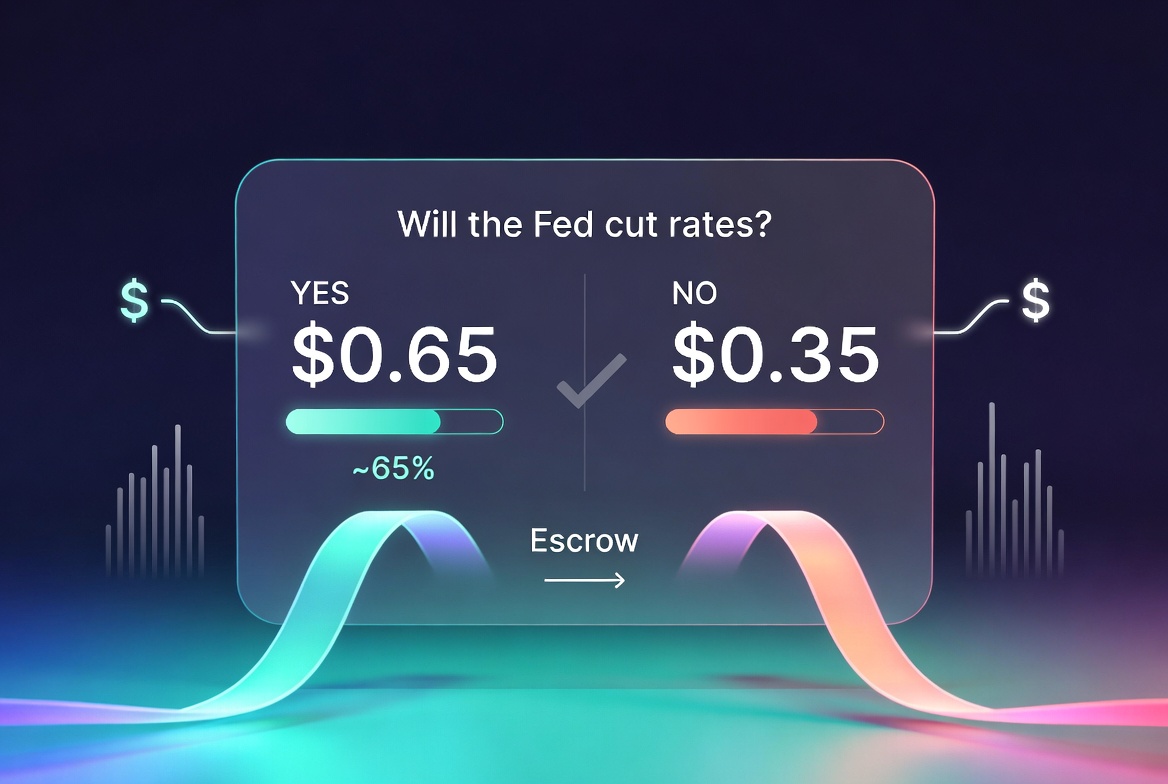
    Here’s a concrete example. Say the question is: “Will the Federal Reserve cut interest rates by June 2026?” The YES contract is trading at $0.65 and the NO contract at $0.35. If you buy 100 YES contracts at $0.65 each, you spend $65. If the Fed does cut rates, you receive $100 (a $35 profit before fees). If it doesn’t, you lose your $65.

    The price reflects what the market collectively believes the probability is. A $0.65 YES contract means traders estimate roughly a 65% chance the event will occur. That price isn’t set by the platform. It’s determined by the buying and selling activity of every trader in that market.

    Legally, these instruments are classified as event contracts under the Commodity Exchange Act. 1CFTC, “Order of Designation: KalshiEX LLC,” cftc.gov, November 2020 On CFTC-regulated platforms like Kalshi, they’re cleared through a regulated clearinghouse. On crypto-native platforms like Polymarket’s global exchange, settlement runs through smart contracts on the Polygon blockchain. 2Polymarket, “How to Sign Up,” docs.polymarket.com, March 2026 The structure looks similar from the outside, but the regulatory and counterparty frameworks behind each contract are fundamentally different.

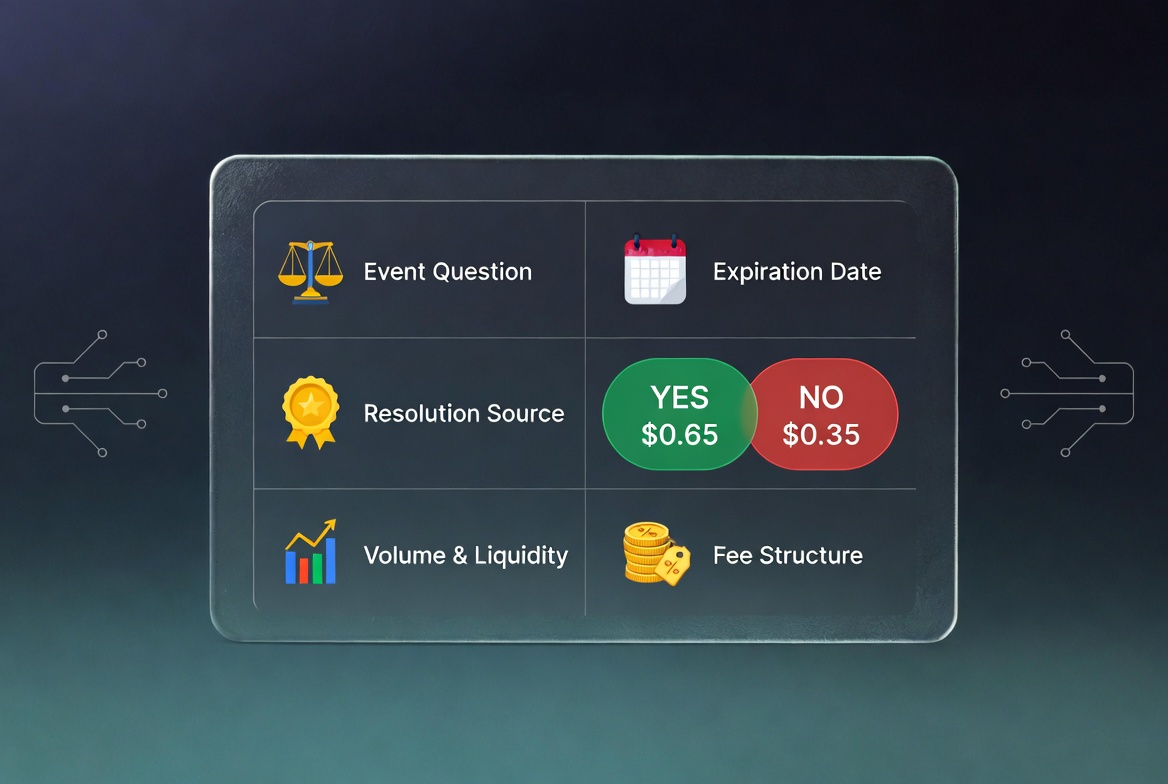
    Anatomy of a Contract: The Six Fields That Matter

    Every prediction market contract has six components. Understanding them takes two minutes. Ignoring them can cost you money.

    1. The Event Question

    This defines exactly what you’re trading. A well-written question is specific and binary: “Will the BLS report U.S. CPI above 3.0% for March 2026?” A poorly written question leaves room for interpretation: “Will inflation be high this year?” The quality of this question determines whether resolution will be clean or contested.

    2. Expiration Date

    This is when the contract stops trading and enters resolution. Some contracts expire within hours (Kalshi’s Flash Markets on the S&P 500). Others run for months (presidential election contracts). As expiration approaches, contracts near certainty compress toward $1.00 or $0.00, while contracts near $0.50 can experience sharp volatility. If you’ve traded options, think of this as a simplified version of theta decay.

    3. Resolution SourceThis is the most important field most beginners overlook. The resolution source is the specific data provider or authority the platform uses to determine the outcome. Kalshi uses the Associated Press for election results, ESPN for sports outcomes, government agencies like the Bureau of Labor Statistics for economic data, and CF Benchmarks for crypto markets. 3Kalshi, “Platform Features & UX,” kalshi.com, March 2026 Polymarket’s global platform uses the UMA Optimistic Oracle, a decentralized system where outcomes are proposed and can be disputed within a set window. 4Polymarket, “Trading Fees,” docs.polymarket.com, March 2026 FanDuel Predicts relies on CME Group’s determination based on third-party reported event results. 5CME Group and FanDuel, “FanDuel Predicts Launch,” cmegroup.com, December 2025

    Platforms invest significant effort in resolution criteria design. The resolution source is the single most important field on any contract. Ambiguous criteria create disputes and erode trust. Before buying any contract, look for questions that cite specific, verifiable data sources: “Will the BLS report CPI above 3.0% for March 2026?” is a well-designed contract. “Will inflation be high this year?” is not. The difference between these two questions is the difference between a tradable instrument and a coin flip with extra steps.

    Ben L.

    4. Current Price (YES and NO)

    The YES and NO prices should roughly sum to $1.00 (the small gap is the spread, which represents the market’s friction cost). If YES is $0.65, NO should be near $0.35. A wide gap between the two (say, YES at $0.65 and NO at $0.40) signals thin liquidity. You’re paying more in that spread than you might realize. For a deeper breakdown of how prices translate to probability, see how prediction market odds work.

    5. Volume and Liquidity

    Volume tells you how many contracts have traded. Higher volume means tighter spreads and easier execution. On Kalshi, major political and economic markets show spreads of 2 to 5 cents. 6Kalshi, “Liquidity Assessment,” InsidePredictions Platform Intelligence, March 2026 Lower-volume markets on any platform can have spreads of 10 cents or more, which directly eats into your potential profit.

    6. Fee Structure

    Fees vary dramatically between platforms. Kalshi charges a variable fee based on expected earnings (capped at roughly $0.02 per contract for takers). 7Kalshi, “Fee Schedule,” kalshi.com, February 2026 Polymarket’s global exchange uses a dynamic taker fee that varies by probability: fees peak near $0.50 contracts and decrease toward the extremes, with some categories (geopolitics, world events) remaining fee-free. 8Polymarket, “Trading Fees,” docs.polymarket.com, March 2026; Parameter.io, “Polymarket Introduces New Trading Fees,” March 25, 2026 FanDuel Predicts charges $0.01 per contract per side (CME exchange fee) plus a 2% fee on your potential payout. 9CME Group, “Event Contracts Fee Schedule,” cmegroup.com, February 2026; bonus.com, “FanDuel Predicts Review,” February 2026 On a 100-contract trade at $0.65, Kalshi costs approximately $1.60 in taker fees. Polymarket’s US exchange charges $0.20 (0.30% of $65 premium); global platform fees vary by market category and probability. FanDuel Predicts costs $1.00 (CME) plus $2.00 (2% of $100 payout) for $3.00 total.

    Expert Tip

    The resolution source is your contract’s source of truth. If you can’t find the resolution source on a contract’s detail page, or if the source is vague, skip that contract. Ambiguous resolution criteria are the number one cause of disputed outcomes and delayed payouts.

    How the Same Event Looks on Three Different Platforms

    The same question, “Will the Fed cut rates?”, produces a different contract on each platform. The underlying event is identical. Everything else changes.

    FeatureKalshi
    Polymarket (Global)

    FanDuel Predicts

    Regulatory Framework

    CFTC-regulated DCM

    Crypto-native (Polygon blockchain)

    CFTC-regulated via CME Group

    Resolution

    Third-party data (BLS, AP, ESPN)

    UMA Optimistic Oracle (decentralized)

    CME Group determination

    Fee Model

    Variable (~$0.02/contract max)

    Dynamic taker fee (varies by probability and category)

    $0.01/side + 2% of payout

    Order Types

    Market, Limit, Combos

    Market, Limit

    IOC, GTD (limit)

    Min Deposit
    $1
    ~$1 (crypto transfer)

    $10

    Funding

    ACH, debit, crypto, PayPal, Venmo, Apple Pay, Google Pay, Cash App

    USDC on Polygon, Coinbase Pay, MoonPay

    Debit card, ACH only

    Access

    Web + mobile app (US); web (intl)

    Web + mobile (global); invite app (US)

    Mobile app only (all 50 states)

    Max Order

    No published cap


    No position limits (global)
    250 contracts per order

    The differences matter most in three areas. 10Kalshi, “Fee Schedule,” kalshi.com, February 2026; Polymarket, “Trading Fees,” docs.polymarket.com, March 2026; FanDuel, “Risk Disclosures,” fanduel.com, December 2025 First, regulation: Kalshi and FanDuel Predicts offer CFTC clearing protections, meaning your funds are held by a regulated entity. Polymarket’s global platform settles through smart contracts, which removes intermediary risk but introduces smart contract risk.

    Second, fees: a 100-contract trade on an identical event costs roughly $1.60 on Kalshi, varies on Polymarket depending on market category and probability (the US exchange charges $0.20 on this trade), and $3.00 on FanDuel Predicts. Over dozens of trades, these differences compound. Polymarket’s fee structure is dynamic and evolving: check the fee status of any specific market before trading.

    Third, resolution speed: Kalshi resolves contracts within hours using official data sources. 11Kalshi, “Withdrawal Methods,” help.kalshi.com, March 2026 Polymarket’s UMA Oracle includes a dispute window that can extend resolution. FanDuel Predicts relies on CME’s timeline, with pending payouts taking 1 to 2 business days before becoming withdrawable.

    What Happens After You Buy (and Before the Event Resolves)

    Once you own a contract, you have three options: hold to resolution, sell early for a profit, or sell early to cut your losses. This flexibility is what separates prediction markets from a traditional bet, where you’re locked in until the outcome.

    Back to our running example. You bought 100 YES contracts at $0.65 on “Will the Fed cut rates by June 2026?” Three days later, an inflation report comes in lower than expected. The market reprices: YES jumps to $0.82. You now have an unrealized profit of $17 (100 contracts × $0.17 price increase).

    You can sell at $0.82, lock in that $17 profit (minus fees), and free your capital for other trades. Or you can hold, hoping the contract resolves YES at $1.00 for a $35 total profit, but accepting the risk that new data could push the price back down before expiration.

    The first time I bought a YES contract at $0.65 and watched it climb to $0.82 over three days, my instinct was to hold for the full $1.00 payout. But that meant locking capital for another six weeks until resolution. I sold at $0.82, pocketed a 26% return in three days, and redeployed the funds into two other positions. You don’t have to hold until the final whistle. The ability to sell early is what separates prediction markets from a straight bet.

    Robert C.

    As expiration approaches, contract prices tend to move toward extremes. A contract trading at $0.82 with two months left has room to swing. That same contract at $0.82 with two hours left is pricing near-certainty. This compression is similar to time decay in options trading: uncertainty decreases as the clock runs out, and the contract’s price reflects that decreasing uncertainty.

    Pro Tip

    If you’ve captured 70% or more of a contract’s potential profit and resolution is weeks away, selling early and redeploying capital often generates better returns than waiting. The last 20 to 30 cents of potential profit carry the most time risk.

    Before You Trade: The 5-Point Contract Checklist

    Run these five checks before buying any prediction market contract. They take under a minute and can save you from the most common beginner mistakes.

    1. Is the resolution source specific and verifiable?

    Look for contracts that cite named data providers: “per the BLS,” “per the Associated Press,” “per ESPN.” Avoid contracts with vague or subjective resolution criteria. If you can’t find the resolution source on the contract’s detail page, that’s a red flag.

    2. When does the contract expire?

    Check whether the timeline fits your trading plan. A contract that expires in six months locks your capital for six months (unless you sell early). Short-duration contracts (daily, weekly) free capital faster but require more active monitoring.

    3. What’s the spread?

    Add the YES price and the NO price. If they sum close to $1.00 (say, $0.65 YES + $0.36 NO = $1.01), the market is liquid. If the sum is $1.05 or higher, the spread is wide and you’re paying a hidden cost to enter. On Kalshi, major markets show spreads of 2 to 5 cents. Thinner markets on any platform can run 10 cents or more. For a complete breakdown of how spreads and order books and liquidity affect your trades, see our dedicated guide.

    4. What fees will you pay?

    Calculate fees before you trade, not after. On a 100-contract position at $0.50, Kalshi charges roughly $1.75 in taker fees. Polymarket’s fee depends on the market category and probability (check the trade confirmation screen for the exact amount). FanDuel Predicts charges $1.00 (CME) plus $2.00 (2% of $100 payout). 12Kalshi, “Fee Schedule,” kalshi.com, February 2026; Polymarket, “Trading Fees,” docs.polymarket.com, March 2026; CME Group, “Event Contracts Fee Schedule,” cmegroup.com, February 2026 Fees matter more on small positions and high-probability contracts.

    5. Does the platform’s regulatory framework fit your needs?

    Kalshi and FanDuel Predicts offer CFTC-regulated clearing. Polymarket’s global platform is crypto-native with on-chain settlement. If you prioritize regulatory protection, choose a CFTC-regulated platform. If you prioritize deep liquidity and global access, Polymarket may fit better. For UK and EU traders, platforms like Betfair Exchange and Smarkets offer exchange-style trading under their own regulatory frameworks. Check your jurisdiction’s current legal status before depositing funds.

    Warning

    Thin liquidity kills more beginner trades than bad predictions. If a contract shows fewer than 100 contracts traded in the last 24 hours and a spread wider than 8 cents, your execution price will likely be worse than the displayed price. Start with high-volume markets until you understand how order books work.

    Placing Your First Trade with Confidence

    A prediction market contract is a bounded-risk position on a real-world event. It pays $1.00 if you’re right and $0.00 if you’re wrong. The price you pay reflects the market’s probability estimate, and you can sell your position anytime before the event resolves.

    The six fields covered here (event question, expiration, resolution source, price, volume, and fees) are everything you need to evaluate before placing a trade. Run the 5-point checklist on your first few contracts until it becomes automatic.If you’re ready to place your first trade, start with a high-volume market on a platform that fits your situation. Kalshi and FanDuel Predicts offer CFTC-regulated protections for US traders. Polymarket offers the deepest global liquidity. Our platform reviews cover the full details for each. For more on how prediction markets settle after you’ve placed a trade, see our resolution guide.

    Sources & References

    • 1
      CFTC, “Order of Designation: KalshiEX LLC,” cftc.gov, November 2020
    • 2
      Polymarket, “How to Sign Up,” docs.polymarket.com, March 2026
    • 3
      Kalshi, “Platform Features & UX,” kalshi.com, March 2026
    • 4
      Polymarket, “Trading Fees,” docs.polymarket.com, March 2026
    • 5
      CME Group and FanDuel, “FanDuel Predicts Launch,” cmegroup.com, December 2025
    • 6
      Kalshi, “Liquidity Assessment,” InsidePredictions Platform Intelligence, March 2026
    • 7
      Kalshi, “Fee Schedule,” kalshi.com, February 2026
    • 8
      Polymarket, “Trading Fees,” docs.polymarket.com, March 2026; Parameter.io, “Polymarket Introduces New Trading Fees,” March 25, 2026
    • 9
      CME Group, “Event Contracts Fee Schedule,” cmegroup.com, February 2026; bonus.com, “FanDuel Predicts Review,” February 2026
    • 10
      Kalshi, “Fee Schedule,” kalshi.com, February 2026; Polymarket, “Trading Fees,” docs.polymarket.com, March 2026; FanDuel, “Risk Disclosures,” fanduel.com, December 2025
    • 11
      Kalshi, “Withdrawal Methods,” help.kalshi.com, March 2026
    • 12
      Kalshi, “Fee Schedule,” kalshi.com, February 2026; Polymarket, “Trading Fees,” docs.polymarket.com, March 2026; CME Group, “Event Contracts Fee Schedule,” cmegroup.com, February 2026
  • How Prediction Markets Actually Work: A Complete Guide to Buying and Selling Event Contracts

    How Prediction Markets Actually Work: A Complete Guide to Buying and Selling Event Contracts

    Prediction markets let you buy a contract on any future event for less than a dollar and collect a dollar if you are right. That single mechanic powers a $44-billion-per-year industry that correctly called the 2024 presidential election when polls could not.

    Understanding how prediction markets work starts with one concept: a contract priced at $0.65 means the market collectively estimates a 65% chance that event happens. If you buy that contract and the event occurs, you collect $1.00. If it does not, you lose your $0.65. Every trade on every platform, from Kalshi to Polymarket, runs on that principle.

    This guide walks you through the complete lifecycle of a prediction market contract, from listing to resolution, using a single running example with real dollar amounts. You will see exactly how prices form, what happens to your money at each stage, why you can sell before an event resolves, and how platforms decide which markets to offer.

    Risk Warning:

    Prediction markets involve financial risk. Only trade with money you can afford to lose. Past performance does not guarantee future results. Check your local regulations before trading on any prediction market platform.

    What Is a Prediction Market?

    A prediction market is an exchange where you buy and sell contracts tied to the outcomes of real-world events. Each contract is a simple binary question with a YES or NO answer, and its price reflects the crowd’s estimate of how likely that outcome is.

    Here is the example we will carry through this entire guide. On a platform like Kalshi, you see the contract: “Will the Federal Reserve cut interest rates in June 2026?” The YES contract is currently priced at $0.65. That price tells you the market collectively believes there is a 65% chance the Fed cuts rates. The NO contract, by definition, is priced at $0.35 (because YES + NO always equals $1.00, minus a small spread for fees).

    If you believe the probability is higher than 65%, you buy YES contracts. If you think the Fed will hold steady, you buy NO contracts at $0.35. When the Fed announces its decision, the contract resolves: YES pays $1.00, NO pays $0.00 (or vice versa). The difference between your purchase price and the $1.00 payout is your profit.

    The concept is not new. The Iowa Electronic Markets at the University of Iowa launched in 1988, making it one of the first modern electronic prediction markets.1University of Iowa, “Iowa Electronic Markets,” tippie.uiowa.edu/iem, March 2026 In 2020, Kalshi received CFTC approval as a designated contract market, the first federally regulated exchange dedicated exclusively to event contracts.2CFTC, “CFTC Approves KalshiEX LLC as Designated Contract Market,” cftc.gov, November 2020 By 2025, the prediction market industry recorded over $44 billion in total notional trading volume, with monthly active users surpassing 600,000.3Keyrock and Dune Analytics, “Prediction Markets 2025 Report,” via Gambling Insider, February 2026

    The theory behind prediction markets traces back to Friedrich Hayek’s 1945 insight that markets aggregate dispersed information more efficiently than any single individual or committee. When hundreds of thousands of traders put real money behind their beliefs, the resulting price becomes a remarkably accurate probability estimate. A CEPR study analyzing over 300,000 Kalshi contracts found that contract prices broadly reflect actual outcome frequencies, and accuracy improves as events approach.4Burgi, Deng, and Whelan, “Makers and Takers: The Economics of the Kalshi Prediction Market,” CEPR Discussion Paper No. 20631, 2026

    The Lifecycle of a Prediction Market Contract

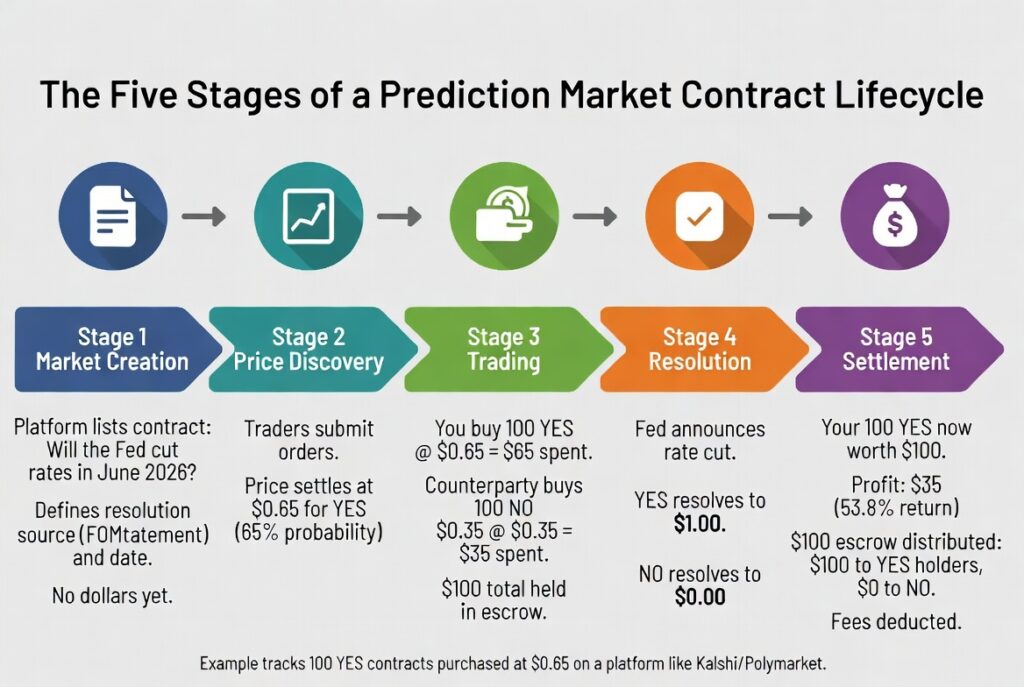
    Five stages diagram of a prediction market contract lifecycle

    Every prediction market contract follows the same five stages: creation, price discovery, trading, resolution, and settlement. Here is what that looks like with our Fed rate cut example, tracked dollar by dollar.

    Stage 1: Market Creation. The platform lists the contract: “Will the Federal Reserve cut interest rates in June 2026?” It defines a clear resolution source (the official FOMC statement), a resolution date (after the June 2026 meeting), and the binary outcomes (YES or NO).

    Stage 2: Price Discovery. Traders begin submitting orders. Early buyers and sellers establish the initial price. On Kalshi, this happens through an order book where buyers post bid prices and sellers post ask prices, similar to a stock exchange. Polymarket uses a hybrid model combining automated market makers with order books. The price settles at $0.65 for YES, meaning the collective market estimates a 65% probability.

    Stage 3: Trading. You decide the market is underpricing the likelihood of a rate cut. You buy 100 YES contracts at $0.65 each, spending $65.00 total. That $65.00 moves from your account balance into your open position. Meanwhile, someone on the other side buys 100 NO contracts at $0.35 each, spending $35.00. Combined, that is $100.00 held in escrow (100 contracts multiplied by $1.00 each), guaranteeing that the winning side gets paid.

    Stage 4: Resolution. The Fed announces a 25 basis point rate cut. The platform’s resolution process confirms the outcome against the official FOMC statement. The YES contract resolves to $1.00. The NO contract resolves to $0.00.

    Stage 5: Settlement. Your 100 YES contracts are now worth $100.00. You paid $65.00, so your profit is $35.00 (a 53.8% return on your investment). The $100.00 in escrow is distributed: $100.00 to you, $0.00 to the NO holders. Platform fees (which vary by provider) are deducted from your proceeds.

    When I bought YES on a political contract at $0.45, the market was pricing the event at 45% likely. Within two weeks, news broke that shifted the odds, and the contract moved to $0.78. I sold for a 73% return without waiting for resolution. That is the core mechanic: you are trading probability, not waiting for outcomes.

    Robert C.

    How Prices Form (and Why This Is Not Sports Betting)

    Prediction market prices are not set by a bookmaker. They form through buyer-seller matching on an exchange, exactly the way stock prices form on the NYSE or Nasdaq. When you buy YES at $0.65 on our Fed rate cut contract, a seller on the opposite side is simultaneously selling YES at $0.65 (or equivalently, buying NO at $0.35). The platform facilitates the match and earns a transaction fee. It has no stake in the outcome.

    This is a fundamental structural difference from sports betting. At DraftKings or FanDuel, the sportsbook sets the odds, takes the other side of your bet, and profits when you lose. The house has a direct financial interest in outcomes. Prediction market platforms are neutral exchanges that earn revenue from fees regardless of which side wins.5Kalshi, “Kalshi Fee Schedule,” kalshi.com, effective February 5, 2026

    How It Compares: Prediction Markets vs. Sports Betting vs. Stock Trading

    FeaturePrediction MarketsSports BettingStock Trading
    Price FormationOrder book matching between buyers and sellersBookmaker sets the lineExchange-based order book
    CounterpartyAnother traderThe sportsbook (the house)Another investor
    Settlement$1.00 or $0.00 per contractFixed odds payoutDividends, appreciation, sale
    Can You Exit Early?Yes, sell anytime before resolutionRarely (limited cash-out options)Yes, sell shares anytime
    Platform Profits FromTransaction fees
    Your losses (house edge)

    Commissions, payment for order flow

    Penalized for Winning?

    No

    Yes (accounts may be limited or banned)
    No

    Expert Tip:

    Because prediction markets are neutral exchanges, you will never be throttled or banned for being too profitable. In sports betting, winning consistently gets your account limited. In prediction markets, consistent winners improve price accuracy and are good for the marketplace.

    The practical result of this structure: prediction market prices tend to be more accurate probability estimates than polling data or expert forecasts. A 2025 industry analysis found average Brier scores (a standard accuracy measure where lower is better) near 0.09 across major platforms, indicating high calibration between predicted probabilities and actual outcomes.6Keyrock and Dune Analytics, “Prediction Markets 2025 Report,” via Gambling Insider, February 2026

    You Do Not Have to Wait: Selling Before Resolution

    The most common misconception about prediction markets: that you buy a contract and sit on it until the event happens. In reality, you can sell your position at any time the market is open, exactly the way you sell a stock.

    Return to our running example. You bought 100 YES contracts on the Fed rate cut at $0.65 each ($65.00 total). Two weeks later, a weak jobs report hits and the market now prices the rate cut at 82% likely. Your YES contracts are trading at $0.82.

    You have two choices. First, you can hold to resolution and collect $100.00 if the Fed cuts (a $35.00 profit, or 53.8% return). But you wait months with your $65.00 locked up. Second, you can sell now at $0.82 each and collect $82.00 (a $17.00 profit, or 26.2% return). You free your capital in minutes and can redeploy it into other positions.

    Warning:

    Selling before resolution means you can also lock in losses. If your $0.65 YES contracts drop to $0.40 on bad news, selling means accepting a $0.25 per contract loss ($25.00 on 100 contracts). The alternative is holding and hoping the event still occurs, but that carries the risk of a total loss. Know your risk tolerance before entering any position.

    This ability to exit early is the single biggest structural advantage prediction markets have over traditional sports betting. Once you place a bet at a sportsbook, your money is locked until the game ends. On a prediction market, you are trading a liquid position that you control. The decision to hold, sell for profit, or sell at a loss to cut exposure is entirely yours.

    I held a YES position on a Polymarket contract I bought at $0.38. After a few weeks, new polling data pushed the price to $0.71. So, I took the 87% return, freed up the capital, and redeployed. The contract eventually resolved YES, which means I left $0.29 per share on the table. But I had already redeployed that capital into two other positions. You do not maximize individual trades. You maximize total capital return across your portfolio.

    Robert C.

    How Platforms Decide Which Markets to List

    Not every question becomes a prediction market. Platforms curate their market offerings based on regulatory requirements, resolution clarity, and expected trader interest. Understanding this process helps you evaluate the quality of the markets you trade on.

    On Kalshi, every market must be self-certified with the CFTC before it goes live.7CFTC, “CFTC Approves KalshiEX LLC as Designated Contract Market,” cftc.gov, November 2020 That process involves legal review, compliance documentation, and defining a verifiable resolution source (such as an official government report or a recognized data provider). It is expensive and time-consuming, which is why Kalshi’s market catalog, while spanning over 10,000 active markets across nine categories, still covers fewer event types than less-regulated competitors.8Kalshi, “Kalshi Public API,” kalshi.com, verified March 2026

    Polymarket’s global platform takes a different approach. Markets can be proposed by the community, and resolution relies on the UMA Optimistic Oracle, a decentralized system where outcomes are verified on-chain.9Polymarket, “Resolution Sources,” docs.polymarket.com, March 2026 This allows Polymarket to list markets on nearly any topic that generates interest, from presidential elections to whether a specific celebrity will tweet on a given day. The tradeoff: faster market creation, but without the legal protections of CFTC oversight.

    Three factors determine whether a market is worth trading on. First, resolution criteria: is the outcome clearly defined and verifiable? A contract that resolves based on an official FOMC statement is more reliable than one that depends on a subjective judgment. Second, liquidity: are enough people trading to let you enter and exit at fair prices? Low-liquidity markets have wide spreads that eat into your returns. Third, time horizon: longer-dated contracts lock your capital for extended periods, which has an opportunity cost even if you end up right.

    From an operator perspective, every market on a regulated platform like Kalshi lists has to be self-certified with the CFTC. That process involves legal review, compliance documentation, and regulator scrutiny. It is expensive and time-consuming, which is exactly why Kalshi has fewer markets than Polymarket. Polymarket’s global platform does not face that bottleneck, so they can spin up markets on almost anything that generates interest. The tradeoff is clear: regulatory certainty means slower market creation, but stronger legal protections for traders. It is the same dynamic I saw in casino operations: heavily regulated venues offer fewer games but better consumer protections. Offshore operators offer everything, but you are on your own if something goes wrong.

    Ben L.

    Start Trading on Prediction Markets

    Prediction markets give you a way to trade your knowledge of real-world events through a simple mechanic: buy a contract below $1.00, collect $1.00 if you are right. The exchange-based structure means no bookmaker is working against you, and the ability to sell before resolution gives you control that traditional betting never has.

    If you already understand odds, probability, and risk from sports betting, stock trading, or poker, you have the foundation to trade prediction markets effectively. The learning curve is about platform mechanics and market evaluation, not the underlying concepts.For US traders who prioritize regulatory certainty, Kalshi is the only CFTC-regulated prediction market exchange. For traders comfortable with crypto wallets who want maximum market variety, Polymarket offers the deepest liquidity across the widest range of event types.

    Pro Tip: Evaluating Market Quality Before You Trade

    Before entering any prediction market position, check three things: (1) Read the resolution criteria carefully. Ambiguous resolution language is the number one source of disputes. (2) Check the order book depth. If only a few hundred dollars are on each side, you may not be able to exit at a fair price. (3) Confirm the resolution source. Markets tied to official government data, verified sports results, or auditable on-chain data are more reliable than markets resolved by a single entity’s judgment.

    Sources & References

    • 1
      University of Iowa, “Iowa Electronic Markets,” tippie.uiowa.edu/iem, March 2026
    • 2
      CFTC, “CFTC Approves KalshiEX LLC as Designated Contract Market,” cftc.gov, November 2020
    • 3
      Keyrock and Dune Analytics, “Prediction Markets 2025 Report,” via Gambling Insider, February 2026
    • 4
      Burgi, Deng, and Whelan, “Makers and Takers: The Economics of the Kalshi Prediction Market,” CEPR Discussion Paper No. 20631, 2026
    • 5
      Kalshi, “Kalshi Fee Schedule,” kalshi.com, effective February 5, 2026
    • 6
      Keyrock and Dune Analytics, “Prediction Markets 2025 Report,” via Gambling Insider, February 2026
    • 7
      CFTC, “CFTC Approves KalshiEX LLC as Designated Contract Market,” cftc.gov, November 2020
    • 8
      Kalshi, “Kalshi Public API,” kalshi.com, verified March 2026
    • 9
      Polymarket, “Resolution Sources,” docs.polymarket.com, March 2026