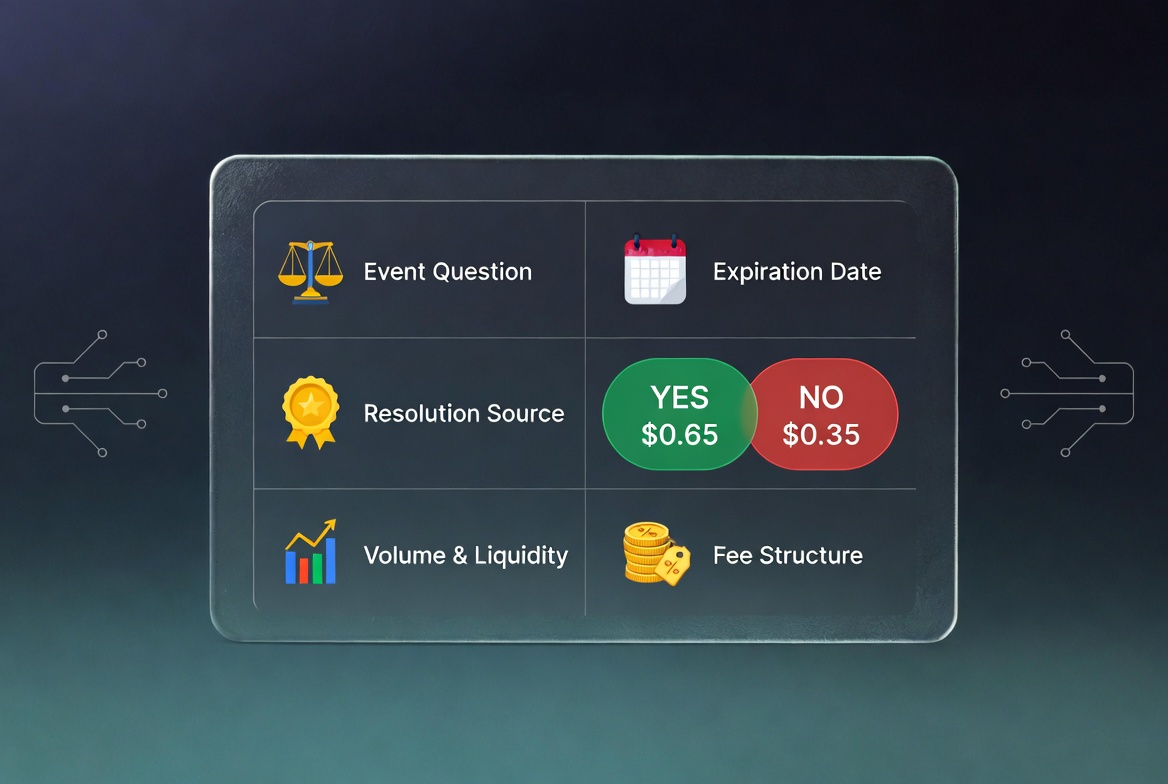
A prediction market contract is the simplest financial instrument you’ve never been taught. You pick a real-world event, choose YES or NO, and pay somewhere between $0.01 and $0.99 for that position. If you’re right, the contract pays $1.00. If you’re wrong, it pays $0.00. That’s the entire instrument.
But “simple” doesn’t mean there’s nothing to learn. Every contract has components that determine whether you’re making a smart trade or a blind guess: the event question, the expiration date, the resolution source, the current price, trading volume, and fees. Knowing what each piece does (and what to check before you buy) is what separates informed traders from everyone else.
This guide breaks down the anatomy of a prediction market contract field by field, compares how the same event is structured across Kalshi, Polymarket, and FanDuel Predicts, and gives you a 5-point checklist to run before placing any trade. By the end, you’ll understand exactly what you’re buying and how prediction markets work at the contract level.
What Is a Prediction Market Contract?
A prediction market contract is a YES or NO position on a specific real-world event that trades between $0.01 and $0.99 and settles at either $1.00 or $0.00. If the event happens, YES pays $1.00 and NO pays nothing. If it doesn’t, the reverse applies.
Here’s a concrete example. Say the question is: “Will the Federal Reserve cut interest rates by June 2026?” The YES contract is trading at $0.65 and the NO contract at $0.35. If you buy 100 YES contracts at $0.65 each, you spend $65. If the Fed does cut rates, you receive $100 (a $35 profit before fees). If it doesn’t, you lose your $65.
The price reflects what the market collectively believes the probability is. A $0.65 YES contract means traders estimate roughly a 65% chance the event will occur. That price isn’t set by the platform. It’s determined by the buying and selling activity of every trader in that market.
Legally, these instruments are classified as event contracts under the Commodity Exchange Act. 1CFTC, “Order of Designation: KalshiEX LLC,” cftc.gov, November 2020 On CFTC-regulated platforms like Kalshi, they’re cleared through a regulated clearinghouse. On crypto-native platforms like Polymarket’s global exchange, settlement runs through smart contracts on the Polygon blockchain. 2Polymarket, “How to Sign Up,” docs.polymarket.com, March 2026 The structure looks similar from the outside, but the regulatory and counterparty frameworks behind each contract are fundamentally different.
Anatomy of a Contract: The Six Fields That Matter
Every prediction market contract has six components. Understanding them takes two minutes. Ignoring them can cost you money.
1. The Event Question
This defines exactly what you’re trading. A well-written question is specific and binary: “Will the BLS report U.S. CPI above 3.0% for March 2026?” A poorly written question leaves room for interpretation: “Will inflation be high this year?” The quality of this question determines whether resolution will be clean or contested.
2. Expiration Date
This is when the contract stops trading and enters resolution. Some contracts expire within hours (Kalshi’s Flash Markets on the S&P 500). Others run for months (presidential election contracts). As expiration approaches, contracts near certainty compress toward $1.00 or $0.00, while contracts near $0.50 can experience sharp volatility. If you’ve traded options, think of this as a simplified version of theta decay.
3. Resolution SourceThis is the most important field most beginners overlook. The resolution source is the specific data provider or authority the platform uses to determine the outcome. Kalshi uses the Associated Press for election results, ESPN for sports outcomes, government agencies like the Bureau of Labor Statistics for economic data, and CF Benchmarks for crypto markets. 3Kalshi, “Platform Features & UX,” kalshi.com, March 2026 Polymarket’s global platform uses the UMA Optimistic Oracle, a decentralized system where outcomes are proposed and can be disputed within a set window. 4Polymarket, “Trading Fees,” docs.polymarket.com, March 2026 FanDuel Predicts relies on CME Group’s determination based on third-party reported event results. 5CME Group and FanDuel, “FanDuel Predicts Launch,” cmegroup.com, December 2025
4. Current Price (YES and NO)
The YES and NO prices should roughly sum to $1.00 (the small gap is the spread, which represents the market’s friction cost). If YES is $0.65, NO should be near $0.35. A wide gap between the two (say, YES at $0.65 and NO at $0.40) signals thin liquidity. You’re paying more in that spread than you might realize. For a deeper breakdown of how prices translate to probability, see how prediction market odds work.
5. Volume and Liquidity
Volume tells you how many contracts have traded. Higher volume means tighter spreads and easier execution. On Kalshi, major political and economic markets show spreads of 2 to 5 cents. 6Kalshi, “Liquidity Assessment,” InsidePredictions Platform Intelligence, March 2026 Lower-volume markets on any platform can have spreads of 10 cents or more, which directly eats into your potential profit.
6. Fee Structure
Fees vary dramatically between platforms. Kalshi charges a variable fee based on expected earnings (capped at roughly $0.02 per contract for takers). 7Kalshi, “Fee Schedule,” kalshi.com, February 2026 Polymarket’s global exchange uses a dynamic taker fee that varies by probability: fees peak near $0.50 contracts and decrease toward the extremes, with some categories (geopolitics, world events) remaining fee-free. 8Polymarket, “Trading Fees,” docs.polymarket.com, March 2026; Parameter.io, “Polymarket Introduces New Trading Fees,” March 25, 2026 FanDuel Predicts charges $0.01 per contract per side (CME exchange fee) plus a 2% fee on your potential payout. 9CME Group, “Event Contracts Fee Schedule,” cmegroup.com, February 2026; bonus.com, “FanDuel Predicts Review,” February 2026 On a 100-contract trade at $0.65, Kalshi costs approximately $1.60 in taker fees. Polymarket’s US exchange charges $0.20 (0.30% of $65 premium); global platform fees vary by market category and probability. FanDuel Predicts costs $1.00 (CME) plus $2.00 (2% of $100 payout) for $3.00 total.
Expert Tip
The resolution source is your contract’s source of truth. If you can’t find the resolution source on a contract’s detail page, or if the source is vague, skip that contract. Ambiguous resolution criteria are the number one cause of disputed outcomes and delayed payouts.
How the Same Event Looks on Three Different Platforms
The same question, “Will the Fed cut rates?”, produces a different contract on each platform. The underlying event is identical. Everything else changes.
| Feature | Kalshi | Polymarket (Global) | FanDuel Predicts |
|---|---|---|---|
Regulatory Framework | CFTC-regulated DCM | Crypto-native (Polygon blockchain) | CFTC-regulated via CME Group |
Resolution | Third-party data (BLS, AP, ESPN) | UMA Optimistic Oracle (decentralized) | CME Group determination |
Fee Model | Variable (~$0.02/contract max) | Dynamic taker fee (varies by probability and category) | $0.01/side + 2% of payout |
Order Types | Market, Limit, Combos | Market, Limit | IOC, GTD (limit) |
Min Deposit | $1 | ~$1 (crypto transfer) | $10 |
Funding | ACH, debit, crypto, PayPal, Venmo, Apple Pay, Google Pay, Cash App | USDC on Polygon, Coinbase Pay, MoonPay | Debit card, ACH only |
Access | Web + mobile app (US); web (intl) | Web + mobile (global); invite app (US) | Mobile app only (all 50 states) |
Max Order | No published cap | No position limits (global) | 250 contracts per order |
The differences matter most in three areas. 10Kalshi, “Fee Schedule,” kalshi.com, February 2026; Polymarket, “Trading Fees,” docs.polymarket.com, March 2026; FanDuel, “Risk Disclosures,” fanduel.com, December 2025 First, regulation: Kalshi and FanDuel Predicts offer CFTC clearing protections, meaning your funds are held by a regulated entity. Polymarket’s global platform settles through smart contracts, which removes intermediary risk but introduces smart contract risk.
Second, fees: a 100-contract trade on an identical event costs roughly $1.60 on Kalshi, varies on Polymarket depending on market category and probability (the US exchange charges $0.20 on this trade), and $3.00 on FanDuel Predicts. Over dozens of trades, these differences compound. Polymarket’s fee structure is dynamic and evolving: check the fee status of any specific market before trading.
Third, resolution speed: Kalshi resolves contracts within hours using official data sources. 11Kalshi, “Withdrawal Methods,” help.kalshi.com, March 2026 Polymarket’s UMA Oracle includes a dispute window that can extend resolution. FanDuel Predicts relies on CME’s timeline, with pending payouts taking 1 to 2 business days before becoming withdrawable.
What Happens After You Buy (and Before the Event Resolves)
Once you own a contract, you have three options: hold to resolution, sell early for a profit, or sell early to cut your losses. This flexibility is what separates prediction markets from a traditional bet, where you’re locked in until the outcome.
Back to our running example. You bought 100 YES contracts at $0.65 on “Will the Fed cut rates by June 2026?” Three days later, an inflation report comes in lower than expected. The market reprices: YES jumps to $0.82. You now have an unrealized profit of $17 (100 contracts × $0.17 price increase).
You can sell at $0.82, lock in that $17 profit (minus fees), and free your capital for other trades. Or you can hold, hoping the contract resolves YES at $1.00 for a $35 total profit, but accepting the risk that new data could push the price back down before expiration.
As expiration approaches, contract prices tend to move toward extremes. A contract trading at $0.82 with two months left has room to swing. That same contract at $0.82 with two hours left is pricing near-certainty. This compression is similar to time decay in options trading: uncertainty decreases as the clock runs out, and the contract’s price reflects that decreasing uncertainty.
Pro Tip
If you’ve captured 70% or more of a contract’s potential profit and resolution is weeks away, selling early and redeploying capital often generates better returns than waiting. The last 20 to 30 cents of potential profit carry the most time risk.
Before You Trade: The 5-Point Contract Checklist
Run these five checks before buying any prediction market contract. They take under a minute and can save you from the most common beginner mistakes.
1. Is the resolution source specific and verifiable?
Look for contracts that cite named data providers: “per the BLS,” “per the Associated Press,” “per ESPN.” Avoid contracts with vague or subjective resolution criteria. If you can’t find the resolution source on the contract’s detail page, that’s a red flag.
2. When does the contract expire?
Check whether the timeline fits your trading plan. A contract that expires in six months locks your capital for six months (unless you sell early). Short-duration contracts (daily, weekly) free capital faster but require more active monitoring.
3. What’s the spread?
Add the YES price and the NO price. If they sum close to $1.00 (say, $0.65 YES + $0.36 NO = $1.01), the market is liquid. If the sum is $1.05 or higher, the spread is wide and you’re paying a hidden cost to enter. On Kalshi, major markets show spreads of 2 to 5 cents. Thinner markets on any platform can run 10 cents or more. For a complete breakdown of how spreads and order books and liquidity affect your trades, see our dedicated guide.
4. What fees will you pay?
Calculate fees before you trade, not after. On a 100-contract position at $0.50, Kalshi charges roughly $1.75 in taker fees. Polymarket’s fee depends on the market category and probability (check the trade confirmation screen for the exact amount). FanDuel Predicts charges $1.00 (CME) plus $2.00 (2% of $100 payout). 12Kalshi, “Fee Schedule,” kalshi.com, February 2026; Polymarket, “Trading Fees,” docs.polymarket.com, March 2026; CME Group, “Event Contracts Fee Schedule,” cmegroup.com, February 2026 Fees matter more on small positions and high-probability contracts.
5. Does the platform’s regulatory framework fit your needs?
Kalshi and FanDuel Predicts offer CFTC-regulated clearing. Polymarket’s global platform is crypto-native with on-chain settlement. If you prioritize regulatory protection, choose a CFTC-regulated platform. If you prioritize deep liquidity and global access, Polymarket may fit better. For UK and EU traders, platforms like Betfair Exchange and Smarkets offer exchange-style trading under their own regulatory frameworks. Check your jurisdiction’s current legal status before depositing funds.
Warning
Thin liquidity kills more beginner trades than bad predictions. If a contract shows fewer than 100 contracts traded in the last 24 hours and a spread wider than 8 cents, your execution price will likely be worse than the displayed price. Start with high-volume markets until you understand how order books work.
Placing Your First Trade with Confidence
A prediction market contract is a bounded-risk position on a real-world event. It pays $1.00 if you’re right and $0.00 if you’re wrong. The price you pay reflects the market’s probability estimate, and you can sell your position anytime before the event resolves.
The six fields covered here (event question, expiration, resolution source, price, volume, and fees) are everything you need to evaluate before placing a trade. Run the 5-point checklist on your first few contracts until it becomes automatic.If you’re ready to place your first trade, start with a high-volume market on a platform that fits your situation. Kalshi and FanDuel Predicts offer CFTC-regulated protections for US traders. Polymarket offers the deepest global liquidity. Our platform reviews cover the full details for each. For more on how prediction markets settle after you’ve placed a trade, see our resolution guide.