Your sports betting skills are more valuable than you think in prediction markets. The odds reading, EV calculation, and bankroll discipline you’ve built translate directly to a market that’s still young enough to reward sharp thinking.
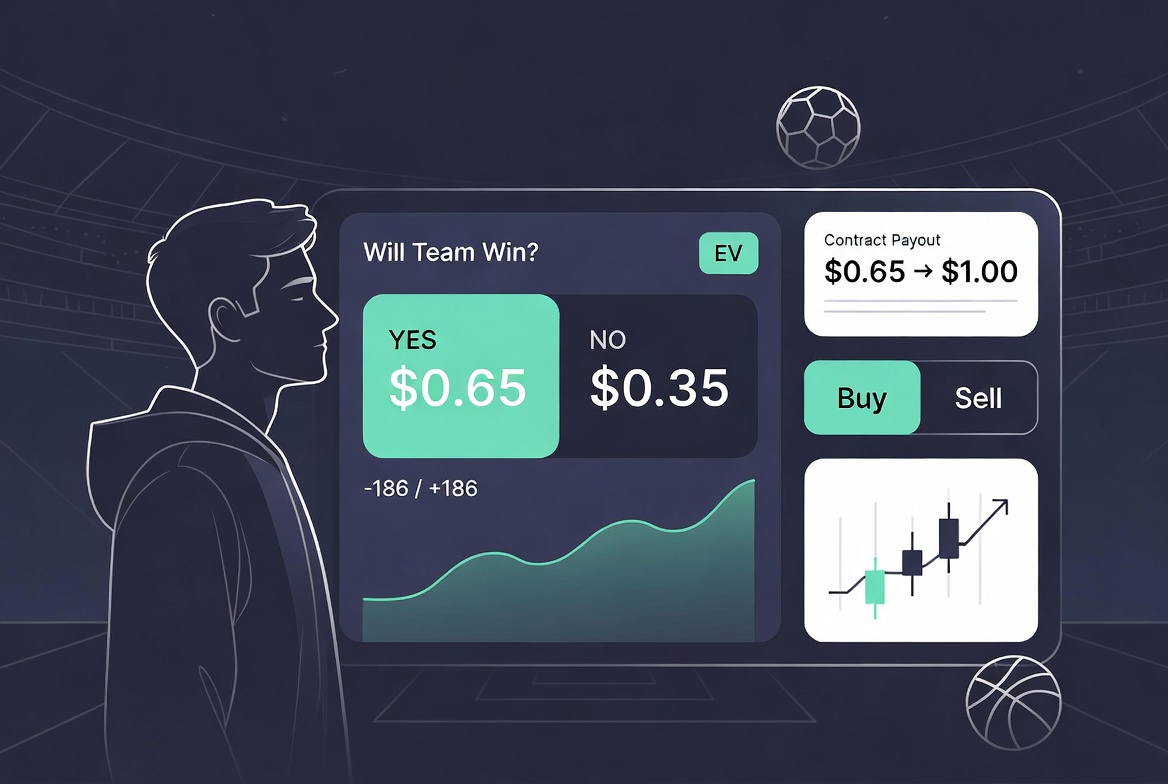
Prediction markets are exchange-based platforms where you buy and sell contracts on the outcomes of real-world events. Instead of betting against a bookmaker’s line, you’re trading against other participants at prices that reflect crowd-sourced probability. A contract priced at $0.65 means the market estimates a 65% chance of that outcome occurring. If you’re right and the event happens, the contract pays $1.00. If not, it pays $0.00.
For sports bettors, the mechanics feel familiar but the structure is fundamentally different. There’s no vig baked into every line. You can sell your position before the event resolves. And nobody limits your account for winning too much.
This guide translates every core sports betting concept into prediction market language, walks you through your first trade using the terminology you already know, and identifies where your analytical edge is strongest.
Prediction markets involve financial risk. Only trade with money you can afford to lose.
What Sports Bettors Need to Know About Prediction Markets
The single biggest difference between sports betting and prediction markets is who you’re trading against. At a sportsbook, you’re betting against the house. The bookmaker sets odds, takes your wager, and profits from the built-in margin (the vig). On a prediction market exchange, you’re trading against other participants. The exchange is just the venue.
This distinction matters more than anything else in this guide. When you place a $100 bet at -110 on DraftKings, the sportsbook is your counterparty. They’ve built roughly 4.5% margin into that line. On a prediction market like Kalshi or Polymarket, your counterparty is another person who disagrees with you. The platform charges a small trading fee, but the price itself is set entirely by supply and demand.
Think of it like the difference between selling your car to a dealership versus listing it on an open marketplace. The dealership builds in their margin. The marketplace just connects buyers and sellers.
This peer-to-peer structure creates three advantages sports bettors notice immediately. First, no vig means your break-even point is lower. Second, the exchange doesn’t care if you win consistently, so nobody limits your account. Third, prices on liquid markets can be tighter than sportsbook lines, because there’s no bookmaker margin to cover.
Prediction market exchanges are federally regulated. Kalshi operates as a CFTC-designated contract market. 1CFTC, “Order of Designation: KalshiEX LLC,” cftc.gov, November 2020 FanDuel Predicts partners with CME Group. 2CME Group, “FanDuel and CME Group Launch FanDuel Predicts,” cmegroup.com, December 2025 Polymarket’s US platform runs through a separate CFTC-regulated entity. 3Polymarket, “CFTC Approval of Amended Order of Designation,” prnewswire.com, November 2025 These aren’t offshore operations. They’re regulated exchanges operating under federal oversight.
For a deeper comparison of prediction markets vs. sports betting, see our dedicated guide. If you’re new to the concept entirely, our guide to how prediction markets work covers the fundamentals.
The Translation Table: Sports Betting Concepts in Prediction Market Language
If you’ve been sports betting for any length of time, you already understand 80% of prediction market mechanics. The concepts are the same. The vocabulary changes.
This table maps every sports betting concept you know to its prediction market equivalent.
Sports Betting Term | Prediction Market Term | What Changes |
|---|---|---|
Moneyline odds (-150, +200) | Contract price ($0.60, $0.33) | Price = implied probability in cents |
Vig / juice | Spread + trading fee | Set by traders, not the house |
Line movement | Price movement | Driven by trader activity, not oddsmaker |
Sharp money / steam moves | Smart money / volume spikes | Visible in order book depth or on-chain |
Closing line value (CLV) | Final price before resolution | Same concept: were you on the right side? |
Bankroll management | Position sizing | Adds capital lockup as a variable |
Parlay | Multi-leg position / Kalshi Combos | Positions can be correlated without formal parlay |
Cash out / early payout | Sell position on exchange | Available anytime at current market price |
The house (bookmaker) | Other traders (peer-to-peer) | Fundamental structural change |
Betting limits / getting limited | Order book liquidity | Exchanges don’t limit winners |
Futures bet | Long-dated contract | PM contracts are liquid throughout |
Props / exotics | Non-sports markets | PM covers politics, economics, culture, weather |
Here’s the translation in action. A sportsbook lists the Kansas City Chiefs to win the Super Bowl at +350. That’s implied probability of 22.2%. On Kalshi, the same outcome is a contract priced at $0.22 (YES) and $0.78 (NO). Same probability, different format.
If you buy 100 YES contracts at $0.22, you spend $22. If the Chiefs win, each contract pays $1.00. Your payout is $100, and your profit is $78 (minus any trading fees). If they lose, your contracts are worth $0.00.
The critical difference: you can sell those contracts at any time before the Super Bowl. If the Chiefs go on a winning streak and the contract price moves to $0.40, you can sell for $40, locking in an $18 profit without waiting for the championship game. At a sportsbook, your futures bet is locked until the season ends.
For the full breakdown of how prediction market odds work, including YES/NO pair pricing and spread mechanics, see our dedicated odds guide.
Pro Tip
Kalshi’s mobile app lets you toggle between contract prices and American odds in your display settings. 4Kalshi, App Store listing and help documentation, kalshi.com, March 2026 If $0.22 contracts feel unfamiliar, switch to the +350 view until the format clicks.
Your First Prediction Market Trade (in Sports Betting Language)
Here’s what your first prediction market trade looks like, narrated in the language you already think in.
Step 1: Pick your market. Open Kalshi or FanDuel Predicts and browse sports markets. You’ll see events listed as questions: “Will the Lakers win tonight?” or “Will the NFL MVP be Josh Allen?” These are your moneylines and futures, repackaged.
Step 2: Read the price. A YES contract at $0.65 means the market gives the outcome a 65% chance. In sportsbook terms, that’s approximately -186. A YES at $0.35 is roughly +186. If you disagree with that probability, you’ve found potential value.
Step 3: Size your position. Decide how many contracts to buy. At $0.65 per contract, 100 contracts costs $65. If the outcome happens, you collect $100 (profit: $35 minus fees). If it doesn’t, you lose your $65. Same risk/reward calculation you’d make sizing a sportsbook bet.
Step 4: Place the order. On Kalshi, you can place a market order (filled immediately at best available price) or a limit order (you set your price and wait for a match). Limit orders are like getting a better line: you name your price and wait for someone to take the other side.
Step 5: Manage or hold. Here’s where prediction markets diverge from sportsbooks. You don’t have to wait for the game to end. If the price moves in your favor (from $0.65 to $0.82), you can sell your contracts and take profit immediately. If the price moves against you ($0.65 drops to $0.45), you can cut your loss and free up capital for other trades. Or you can hold to resolution, just like a standard sports bet.
This sell-anytime feature is the single most powerful tool prediction markets give sports bettors. It transforms a locked bet into a liquid position. Think of it as a cash-out button that’s always available at the true market price, not a discounted sportsbook cash-out offer.
For a detailed walkthrough of contract anatomy, see our guide to your first prediction market trade.
Skills That Transfer and Skills That Don’t
Skills that transfer directly
Probability assessment. You already think in terms of “is this line right?” That instinct is the core skill in prediction markets. If a contract is priced at $0.45 and your analysis puts the true probability at 60%, you’ve found a value play. Same thought process as spotting a mispriced spread.
EV calculation. Expected value math is identical. Buy at $0.40, win probability is 55%: EV = (0.55 × $0.60) − (0.45 × $0.40) = $0.33 − $0.18 = +$0.15 per contract. Positive EV is positive EV regardless of format.
Bankroll discipline. Unit-based thinking translates. If you bet 2% of your bankroll per sportsbook wager, you can apply the same principle to prediction market position sizing. For position sizing specifics, see our bankroll management for prediction markets guide.
Contrarian thinking. Fading the public works in both markets. When the crowd overreacts to headlines, prices move away from fundamental value. Disciplined bettors who wait for overreactions profit in both arenas.
Skills that need recalibration
Timeline patience. Sports bets resolve in hours. Many prediction market contracts take weeks or months. Buying a political contract in March that settles in November requires a different emotional toolkit. Your capital is locked (unless you sell early), and you’ll watch the position value fluctuate for months.
Unrealized P&L management. At a sportsbook, your bet is either pending or settled. On a prediction market, your position has a live market value that changes constantly. Watching a $0.70 position drop to $0.55 on news before recovering to $0.80 requires stomach most sports bettors haven’t developed.Overtrade risk. The ability to sell anytime is a feature, not a license to trade every fluctuation. Sports bettors accustomed to immediate action sometimes overtrade prediction market positions, eroding profits through fees and poor timing.
Warning
The most common mistake sports bettors make in prediction markets is treating the sell button like a sportsbook cash-out. Sportsbook cash-outs are designed to favor the house. Prediction market sell prices are true market prices. Don’t panic-sell at fair value just because the habit says “take the cash-out.”
Where Sports Bettors Have an Edge in Prediction Markets
Sports bettors bring a genuine analytical advantage to prediction markets because most prediction market participants don’t think in probability. They trade on gut feeling, headline reactions, and tribal loyalty. Disciplined sports bettors, who are trained to calculate EV and spot mispriced lines, enter a market where the competition is softer than what they’re used to.
Political and economic markets. These categories attract the most gut-feeling traders. People who are emotionally invested in political outcomes consistently overpay for contracts aligned with their beliefs. The result: persistent mispricings that disciplined bettors can exploit. The same “fade the public” approach that works on Sunday NFL games works on Tuesday night political markets.
Longer-dated futures. Sports bettors who trade NFL futures and championship markets understand the patience required for long-dated positions. Most prediction market participants avoid contracts that settle months out because they want fast resolution. That reduced demand creates value for patient capital.
Cross-category diversification. A sports bettor’s instinct to spread action across multiple games translates naturally to prediction market portfolio thinking. Instead of five NFL bets on Sunday, you can hold positions across politics, economics, sports, and entertainment, with genuinely uncorrelated outcomes.
Sports markets on prediction exchanges. Kalshi, FanDuel Predicts, and Polymarket all offer sports contracts. For sports bettors, these are the most familiar entry point. The advantage here is that prediction market sports pricing sometimes lags sportsbook line movement, creating brief windows where the PM price hasn’t caught up to the sharp sportsbook line. A Wharton analysis confirmed that prediction market pricing rewards sophisticated participants who apply disciplined analytical frameworks. 5Wharton School, “Prediction Markets and the Future of Sports Betting Analytics,” knowledge.wharton.upenn.edu, January 2026
Getting Started: Which Platform Fits Your Sports Betting Background
The right prediction market platform depends on what you’re coming from and what you want to trade.
If you’re a sportsbook regular (DraftKings, FanDuel, BetMGM users): Start with FanDuel Predicts. It’s available in all 50 states, the interface feels like a sportsbook, and you can fund your account with a debit card or ACH transfer. 6FanDuel, App Store listing, apps.apple.com, March 2026 The tradeoff: market selection is narrower than dedicated exchanges, and sports contracts are only available in 18 states where FanDuel doesn’t operate a sportsbook. Minimum deposit is $10. Trading fees include a CME exchange fee of $0.01 per contract per side plus FanDuel’s 2% fee on potential payouts. 7CME Group, “Event Contracts Fee Schedule,” cmegroup.com, February 2026 Our FanDuel Predicts guide covers the full platform walkthrough.
If you’re comfortable with exchanges and want the widest selection: Choose Kalshi. It offers a daily refreshed catalog of markets across sports, politics, economics, entertainment, and more. 8Kalshi, Public API series data, api.elections.kalshi.com, March 2026 The mobile app includes an American odds display toggle for sports bettors. Kalshi is CFTC-regulated, accepts deposits from $1 via ACH (free), debit card (2%), or USDC. Trading fees are capped at $0.02 per contract for takers, with 75% lower fees for limit orders. 9Kalshi, “Fee Schedule,” kalshi.com/docs/kalshi-fee-schedule.pdf, February 2026
If you’re crypto-comfortable and want deep liquidity on political markets: Consider Polymarket. The global platform runs on USDC (Polygon network) with probability-based trading fees across most market categories. Sports markets carry a 0.75% peak effective rate, while politics and finance markets peak at 1.00%. Geopolitical and world events markets remain fee-free. 10Polymarket, “Trading Fees,” docs.polymarket.com/trading/fees, March 2026 The US platform charges 0.30% taker fees (with 0.20% maker rebates) and requires full KYC. 11Polymarket US, “Trading Fee Schedule,” polymarketexchange.com/fees-hours.html, March 2026 Polymarket’s political and economic markets consistently have the deepest liquidity in the industry.
Start with one platform, make 5 to 10 small trades across different market categories, and get comfortable with the contract format before sizing up. Your sports betting instincts will translate faster than you expect. International readers can explore exchange-based alternatives like Betfair Exchange or Smarkets, which offer similar peer-to-peer mechanics for sports and other events.
Bottom Line
Sports betting and prediction markets share the same analytical DNA. The odds formats are different. The vocabulary changes. But the core skill set (probability assessment, EV calculation, bankroll discipline, and contrarian thinking) transfers directly.
The structural advantage prediction markets offer over sportsbooks is clear: lower cost of participation (no vig), the ability to exit positions before resolution, and a peer-to-peer model that doesn’t penalize consistent winners. The tradeoff is longer resolution timescales and the emotional discipline required to manage live positions over weeks or months.
If you’re a sports bettor looking to expand your edge, start with a familiar sports market on Kalshi or FanDuel Predicts. Make a few small trades using the translation table in this guide. Then explore political and economic markets, where the competition is softer and the mispricings are more pronounced.
Your sports betting experience isn’t a liability here. It’s your biggest asset.