Category: Crossover

  • Why Sports Bettors and Fantasy Players Are Moving to Prediction Markets

    Why Sports Bettors and Fantasy Players Are Moving to Prediction Markets

    Sports bettors are leaving money on the table, and prediction markets are where they’re finding it. The numbers tell the story: prediction market trading volume surged past $63 billion in 2025, a fourfold increase from the prior year.1Gambling Insider, “Prediction Markets Statistics 2026,” gamblinginsider.com, February 2026 FanDuel, DraftKings, and Robinhood have all launched prediction market products. The New York Stock Exchange’s parent company invested $2 billion in Polymarket.2TRM Labs, “How Prediction Markets Scaled to USD 21B,” trmlabs.com, March 2026 This is not a fringe experiment anymore.

    If you’ve spent years reading odds, managing a bankroll, and grinding out edges on sportsbooks, prediction markets offer something worth your attention: lower costs, broader markets, and the ability to trade out of positions before events resolve. But the picture isn’t all upside. Thinner liquidity, unfamiliar interfaces, and crypto friction on some platforms are real tradeoffs.

    This article lays out both sides honestly. You’ll get the case for making the move, the genuine downsides, and a decision framework based on your specific background and goals. No sales pitch. Just the information you need to decide whether prediction markets deserve a spot alongside your sportsbook.

    The Numbers Behind the Migration

    The growth is not subtle. Global prediction market trading volume hit $63.5 billion in 2025, up from roughly $15.8 billion in 2024.3Gambling Insider, “Prediction Markets Statistics 2026,” gamblinginsider.com, February 2026 Monthly active users climbed from around 4,000 in early 2024 to over 600,000 by late 2025. Those are not projections. Those are recorded transactions on regulated and tracked platforms.

    The institutional signal is even louder. In October 2025, the Intercontinental Exchange (parent of the New York Stock Exchange) invested up to $2 billion in Polymarket at an $8 billion valuation.4TRM Labs, “How Prediction Markets Scaled to USD 21B,” trmlabs.com, March 2026 DraftKings acquired prediction market startup Railbird Technologies and launched its own product in December 2025.5Boston Globe, “To DraftKings, the prediction markets are both a threat and an opportunity,” bostonglobe.com, April 2026

    FanDuel partnered with CME Group to create FanDuel Predicts, routing trades through one of the world’s largest derivatives exchanges.6International Banker, “Accounting for the Explosive Growth in Prediction Markets,” internationalbanker.com, January 2026 Robinhood reported that prediction markets became its fastest-growing product line by revenue, with annualized prediction market revenue reaching $435 million by Q4 2025.7FalconX Research, “From Opinions to Odds,” falconx.io, February 2026

    The sports betting industry has taken notice. More than 80% of prediction market volume now comes from sports event contracts.8Yahoo Finance/Covers, “Prediction Market Volume Quadrupled in Past 2 Years,” yahoo.com, March 2026 For states with legalized sports betting, this has triggered regulatory battles, with over a dozen states filing lawsuits against prediction market operators.9NPR, “As hoops betting spikes, it’s states vs. prediction markets,” npr.org, April 2026 The legal landscape is evolving fast, but the direction of capital is unmistakable: money is flowing from traditional sportsbooks into prediction markets, and the biggest names in gambling are following it.

    By the Numbers
    Prediction market trading volume grew from less than $100 million per month in early 2024 to over $13 billion per month by late 2025. Industry analysts project the sector could process over $1 trillion annually by 2030.

    Those numbers explain the why. Here’s what the shift actually looks like for someone used to sportsbooks.

    The Case for Prediction Markets: What Sports Bettors Gain

    The structural differences between prediction markets and sports betting start with how you pay for access to the market.

    Lower cost structure

    On a traditional sportsbook, the vig is baked into every line. A standard NFL moneyline might show -110/-110, meaning you pay roughly 4.5% to the house on every bet. On a prediction market exchange like Kalshi, you trade against other users, not against the house. Kalshi’s fees are capped at $0.02 per contract.10Kalshi, “Fee Schedule,” kalshi.com, February 2026 The cost is the spread between buyers and sellers, which on liquid markets runs 1 to 5 cents. On high-volume political and economic contracts, that spread can drop to 1 to 2 cents, a 1 to 2% effective cost. That is a significant reduction from the 4 to 6% vig built into most sportsbook lines.

    Ability to sell before resolution

    Place a futures bet on a sportsbook, and you’re locked in until the season ends. Buy a prediction market contract, and you can sell your position any time the market is open. Your assessment changed? Sell. Locked in a profit and want to move your capital elsewhere? Sell. This flexibility transforms a binary bet into a tradeable position.

    Broader event categories

    Sportsbooks offer sports. Prediction markets offer sports, politics, economics, entertainment, weather, crypto, and more. Kalshi alone lists over 10,000 active markets across nine categories.11Kalshi, “Public API market data,” kalshi.com, March 2026 If you have an informed view on Fed interest rate decisions, inflation numbers, or Oscar winners, prediction markets let you trade on that edge.

    The moment that sold me on switching from traditional sports books to prediction markets: I found a political contract on Kalshi at $0.52 that I assessed at 70% probability. In sports betting terms, that’s +92 odds on a -233 line. That mispricing barely exists in mature sports markets. It exists in prediction markets because the market is young and still full of participants trading on gut feeling.

    Robert C.

    The Honest Tradeoffs: What You Give Up

    Prediction markets are not a pure upgrade from sports betting. Pretending otherwise does you a disservice. Here are the real tradeoffs.

    Thinner liquidity on non-headline events. Major political races and marquee sporting events attract deep liquidity. A mid-season MLS match or a niche policy contract? You might face wider spreads and slower fills. In sports betting, your sportsbook will always take the other side of your bet at posted odds. On a prediction market exchange, you need another trader to match your order.

    Crypto friction on some platforms. Polymarket, the world’s largest prediction market by global volume, runs on USDC (a stablecoin on the Polygon blockchain).12Polymarket, “How to Deposit,” docs.polymarket.com, March 2026 If you’ve never set up a crypto wallet, that’s a real barrier. The learning curve is not trivial for someone used to depositing via debit card at DraftKings.

    Pro Tip

    If the crypto learning curve concerns you, start with a fiat-funded platform. Kalshi accepts bank transfers, debit cards, Apple Pay, Google Pay, PayPal, Venmo, and Cash App with a $1 minimum deposit.13Kalshi, “Deposit Funds,” help.kalshi.com, March 2026 FanDuel Predicts accepts debit cards and ACH transfers with a $10 minimum.14FanDuel, “Predicts Risk Disclosures,” fanduel.com, March 2026

    Sportsbook advantages that still matter. Sportsbooks offer promotional credits, sign-up bonuses, deeper liquidity on individual games, and a mature user experience refined over decades. If you’re a casual bettor who values simplicity and promos over cost efficiency, sportsbooks still deliver.

    Capital lockup. Sports bets resolve in hours. Many prediction market contracts resolve in weeks or months. Your capital is tied up longer, which changes how you think about position sizing and bankroll allocation. A $500 position on “Will the Fed cut rates in June?” locks that capital until the Fed announces its decision.

    Skills That Transfer: Why Bettors and Fantasy Players Have an Edge

    If you’ve been sports betting or playing DFS for any length of time, you already have skills that most prediction market participants lack. The market is young, and a surprising number of traders are making decisions based on gut feeling rather than disciplined analysis.

    From sports betting: Your ability to read probability, assess value, and identify when the line is wrong translates directly, and the sports bettor’s guide to prediction markets maps those translations in detail. On a sportsbook, you look for +EV bets where the odds understate the true probability. On a prediction market, you buy contracts priced below your estimated probability, and understanding how prediction market odds work helps you identify where the value sits. Same skill, different interface.

    From fantasy sports: DFS grinders bring statistical modeling, correlation analysis, and portfolio construction skills that are rare in prediction markets. Building a DFS lineup under a salary cap is conceptually similar to constructing a portfolio of prediction market positions across uncorrelated events. If you’ve built projection models for NFL player props, you can build probability models for prediction market contracts.

    The uncomfortable question: am I just gambling differently? Honest answer: it depends on how you approach it. If you’re buying contracts on gut feeling with no edge, yes, you’re gambling. If you’re applying the same disciplined probability assessment, bankroll management, and expected value calculations you use for sports betting, you’re trading. The platform doesn’t determine the activity. Your process does.

    Having worked on the operator side of sportsbooks, I can tell you the prediction market model changes the economics fundamentally. On a sportsbook, the house always takes its margin, whether you win or lose. On a prediction market exchange, your cost is the spread between what buyers and sellers are willing to accept. On liquid markets, that spread can be lower than any sportsbook vig. That is a structural advantage for skilled bettors.

    Ben L.

    Who Should Make the Move (and Who Should Wait)

    Not every sports bettor needs prediction markets, and not every prediction market needs sports bettors. Here’s a framework based on who you are and what you want.

    You should explore prediction markets if you’re a sharp or semi-sharp bettor frustrated by sportsbook vig, closing line value that’s hard to beat, and getting limited on winning accounts. Prediction market exchanges don’t profile winners or restrict accounts. Your edge is welcome.

    You should explore prediction markets if you’re a DFS player who enjoys building models and analyzing data across multiple events. Your statistical modeling skills give you a genuine advantage in prediction markets where contract pricing is less efficient than sportsbook odds.

    You should wait if you’re a casual bettor who places a few bets per week for entertainment and values a clean, simple experience. Sportsbook apps from FanDuel and DraftKings are still easier to use, and their promotional offers have real value for recreational players.

    You should wait if you’re exclusively interested in single-game sports betting with no appetite for politics, economics, or longer-duration events. Sports contract liquidity on prediction market platforms still trails traditional sportsbooks for individual game markets. That gap is closing, but it hasn’t closed yet.

    The practical starting point: If you decide to explore, start with one platform and a small amount of capital. Kalshi requires just $1 to start. FanDuel Predicts requires $10. Place a few trades, experience the mechanics, and decide from a position of knowledge rather than theory.

    The Bottom Line

    The case for sports bettors and fantasy players exploring prediction markets is straightforward: lower trading costs, the flexibility to sell positions before events resolve, and access to markets well beyond sports. Those are structural advantages, not marketing promises.

    The tradeoffs are equally real. Thinner liquidity on smaller events, crypto requirements on some platforms, and a learning curve for exchange mechanics mean prediction markets aren’t a plug-and-play replacement for your sportsbook.

    The smart move for most bettors isn’t to choose one over the other. It’s to use both. Keep your sportsbook for individual game bets where liquidity is deep and the experience is polished. Add a prediction market account for longer-duration trades, non-sports events, and situations where the exchange model gives you a cost advantage.

    The skills you’ve already built, from reading probability and managing bankroll to spotting value, give you a head start over most prediction market participants.

    Sources & References

    • 1
      Gambling Insider, “Prediction Markets Statistics 2026,” gamblinginsider.com, February 2026
    • 2
      TRM Labs, “How Prediction Markets Scaled to USD 21B,” trmlabs.com, March 2026
    • 3
      Gambling Insider, “Prediction Markets Statistics 2026,” gamblinginsider.com, February 2026
    • 4
      TRM Labs, “How Prediction Markets Scaled to USD 21B,” trmlabs.com, March 2026
    • 5
      Boston Globe, “To DraftKings, the prediction markets are both a threat and an opportunity,” bostonglobe.com, April 2026
    • 6
      International Banker, “Accounting for the Explosive Growth in Prediction Markets,” internationalbanker.com, January 2026
    • 7
      FalconX Research, “From Opinions to Odds,” falconx.io, February 2026
    • 8
      Yahoo Finance/Covers, “Prediction Market Volume Quadrupled in Past 2 Years,” yahoo.com, March 2026
    • 9
      NPR, “As hoops betting spikes, it’s states vs. prediction markets,” npr.org, April 2026
    • 10
      Kalshi, “Fee Schedule,” kalshi.com, February 2026
    • 11
      Kalshi, “Public API market data,” kalshi.com, March 2026
    • 12
      Polymarket, “How to Deposit,” docs.polymarket.com, March 2026
    • 13
      Kalshi, “Deposit Funds,” help.kalshi.com, March 2026
    • 14
      FanDuel, “Predicts Risk Disclosures,” fanduel.com, March 2026
  • Prediction Market Bankroll Management: A Sports Bettor’s Guide to Position Sizing

    Prediction Market Bankroll Management: A Sports Bettor’s Guide to Position Sizing

    Your sports betting bankroll rules will lose you money in prediction markets. Not because the principles are wrong, but because the mechanics are different in ways that quietly change the math.

    Prediction market bankroll management requires adjustments that most sports bettors don’t see coming. Your capital gets locked for weeks instead of hours. You can sell a position before resolution (a second decision point that doesn’t exist in sports). And your “diversified” positions across politics, economics, and crypto might all move on the same headline.

    The core discipline transfers: never risk enough on a single trade to threaten your account. But the sizing formulas, the correlation math, and the capital allocation all need recalibration. This guide covers three approaches to PM position sizing, explains why Kelly Criterion works better for prediction markets than for sports, and gives you specific rules for managing correlated exposure.

    Why Sports Bankroll Rules Need Adjusting for Prediction Markets

    If you manage a sports betting bankroll, you already understand the most important rule: size your bets so that no single loss threatens your account. That principle carries over to prediction markets unchanged. What doesn’t carry over is the math behind your sizing.

    Three differences force the adjustment.

    Your capital stays locked longer. A $100 NFL moneyline bet resolves in three hours. A $100 prediction market contract on a Fed rate decision might not resolve for six weeks. During those six weeks, that $100 is unavailable for other trades. If you have $2,000 in your account and $800 is locked in positions expiring next month, you size new trades against the $1,200 that’s actually available, not the full $2,000.

    You can sell before resolution. Sports bets are binary: you wait for the final score. Prediction market positions can be sold on the open market at any time before the event resolves. This creates a second decision point: hold to resolution or sell at the current price. That option has value, and deciding when to sell is its own exit strategy discipline. A larger position becomes more defensible when you know you can exit if new information shifts the odds.

    Correlation hides across categories. In sports betting, a five-team parlay is obviously correlated because you chose to link the bets. In prediction markets, correlation is less visible. Five separate contracts on “Will the Fed cut rates?”, “Will inflation drop below 3%?”, “Will the S&P 500 reach 6,000?”, “Will unemployment stay below 4%?”, and “Will GDP growth exceed 2.5%?” look like diversification across five markets. They’re not. All five respond to the same macroeconomic conditions. That’s a hidden parlay.

    Sports Bankroll vs. Prediction Market Bankroll: Key Differences

    FactorSports BettingPrediction Markets
    Resolution timeHours (game ends)Days to months (event resolves)
    Capital availabilityRecycled same dayLocked until resolution or sale
    Exit optionNone (bet is placed)Sell position on open market
    Correlation visibilityObvious (parlays are labeled)Hidden (separate contracts, same drivers)
    Sizing baseFull bankrollAvailable bankroll minus locked positions

    Three Approaches to Sizing Your Prediction Market Positions

    Sports bettors have a universal sizing language: bet in units, typically 1-3% of your bankroll per wager. Prediction market position sizing offers three distinct approaches, each with different strengths depending on your experience and how many trades you’re making.

    Fixed percentage is the simplest. Pick a number (2-3% is standard for PM trading, same as sports) and risk that amount on every trade. On a $5,000 account, that’s $100 to $150 per position. The advantage is consistency: you never need to calculate anything beyond basic multiplication. The disadvantage is that you treat a 52% edge the same as a 15% edge, leaving money on the table when your conviction is high and overexposing when your edge is thin.

    Kelly Criterion sizes each trade based on your estimated edge. The formula tells you to bet more when your probability assessment differs significantly from the market price and less when the edge is slim. Prediction markets make Kelly more practical than sports betting because the contract price IS the market’s probability estimate. You don’t need to reverse-engineer implied probability from American odds. We’ll walk through the full calculation in the next section.

    Portfolio allocation treats your prediction market account as a diversified portfolio rather than a series of individual bets. Instead of asking “how much should I bet on this contract?”, you ask “what percentage of my total capital should be allocated to economic events, political events, and sports events?” This approach works best for active traders running 10 or more simultaneous positions.

    Three Approaches Compared

    ApproachFormulaPM Example ($5K)Best ForWeakness
    Fixed %2-3% of bankroll per trade$100-$150 per contractBeginners, low trade volumeIgnores edge size
    Kelly Criterionf* = (p – price) / (1 – price)Varies by edge (see worked example)Intermediate traders with tracked recordsRequires accurate probability estimates
    Portfolio AllocationCategory caps (e.g., 30% politics, 30% econ, 20% sports, 20% other)$1,500 max per categoryActive traders with 10+ positionsComplex to manage, rebalancing overhead

    Start with fixed percentage. It’s the same discipline you already use in sports. Graduate to Kelly once you’ve tracked at least 50 trades and can verify your probability estimates are well-calibrated.

    Kelly Criterion for Prediction Markets: A Worked Example

    The Kelly Criterion was developed by Bell Labs researcher John Kelly in 1956 to optimize bet sizing for maximum long-term growth.1J.L. Kelly Jr., “A New Interpretation of Information Rate,” Bell System Technical Journal, 1956 It works more cleanly for prediction markets than for any other betting domain because contract prices hand you one of the two inputs you need.

    Here’s the formula adapted for binary PM contracts:

    Kelly fraction = (your probability estimate − contract price) / (1 − contract price)

    Suppose you find a contract trading at $0.40 (the market says 40% probability). You’ve done your research and believe the true probability is 55%. Your Kelly fraction is:

    f* = (0.55 − 0.40) / (1 − 0.40) = 0.15 / 0.60 = 0.25 (25%)

    On a $5,000 bankroll, full Kelly says to risk $1,250. That’s a massive position, and it illustrates why experienced traders almost never use full Kelly.

    The problem with full Kelly is that it assumes your probability estimate is perfect. It’s not. If the true probability turns out to be 45% instead of 55%, you’ve massively oversized a losing trade. Full Kelly also produces stomach-churning drawdowns: research shows it can produce 50% or greater peak-to-trough drops even when your long-term edge is real.2Edward O. Thorp, “The Kelly Criterion in Blackjack, Sports Betting, and the Stock Market,” Handbook of Asset and Liability Management, 2006

    Full Kelly vs. Fractional Kelly

    FractionPosition Size ($5K)Growth RateMax Drawdown RiskEmotional Experience
    Full Kelly (100%)$1,250Maximum theoretical50%+ drawdowns likelyBrutal. Most people quit.
    Half Kelly (50%)$625~75% of full Kelly growthSignificantly reducedManageable for experienced traders
    Quarter Kelly (25%)$312.50~50% of full Kelly growthModest drawdownsComfortable for most people

    Half Kelly is the sweet spot for most prediction market traders. You sacrifice roughly 25% of long-term growth rate in exchange for dramatically smoother results.3Edward O. Thorp, “The Kelly Criterion in Blackjack, Sports Betting, and the Stock Market,” Handbook of Asset and Liability Management, 2006 Quarter Kelly is appropriate when you’re less confident in your estimate or when the market is thin enough that your entry might move the price.

    Notice the advantage prediction markets offer here: the contract price at $0.40 tells you directly that the market estimates 40% probability. In sports betting, you’d need to strip the vig from the odds to understand prediction market odds and find implied probability. PM contract prices hand you a cleaner baseline for the Kelly calculation.

    Correlation Risk: Why Five “Yes” Positions Isn’t Diversification

    If you’ve ever placed a same-game parlay in sports betting, you understand correlation intuitively. When you parlay the Chiefs moneyline with Travis Kelce over 5.5 receptions and over 48.5 total points, those outcomes are linked. If the Chiefs are winning big, Kelce is probably catching passes, and the total is probably going over. That’s why the parlay pays more: the bookmaker knows the legs aren’t independent.

    Prediction market correlation works the same way but is harder to spot. Your positions don’t come labeled as a parlay. They sit in separate markets with separate contracts. But the underlying drivers can be identical.

    Consider these five positions held simultaneously: “Fed cuts rates in June” (YES at $0.45), “CPI falls below 3%” (YES at $0.55), “S&P 500 reaches 6,000” (YES at $0.35), “Unemployment stays below 4%” (YES at $0.62), and “GDP growth exceeds 2.5%” (YES at $0.48). Five contracts across three different categories (economics, finance, news). Looks diversified. It’s not.

    All five positions win in the same scenario: the economy stays strong while inflation cools. All five positions lose in the same scenario: inflation spikes, forcing the Fed to hold or raise rates. One bad CPI report could move all five contracts against you simultaneously. If you’ve put 5% of your bankroll in each, you haven’t risked 5%. You’ve risked 25% on a single macroeconomic outcome.

    The fix is a correlated exposure cap. Group your positions by their primary driver, not by their market category. Set a maximum allocation per driver group. A reasonable starting point: no more than 15-20% of your bankroll exposed to positions that share a primary driver. This means that if you already hold $750 in “soft landing” positions on a $5,000 account (15%), your next Fed-related contract needs to wait until one resolves or you sell a position.

    When to Cut Your Position Size

    Knowing your default sizing rule is half the equation. The other half is knowing when to go smaller. Here are six specific triggers that should reduce your position size below your standard allocation.

    Thin liquidity. If buying $200 worth of contracts would move the price by more than 2 cents, the market is too thin for that position size. Check the order book depth before entering. Thin markets also make selling harder if you need to exit before resolution.

    Long timeline to resolution. A contract resolving in two weeks locks your capital briefly. A contract resolving in six months locks it for half a year. Size longer-dated positions smaller to account for the opportunity cost: that capital can’t be redeployed if a better opportunity appears next week.

    High correlation with existing positions. If you already hold exposure to a macro driver and a new opportunity has the same underlying thesis, cut the new position to stay within your correlated exposure cap.

    Low confidence in your estimate. Kelly-style sizing naturally adjusts for this: smaller edge = smaller position. But even with fixed percentage sizing, you should distinguish between “I’ve spent 10 hours researching this and I’m confident the market is wrong” and “I have a hunch.” Size accordingly.

    You’re in a drawdown. If your account is down 15% or more from its peak, reduce all position sizes by half until you recover. Drawdowns compound: a 20% loss requires a 25% gain to break even. Smaller positions during drawdowns protect your ability to stay in the game.

    The fee eats your edge. On small positions, trading fees can consume a meaningful percentage of your expected profit. If fees on a trade represent more than 20% of your expected value, checking platform fee schedules confirms the position isn’t worth taking at that size.

    Coming from poker, I adapted buy-in thinking for prediction markets. My rule: never more than 5% of my PM bankroll in a single contract, never more than 20% in correlated positions. On a $5,000 account, max single position is $250, max correlated exposure is $1,000. I’ve broken both rules exactly once. The single-position rule cost me $380 on a political contract I was certain about. ‘Certain’ turned out to be worth about 60%. The correlated exposure violation was during the 2024 election: I had five election-adjacent positions that all moved against me on the same polling shift. Lessons I should have already known from poker, relearned the expensive way.

    Robert C.

    Start Simple, Size Smart

    The best prediction market bankroll management system is the one you actually follow. Fixed percentage sizing (2-3% per trade) gives you a reliable floor. Kelly Criterion lets you size up when your edge is real and scale down when it’s marginal. Portfolio allocation keeps you from accidentally concentrating on a single economic thesis.

    Whatever approach you choose, the three rules that matter most are the same ones that matter in sports betting: never risk enough on one trade to threaten your account, recognize when your positions are correlated, and cut your size when conditions aren’t ideal. The adjustment for prediction markets is understanding that your capital stays locked longer and that selling before resolution is a tool, not a failure.

    Sources & References

    • 1
      J.L. Kelly Jr., “A New Interpretation of Information Rate,” Bell System Technical Journal, 1956
    • 2
      Edward O. Thorp, “The Kelly Criterion in Blackjack, Sports Betting, and the Stock Market,” Handbook of Asset and Liability Management, 2006
    • 3
      Edward O. Thorp, “The Kelly Criterion in Blackjack, Sports Betting, and the Stock Market,” Handbook of Asset and Liability Management, 2006
  • Sportsbook Odds vs. Exchange Prices: How Prediction Markets Set Lines Without a Bookmaker

    Sportsbook Odds vs. Exchange Prices: How Prediction Markets Set Lines Without a Bookmaker

    Every sportsbook line you’ve ever bet includes a built-in cost you never negotiated. The bookmaker sets the price, embeds their margin, and you take it or leave it. Prediction market exchanges work differently. There is no bookmaker.

    On a sportsbook vs prediction market exchange, the fundamental difference is price formation. Sportsbooks employ oddsmakers who set lines and adjust them to manage the house’s risk. Prediction market exchanges use order books where traders set prices directly, matching buyers and sellers without an intermediary taking a cut.

    Three distinct models power today’s prediction market exchanges. Kalshi runs a central limit order book (CLOB) under CFTC regulation. Polymarket operates a hybrid CLOB with on-chain settlement. Betfair Exchange uses the traditional back/lay model that pioneered peer-to-peer wagering over two decades ago. Each sets prices differently, and the cost to you varies.

    This article breaks down how each model works, compares the real cost of trading across all three, and identifies where exchanges offer genuine edge over sportsbooks, and where they don’t.

    How Sportsbooks Build Margin Into Every Line

    A sportsbook doesn’t just facilitate your bet. It prices it, takes the other side, and builds profit into the odds before you ever see them.

    The standard mechanism is the vigorish, or vig. On a coin-flip event with true 50/50 odds, a fair price would be +100 on each side. Instead, a typical sportsbook prices both sides at -110, meaning you risk $110 to win $100. That gap between true odds and offered odds is the margin. On a -110/-110 line, the implied probabilities add up to approximately 104.8% instead of 100%. The extra 4.8% is the house’s take.

    Expert Tip

    The vig isn’t just your cost per bet. It compounds. A bettor placing 100 wagers at -110 needs to win 52.4% just to break even. On an exchange with a 2 cent spread, that breakeven drops closer to 51%.

    Across major sports markets, sportsbooks target 4 to 6% hold on most lines. On parlays and prop bets, margins can exceed 10%. This isn’t hidden, but it is baked in. You never see a line without it.

    Having worked on the operator side of the gaming industry, the bookmaker’s margin is built into every line from the moment it opens. A typical sportsbook targets 4 to 6% margin. That margin is your guaranteed cost. On a prediction market exchange, there is no built-in margin. The cost is the current spread. On liquid political markets, that spread can be 1 to 2 cents (1 to 2% cost). On thin markets, 10+ cents. The exchange gives you the chance to trade at lower cost, but no guaranteed price.

    Ben L.

    The key insight for sports bettors familiar with prediction markets vs sports betting: on a sportsbook, your cost is fixed and guaranteed. You pay the margin whether the market is liquid or not. That predictability has value, but it comes at a price.

    Three Ways Exchanges Set Prices Without a Bookmaker

    Prediction market exchanges replace the bookmaker with an order book. Instead of one entity setting the price, traders on both sides of an event submit bids and offers. The price you see is the result of supply and demand between participants.

    Three models dominate the current landscape.

    CLOB (Central Limit Order Book): Kalshi

    Kalshi operates a pure CLOB under CFTC regulation. Buyers submit bids, sellers submit offers, and the exchange matches them by price and time priority. If you want to buy YES at $0.60, your order sits on the book until someone sells at that price. Market orders fill immediately at the best available price. Kalshi charges a variable taker fee capped at $0.02 per contract, with maker orders (limit orders) paying 75% less.1Kalshi, “Fee Schedule,” kalshi.com, February 2026

    Hybrid CLOB: Polymarket

    Polymarket runs a hybrid-decentralized CLOB. Order matching happens off-chain for speed, while settlement executes on-chain via smart contracts on Polygon. The system uses a unified order book where a YES buy at $0.60 automatically mirrors as a NO sell at $0.40. Polymarket charges taker fees across most market categories on the global platform, with geopolitical and world events remaining fee-free. The US exchange charges a 0.30% taker fee with a 0.20% maker rebate.2Polymarket, “Trading Fees,” docs.polymarket.com, March 2026; Polymarket US, “Fee Schedule,” polymarketexchange.com, April 2026

    Polymarket originally used an automated market maker (AMM), where prices were set by a mathematical formula tied to a liquidity pool. It migrated to the CLOB model in late 2022 because CLOBs deliver tighter spreads and better price discovery at scale.3Phemex, “Polymarket Shifts from AMM to CLOB,” phemex.com, October 2025

    Back/Lay Exchange: Betfair

    Betfair Exchange, launched in 2000, pioneered peer-to-peer wagering. Users can “back” an outcome (equivalent to buying YES) or “lay” it (equivalent to selling YES, or betting against). Betfair charges approximately 5% commission on net winnings per market, with lower rates available through its tiered rewards program.4Betfair, “Charges,” betfair.com, March 2026 Betfair Exchange is unavailable in the United States.

    FeatureSportsbookCLOB (Kalshi)Hybrid CLOB (Polymarket)Back/Lay (Betfair)
    Price setterBookmakerTraders via order bookTraders via order bookTraders via back/lay book
    CounterpartyThe houseAnother traderAnother traderAnother trader
    Cost structureVig (4 to 6%)Spread + fee (up to $0.02/contract)Spread + 0.30% taker fee (US); category-based fees (global)Spread + ~5% on net winnings
    Regulatory frameworkState gaming commissionsCFTC (US federal)CFTC via QCX (US); crypto-native (global)UKGC + MGA (UK/EU)
    US availabilityState by state42+ statesUS platform in rolloutNot available

    On all three exchange models, institutional market makers provide liquidity by placing standing orders on both sides of the book. Unlike bookmakers, these market makers profit from the spread between their buy and sell prices, not from bettors losing.

    Same Event, Different Price: A Side-by-Side Comparison

    The mechanical differences become clear when you price the same event across all three models. Consider a hypothetical: “Will Team X win the championship?” with a true probability around 60%.

    On a sportsbook: The bookmaker prices the favorite at -150 (implied 60%) and the underdog at +130 (implied 43.5%). Those implied probabilities total 103.5%, and that 3.5% overround is your cost. To bet $100 on the favorite, you risk $150 to win $100. Your effective cost: approximately 3.5% embedded in the odds.

    On Kalshi (CLOB): YES trades at $0.60, NO at $0.38. The 2 cent gap between the prices ($0.60 + $0.38 = $0.98, not $1.00) is the spread. Buying 100 YES contracts at $0.60 costs $60. If the event happens, you receive $100. Your profit before fees: $40. Kalshi’s taker fee on this trade: approximately $1.68 (applying the 0.07 multiplier formula).5Kalshi, “Fee Schedule,” kalshi.com, February 2026 Total cost: the 2 cent spread plus the sub-dollar fee.

    On Polymarket (hybrid CLOB): On a liquid political market, YES might trade at $0.61 with NO at $0.40. The tighter spread (a gap of roughly 1 cent from parity) reflects Polymarket’s deeper liquidity on high-volume markets. On the global platform, fees vary by market category, with political markets at a 1.00% peak effective rate and geopolitical/world events remaining fee-free. On the US exchange, the 0.30% taker fee on 100 contracts at $0.61 would be approximately $0.18.6Polymarket, “US Exchange Fees,” polymarketexchange.com, April 2026

    Pro Tip

    The spread is your real cost on an exchange. A “zero fee” platform with a 5 cent spread costs you more than a platform charging $0.02 per contract with a 1 cent spread. Always check the order book depth before trading.

    The pattern holds: sportsbook cost is fixed (the vig, always present), while exchange cost is variable (the spread, dependent on liquidity). On heavily traded markets, exchanges are significantly cheaper. On thin markets, the spread can exceed the sportsbook vig.

    What This Means for Your Edge

    For sports bettors evaluating prediction market exchanges, the pricing difference is more than theoretical. It changes how you think about edge.

    On a sportsbook, the odds reflect the bookmaker’s assessment plus their margin. A team priced at -150 might have a true probability of 58%, but the bookmaker adjusts to 60% (implied by -150) to guarantee their cut. You need to overcome that margin to profit. On an exchange, the price at $0.58 reflects what other traders think, without a house edge pushing it higher. Understanding prediction market odds matters here: that makes exchange prices a purer probability signal.

    This matters for anyone who spots mispricings for a living. If your analysis says an event has a 65% chance and the sportsbook offers -150 (60% implied), you have an edge of roughly 5%. On an exchange quoting $0.58, your perceived edge is 7%, because no vig is inflating the denominator. The exchange gives you a cleaner read on where the market actually stands.

    Where sportsbooks still win:

    Not every market favors the exchange. Sportsbooks offer guaranteed fills at the displayed price (no partial fills or slippage). Promotional offers like boosted odds and deposit bonuses can temporarily erase the vig advantage. On niche sports props (player performance, quarter-by-quarter lines), sportsbooks offer liquidity that most prediction market exchanges cannot match. And sportsbook UX remains faster and more familiar for casual bettors.

    Warning

    Low liquidity on an exchange can cost you more than the vig you’re trying to avoid. If a prediction market shows YES at $0.60 but only $200 of depth at that price, a $500 order will push through multiple price levels. That slippage erases the cost advantage. Always check the order book before placing any trade over $100.

    The honest assessment: prediction market exchanges offer lower-cost trading on liquid, high-profile events (elections, major economic indicators, championship futures). For niche sports props or small-dollar casual bets, sportsbooks remain the more practical choice.

    Which Model Fits Your Trading Style?

    The choice between sportsbook and exchange depends on what you’re trading, how much, and how actively.

    Sportsbooks charge guaranteed margin on every line, but they deliver guaranteed fills, deeper niche sports liquidity, and a simpler experience. Prediction market exchanges eliminate the bookmaker and let traders set prices through order books. On liquid markets, the cost is lower. On thin markets, the spread can exceed the vig.

    For US traders who want exchange-style trading with CFTC regulatory protection, Kalshi offers the most straightforward entry with a familiar order book interface. Polymarket provides the deepest global liquidity and the tightest spreads on political and economic events. Betfair Exchange remains the gold standard for UK and EU users seeking back/lay functionality on sports.

    The exchanges aren’t “better” than sportsbooks across the board. They’re structurally different, and that difference creates specific advantages for specific markets. Understanding the mechanics is how you choose the right tool for each trade.

    Sources & References

    • 1
      Kalshi, “Fee Schedule,” kalshi.com, February 2026
    • 2
      Polymarket, “Trading Fees,” docs.polymarket.com, March 2026; Polymarket US, “Fee Schedule,” polymarketexchange.com, April 2026
    • 3
      Phemex, “Polymarket Shifts from AMM to CLOB,” phemex.com, October 2025
    • 4
      Betfair, “Charges,” betfair.com, March 2026
    • 5
      Kalshi, “Fee Schedule,” kalshi.com, February 2026
    • 6
      Polymarket, “US Exchange Fees,” polymarketexchange.com, April 2026
  • The Sports Bettor’s Guide to Prediction Markets: How to Use What You Already Know to Trade Smarter

    The Sports Bettor’s Guide to Prediction Markets: How to Use What You Already Know to Trade Smarter

    Your sports betting skills are more valuable than you think in prediction markets. The odds reading, EV calculation, and bankroll discipline you’ve built translate directly to a market that’s still young enough to reward sharp thinking.

    Prediction markets are exchange-based platforms where you buy and sell contracts on the outcomes of real-world events. Instead of betting against a bookmaker’s line, you’re trading against other participants at prices that reflect crowd-sourced probability. A contract priced at $0.65 means the market estimates a 65% chance of that outcome occurring. If you’re right and the event happens, the contract pays $1.00. If not, it pays $0.00.

    For sports bettors, the mechanics feel familiar but the structure is fundamentally different. There’s no vig baked into every line. You can sell your position before the event resolves. And nobody limits your account for winning too much.

    This guide translates every core sports betting concept into prediction market language, walks you through your first trade using the terminology you already know, and identifies where your analytical edge is strongest.

    Prediction markets involve financial risk. Only trade with money you can afford to lose.

    What Sports Bettors Need to Know About Prediction Markets

    The single biggest difference between sports betting and prediction markets is who you’re trading against. At a sportsbook, you’re betting against the house. The bookmaker sets odds, takes your wager, and profits from the built-in margin (the vig). On a prediction market exchange, you’re trading against other participants. The exchange is just the venue.

    This distinction matters more than anything else in this guide. When you place a $100 bet at -110 on DraftKings, the sportsbook is your counterparty. They’ve built roughly 4.5% margin into that line. On a prediction market like Kalshi or Polymarket, your counterparty is another person who disagrees with you. The platform charges a small trading fee, but the price itself is set entirely by supply and demand.

    Think of it like the difference between selling your car to a dealership versus listing it on an open marketplace. The dealership builds in their margin. The marketplace just connects buyers and sellers.

    This peer-to-peer structure creates three advantages sports bettors notice immediately. First, no vig means your break-even point is lower. Second, the exchange doesn’t care if you win consistently, so nobody limits your account. Third, prices on liquid markets can be tighter than sportsbook lines, because there’s no bookmaker margin to cover.

    Prediction market exchanges are federally regulated. Kalshi operates as a CFTC-designated contract market. 1CFTC, “Order of Designation: KalshiEX LLC,” cftc.gov, November 2020 FanDuel Predicts partners with CME Group. 2CME Group, “FanDuel and CME Group Launch FanDuel Predicts,” cmegroup.com, December 2025 Polymarket’s US platform runs through a separate CFTC-regulated entity. 3Polymarket, “CFTC Approval of Amended Order of Designation,” prnewswire.com, November 2025 These aren’t offshore operations. They’re regulated exchanges operating under federal oversight.

    For a deeper comparison of prediction markets vs. sports betting, see our dedicated guide. If you’re new to the concept entirely, our guide to how prediction markets work covers the fundamentals.

    Having spent years on the operator side of sportsbooks, I can tell you the margin is built into every line from the moment it opens. A typical sportsbook targets 4–6% margin on each market. That’s your guaranteed cost for participating. On a prediction market exchange, there’s no built-in margin. Your cost is the current spread between the best bid and ask. On liquid markets, that spread can be 1–2 cents. On thin markets, 10 cents or more. The exchange gives you the chance to trade at lower cost, but there’s no guaranteed price.

    Ben L.

    The Translation Table: Sports Betting Concepts in Prediction Market Language

    If you’ve been sports betting for any length of time, you already understand 80% of prediction market mechanics. The concepts are the same. The vocabulary changes.

    This table maps every sports betting concept you know to its prediction market equivalent.


    Sports Betting Term

    Prediction Market Term
    What Changes

    Moneyline odds (-150, +200)

    Contract price ($0.60, $0.33)

    Price = implied probability in cents

    Vig / juice
    Spread + trading fee
    Set by traders, not the house

    Line movement

    Price movement

    Driven by trader activity, not oddsmaker

    Sharp money / steam moves

    Smart money / volume spikes

    Visible in order book depth or on-chain

    Closing line value (CLV)

    Final price before resolution

    Same concept: were you on the right side?

    Bankroll management

    Position sizing

    Adds capital lockup as a variable

    Parlay

    Multi-leg position / Kalshi Combos

    Positions can be correlated without formal parlay

    Cash out / early payout

    Sell position on exchange

    Available anytime at current market price

    The house (bookmaker)

    Other traders (peer-to-peer)

    Fundamental structural change

    Betting limits / getting limited

    Order book liquidity

    Exchanges don’t limit winners

    Futures bet

    Long-dated contract

    PM contracts are liquid throughout

    Props / exotics

    Non-sports markets

    PM covers politics, economics, culture, weather

    Here’s the translation in action. A sportsbook lists the Kansas City Chiefs to win the Super Bowl at +350. That’s implied probability of 22.2%. On Kalshi, the same outcome is a contract priced at $0.22 (YES) and $0.78 (NO). Same probability, different format.

    If you buy 100 YES contracts at $0.22, you spend $22. If the Chiefs win, each contract pays $1.00. Your payout is $100, and your profit is $78 (minus any trading fees). If they lose, your contracts are worth $0.00.

    The critical difference: you can sell those contracts at any time before the Super Bowl. If the Chiefs go on a winning streak and the contract price moves to $0.40, you can sell for $40, locking in an $18 profit without waiting for the championship game. At a sportsbook, your futures bet is locked until the season ends.

    For the full breakdown of how prediction market odds work, including YES/NO pair pricing and spread mechanics, see our dedicated odds guide.

    Pro Tip

    Kalshi’s mobile app lets you toggle between contract prices and American odds in your display settings. 4Kalshi, App Store listing and help documentation, kalshi.com, March 2026 If $0.22 contracts feel unfamiliar, switch to the +350 view until the format clicks.

    Your First Prediction Market Trade (in Sports Betting Language)

    Here’s what your first prediction market trade looks like, narrated in the language you already think in.

    Step 1: Pick your market. Open Kalshi or FanDuel Predicts and browse sports markets. You’ll see events listed as questions: “Will the Lakers win tonight?” or “Will the NFL MVP be Josh Allen?” These are your moneylines and futures, repackaged.

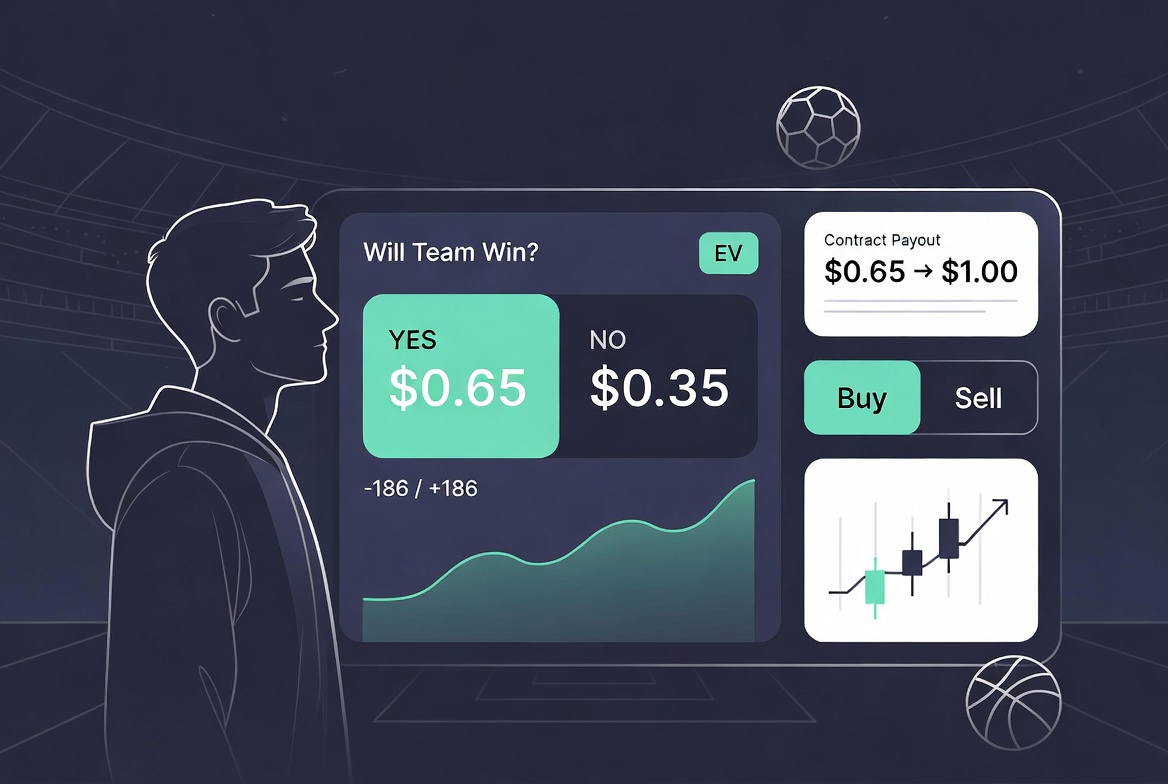
    Step 2: Read the price. A YES contract at $0.65 means the market gives the outcome a 65% chance. In sportsbook terms, that’s approximately -186. A YES at $0.35 is roughly +186. If you disagree with that probability, you’ve found potential value.

    Step 3: Size your position. Decide how many contracts to buy. At $0.65 per contract, 100 contracts costs $65. If the outcome happens, you collect $100 (profit: $35 minus fees). If it doesn’t, you lose your $65. Same risk/reward calculation you’d make sizing a sportsbook bet.

    Step 4: Place the order. On Kalshi, you can place a market order (filled immediately at best available price) or a limit order (you set your price and wait for a match). Limit orders are like getting a better line: you name your price and wait for someone to take the other side.

    Step 5: Manage or hold. Here’s where prediction markets diverge from sportsbooks. You don’t have to wait for the game to end. If the price moves in your favor (from $0.65 to $0.82), you can sell your contracts and take profit immediately. If the price moves against you ($0.65 drops to $0.45), you can cut your loss and free up capital for other trades. Or you can hold to resolution, just like a standard sports bet.

    This sell-anytime feature is the single most powerful tool prediction markets give sports bettors. It transforms a locked bet into a liquid position. Think of it as a cash-out button that’s always available at the true market price, not a discounted sportsbook cash-out offer.

    For a detailed walkthrough of contract anatomy, see our guide to your first prediction market trade.

    Skills That Transfer and Skills That Don’t

    Skills that transfer directly

    Probability assessment. You already think in terms of “is this line right?” That instinct is the core skill in prediction markets. If a contract is priced at $0.45 and your analysis puts the true probability at 60%, you’ve found a value play. Same thought process as spotting a mispriced spread.

    EV calculation. Expected value math is identical. Buy at $0.40, win probability is 55%: EV = (0.55 × $0.60) − (0.45 × $0.40) = $0.33 − $0.18 = +$0.15 per contract. Positive EV is positive EV regardless of format.

    Bankroll discipline. Unit-based thinking translates. If you bet 2% of your bankroll per sportsbook wager, you can apply the same principle to prediction market position sizing. For position sizing specifics, see our bankroll management for prediction markets guide.

    Contrarian thinking. Fading the public works in both markets. When the crowd overreacts to headlines, prices move away from fundamental value. Disciplined bettors who wait for overreactions profit in both arenas.

    I spent years at poker tables and sportsbooks before I touched a prediction market. The first thing I noticed: prediction markets reward the same analytical thinking as poker. You’re trading against other people who think they know more than you. The edge comes from the same place: better research, correct sizing, discipline to wait for spots where the price is wrong. The biggest adjustment was timeline. Sports bets resolve in hours. Prediction market positions can last months. That requires different patience.

    Robert C.

    Skills that need recalibration

    Timeline patience. Sports bets resolve in hours. Many prediction market contracts take weeks or months. Buying a political contract in March that settles in November requires a different emotional toolkit. Your capital is locked (unless you sell early), and you’ll watch the position value fluctuate for months.

    Unrealized P&L management. At a sportsbook, your bet is either pending or settled. On a prediction market, your position has a live market value that changes constantly. Watching a $0.70 position drop to $0.55 on news before recovering to $0.80 requires stomach most sports bettors haven’t developed.Overtrade risk. The ability to sell anytime is a feature, not a license to trade every fluctuation. Sports bettors accustomed to immediate action sometimes overtrade prediction market positions, eroding profits through fees and poor timing.

    Warning

    The most common mistake sports bettors make in prediction markets is treating the sell button like a sportsbook cash-out. Sportsbook cash-outs are designed to favor the house. Prediction market sell prices are true market prices. Don’t panic-sell at fair value just because the habit says “take the cash-out.”

    Where Sports Bettors Have an Edge in Prediction Markets

    Sports bettors bring a genuine analytical advantage to prediction markets because most prediction market participants don’t think in probability. They trade on gut feeling, headline reactions, and tribal loyalty. Disciplined sports bettors, who are trained to calculate EV and spot mispriced lines, enter a market where the competition is softer than what they’re used to.

    Political and economic markets. These categories attract the most gut-feeling traders. People who are emotionally invested in political outcomes consistently overpay for contracts aligned with their beliefs. The result: persistent mispricings that disciplined bettors can exploit. The same “fade the public” approach that works on Sunday NFL games works on Tuesday night political markets.

    Longer-dated futures. Sports bettors who trade NFL futures and championship markets understand the patience required for long-dated positions. Most prediction market participants avoid contracts that settle months out because they want fast resolution. That reduced demand creates value for patient capital.

    Cross-category diversification. A sports bettor’s instinct to spread action across multiple games translates naturally to prediction market portfolio thinking. Instead of five NFL bets on Sunday, you can hold positions across politics, economics, sports, and entertainment, with genuinely uncorrelated outcomes.

    Sports markets on prediction exchanges. Kalshi, FanDuel Predicts, and Polymarket all offer sports contracts. For sports bettors, these are the most familiar entry point. The advantage here is that prediction market sports pricing sometimes lags sportsbook line movement, creating brief windows where the PM price hasn’t caught up to the sharp sportsbook line. A Wharton analysis confirmed that prediction market pricing rewards sophisticated participants who apply disciplined analytical frameworks. 5Wharton School, “Prediction Markets and the Future of Sports Betting Analytics,” knowledge.wharton.upenn.edu, January 2026

    I found a political contract on Kalshi trading at $0.40 when my research put the true probability closer to 60%. In sports betting terms, that’s getting +150 on what should be a -150 favorite. That kind of mispricing barely exists in mature sports markets anymore, where sharps have squeezed the value out of most lines. It exists in prediction markets because the market is young, and a significant percentage of participants are trading on gut feeling rather than analysis.

    Robert C.

    Getting Started: Which Platform Fits Your Sports Betting Background

    The right prediction market platform depends on what you’re coming from and what you want to trade.

    If you’re a sportsbook regular (DraftKings, FanDuel, BetMGM users): Start with FanDuel Predicts. It’s available in all 50 states, the interface feels like a sportsbook, and you can fund your account with a debit card or ACH transfer. 6FanDuel, App Store listing, apps.apple.com, March 2026 The tradeoff: market selection is narrower than dedicated exchanges, and sports contracts are only available in 18 states where FanDuel doesn’t operate a sportsbook. Minimum deposit is $10. Trading fees include a CME exchange fee of $0.01 per contract per side plus FanDuel’s 2% fee on potential payouts. 7CME Group, “Event Contracts Fee Schedule,” cmegroup.com, February 2026 Our FanDuel Predicts guide covers the full platform walkthrough.

    If you’re comfortable with exchanges and want the widest selection: Choose Kalshi. It offers 10,000+ markets across sports, politics, economics, entertainment, and more. 8Kalshi, Public API series data, api.elections.kalshi.com, March 2026 The mobile app includes an American odds display toggle for sports bettors. Kalshi is CFTC-regulated, accepts deposits from $1 via ACH (free), debit card (2%), or USDC. Trading fees are capped at $0.02 per contract for takers, with 75% lower fees for limit orders. 9Kalshi, “Fee Schedule,” kalshi.com/docs/kalshi-fee-schedule.pdf, February 2026

    If you’re crypto-comfortable and want deep liquidity on political markets: Consider Polymarket. The global platform runs on USDC (Polygon network) with probability-based trading fees across most market categories. Sports markets carry a 0.75% peak effective rate, while politics and finance markets peak at 1.00%. Geopolitical and world events markets remain fee-free. 10Polymarket, “Trading Fees,” docs.polymarket.com/trading/fees, March 2026 The US platform charges 0.30% taker fees (with 0.20% maker rebates) and requires full KYC. 11Polymarket US, “Trading Fee Schedule,” polymarketexchange.com/fees-hours.html, March 2026 Polymarket’s political and economic markets consistently have the deepest liquidity in the industry.

    Start with one platform, make 5 to 10 small trades across different market categories, and get comfortable with the contract format before sizing up. Your sports betting instincts will translate faster than you expect. International readers can explore exchange-based alternatives like Betfair Exchange or Smarkets, which offer similar peer-to-peer mechanics for sports and other events.

    Bottom Line

    Sports betting and prediction markets share the same analytical DNA. The odds formats are different. The vocabulary changes. But the core skill set (probability assessment, EV calculation, bankroll discipline, and contrarian thinking) transfers directly.

    The structural advantage prediction markets offer over sportsbooks is clear: lower cost of participation (no vig), the ability to exit positions before resolution, and a peer-to-peer model that doesn’t penalize consistent winners. The tradeoff is longer resolution timescales and the emotional discipline required to manage live positions over weeks or months.

    If you’re a sports bettor looking to expand your edge, start with a familiar sports market on Kalshi or FanDuel Predicts. Make a few small trades using the translation table in this guide. Then explore political and economic markets, where the competition is softer and the mispricings are more pronounced.

    Your sports betting experience isn’t a liability here. It’s your biggest asset.

    Sources & References

    • 1
      CFTC, “Order of Designation: KalshiEX LLC,” cftc.gov, November 2020
    • 2
      CME Group, “FanDuel and CME Group Launch FanDuel Predicts,” cmegroup.com, December 2025
    • 3
      Polymarket, “CFTC Approval of Amended Order of Designation,” prnewswire.com, November 2025
    • 4
      Kalshi, App Store listing and help documentation, kalshi.com, March 2026
    • 5
      Wharton School, “Prediction Markets and the Future of Sports Betting Analytics,” knowledge.wharton.upenn.edu, January 2026
    • 6
      FanDuel, App Store listing, apps.apple.com, March 2026
    • 7
      CME Group, “Event Contracts Fee Schedule,” cmegroup.com, February 2026
    • 8
      Kalshi, Public API series data, api.elections.kalshi.com, March 2026
    • 9
      Kalshi, “Fee Schedule,” kalshi.com/docs/kalshi-fee-schedule.pdf, February 2026
    • 10
      Polymarket, “Trading Fees,” docs.polymarket.com/trading/fees, March 2026
    • 11
      Polymarket US, “Trading Fee Schedule,” polymarketexchange.com/fees-hours.html, March 2026
  • Prediction Markets vs. Sports Betting: What Every Bettor Needs to Know in 2026

    Prediction Markets vs. Sports Betting: What Every Bettor Needs to Know in 2026

    Prediction markets vs. sports betting comes down to one question: do you want to bet against the house, or trade against the crowd?

    If you’ve been placing bets on DraftKings or FanDuel, prediction markets like Kalshi and Polymarket are built on a completely different model. Instead of wagering against a sportsbook that sets the odds and takes a cut through the vig, you’re buying and selling contracts on an exchange where other traders set the price.

    The practical differences go beyond structure. Prediction markets typically charge lower fees, let you sell your position before an event settles, and cover everything from elections to economic data, not just sports. But sports betting offers simplicity, established regulation in 38+ states, and an experience most bettors already understand.

    To make this concrete, we’ll track the same $100 on an NFL championship market through both systems, comparing what you pay, what you can do with your position, and what you take home. By the end, you’ll know exactly which model fits your goals and where your existing skills give you an edge.

    How Prediction Markets and Sports Betting Actually Work

    At a sportsbook, you bet against the house. The operator sets the odds, builds in a margin (the vig), and pays you if you win. At a prediction market, you trade contracts against other users on an exchange. The price reflects what the crowd believes, and it moves in real time as money flows in.

    Here’s the practical difference with a concrete example. Say you want to back the Kansas City Chiefs to win the NFL championship.

    FeatureSportsbook (e.g., FanDuel)Prediction Market (e.g., Kalshi)
    What you’re doingPlacing a bet against the bookmakerBuying contracts on an exchange
    Pricing formatOdds (e.g., +250)Contract price ($0.00 to $1.00)
    Who sets the priceSportsbook oddsmakersOther traders (supply and demand)
    Built-in house edgeYes (the vig, typically 4-5%)No vig; exchange charges trading fees
    Can you exit early?Limited (cash-out at reduced value)Yes, sell your position anytime
    Payout if you winFixed at the odds you locked in$1.00 per contract, minus purchase price
    RegulationState-by-state gambling licensesFederal CFTC oversight

    At a sportsbook, you’d see the Chiefs listed at, say, +250. A $100 bet returns $350 if they win ($250 profit plus your $100 stake). The odds are fixed at the moment you place the bet.

    On Kalshi, you’d buy “Chiefs to win” contracts priced at, say, $0.28 each (implying a 28% probability). Your $100 buys approximately 357 contracts. If the Chiefs win, each contract pays $1.00. Your return: $357, with profit of roughly $255 after the initial $100 investment and trading fees.

    The numbers are close in this example, but the mechanics underneath are fundamentally different. At the sportsbook, the house controls the line. On the exchange, the market does.

    Pricing, Fees, and the Real Cost of Each

    The vig is the single biggest cost in sports betting, and most bettors never calculate it. On a standard -110/-110 two-way market, the vig is approximately 4.55%. That means for every $100 you risk at -110 odds, you’re paying roughly $4.55 in built-in margin to the sportsbook, whether you win or lose.

    Prediction market fees work differently. Kalshi charges a variable fee based on expected earnings, capped at roughly $0.02 per contract for taker orders. On 100 contracts at $0.50 (a $50 position), the taker fee is $1.75. Maker orders (limit orders that add liquidity) pay 75% less. Polymarket’s US exchange charges 0.10% on the contract premium, so the same $50 position costs $0.05 in fees.

    Expert Tip

    The vig is invisible because it’s built into the odds. Prediction market fees are explicit. This transparency is one reason the exchange model appeals to bettors who already understand that line shopping saves money. The same instinct applies: compare fees across prediction market platforms the way you’d compare lines across sportsbooks.

    Let’s continue our running example. You put $100 on the Chiefs at +250 on FanDuel. The implied probability is 28.6%, but the true probability after removing the vig is closer to 27.1%. The sportsbook pockets the difference across thousands of bets. On Kalshi, you buy 357 contracts at $0.28. Your taker fee is approximately $1.77. The contract price directly reflects market probability with no hidden margin. Your total cost is $100 plus $1.77 in fees.

    For bettors placing $50 to $500 per position, prediction markets are consistently cheaper on equivalent risk. The gap narrows on high-volume or promotional sportsbook bets where operators discount the vig to attract action.

    What You Can Trade (and Where)

    Sports betting covers athletic competition and the markets surrounding it: moneylines, spreads, totals, player props, futures, and parlays. A top-tier sportsbook like DraftKings or FanDuel lists 20+ sports with thousands of markets daily. For pure sports coverage depth, sportsbooks still win.

    Prediction markets cover sports plus everything else. On Kalshi, you can trade on Fed rate decisions, Bitcoin price targets, hurricane forecasts, Oscar winners, and whether the government shuts down, alongside NFL, NBA, and MLB markets. Polymarket offers a similar breadth with particularly deep political and crypto markets. The trade-off is that prediction market sports coverage is narrower in prop and in-game variety compared to a full sportsbook.

    The regulatory picture is where things get interesting. Sports betting is legal in 38+ states, but each state licenses operators individually. If you’re in a state without legal sports betting, you’re locked out. Prediction markets operate under federal CFTC regulation, which means platforms like FanDuel Predicts can offer contracts in all 50 states, including states without legal sports betting. In fact, FanDuel Predicts restricts sports contracts to the 18 states where it doesn’t already run a sportsbook, specifically to avoid regulatory conflict.

    Warning

    Prediction market availability is changing fast. Multiple states have issued cease-and-desist orders to prediction market platforms for sports contracts, arguing they constitute unlicensed gambling. Ohio, Massachusetts, Nevada, and several other states have active legal challenges as of early 2026. Check current availability before depositing on any platform.

    If you want to bet on sports and nothing else, a licensed sportsbook in your state is the straightforward choice. If you want broader event coverage or live in a state without legal sports betting, prediction markets open doors that sportsbooks can’t.

    Selling Positions, Cashing Out, and Tax Differences

    Here’s something sportsbooks can’t match: on a prediction market, you can sell your position before the event settles.

    Back to our running example. You bought 357 Chiefs contracts at $0.28 each. It’s halftime, and the Chiefs are up 21-7. The contract price has climbed to $0.72. You can sell all 357 contracts on the exchange for approximately $257, locking in a profit of roughly $155 (minus fees) without waiting for the final whistle. If you think the lead is safe, you hold. If you want to secure profit, you sell. The choice is yours, in real time.

    At a sportsbook, your +250 futures bet is locked. Some operators offer a cash-out feature, but the offered amount is typically 15-30% below fair value because the sportsbook prices in its own margin on the exit, too. Prediction market exits happen at the current market price, with transparent fees.

    This ability to trade in and out creates strategic possibilities that don’t exist with fixed-odds betting. You can scale into a position as your conviction grows, cut losses early if new information changes the picture, or take partial profits along the way.

    Warning: Tax Treatment Differences

    Tax treatment is a genuinely important difference, and it’s evolving. Sports betting winnings are taxed as gambling income. Sportsbooks issue W-2G forms for qualifying wins. Gambling losses are deductible only if you itemize, and only against gambling winnings. Prediction market earnings may be treated as capital gains, reported on 1099-B forms.

    Capital losses can offset other capital gains and, in some cases, up to $3,000 per year in ordinary income. The IRS has not issued definitive guidance specific to prediction market contracts, so rules may change. Consult a qualified tax professional before making decisions based on tax treatment.

    The position management flexibility and potentially more favorable tax treatment are two of the biggest structural reasons prediction markets appeal to active sports bettors.

    Skills That Transfer (and What’s New to Learn)

    If you’re a sports bettor considering prediction markets, you’re not starting from scratch. Several core skills carry over directly.

    SkillsSports BettingPrediction MarketsTransfers?

    Calculating EV

    Finding +EV lines vs. true probability

    Finding contracts priced below your estimated probability
    Yes

    Bankroll management

    Fixed percentage per bet (1-5%)

    Fixed percentage per position (same principles)
    Yes

    Line shopping

    Comparing odds across sportsbooks

    Comparing prices across Kalshi, Polymarket, FanDuel Predicts
    Yes

    Reading probability
    Converting odds to implied probability
    Contract prices are direct probability (no conversion)
    Yes, simpler

    Emotional discipline

    Avoiding tilt, chasing losses

    Same; market volatility adds a new dimension
    Yes

    What’s new: prediction markets require you to learn order book mechanics (limit orders vs. market orders), position sizing in contracts rather than dollar amounts, and the decision of when to sell a winning position versus holding to settlement. These aren’t difficult concepts, but they’re unfamiliar if you’ve only ever placed fixed-odds bets.

    Robert C.

    The first time I bought a contract on Kalshi after years of betting on DraftKings, the ‘aha’ moment was realizing I could sell my position. I had a futures bet mentality: pick it and forget it. But prediction markets reward active management. If you’ve ever calculated EV on a prop bet or managed a poker bankroll, you already think the right way. The learning curve is the interface, not the concepts.

    Why Sportsbooks Are Launching Prediction Markets

    In December 2025, both DraftKings and FanDuel launched prediction market apps within three days of each other. Robinhood had already enabled event contracts, trading over 500 million presidential election contracts in 2024. Crypto.com partnered with DraftKings in February 2026 to expand into player-specific sports contracts and entertainment markets.

    This isn’t coincidence. It’s a land grab.

    Pro Tip

    The biggest adjustment for sports bettors is shifting from “I placed my bet, now I watch” to “I have an open position I can manage.” Start with small positions and practice selling before settlement to build the habit.

    Prediction markets let these companies reach customers in states where sports betting isn’t legal. FanDuel Predicts launched in all 50 states on day one, offering sports contracts specifically in the 18 states where its sportsbook doesn’t operate. That’s millions of potential users who were previously unreachable.

    The financial stakes are enormous. Kalshi reported over $1 billion in trading volume on Super Bowl Sunday 2026, a 2,700% increase from the year before. Meanwhile, a Citizens analyst estimated prediction markets would attract $630 million in Super Bowl wagering and account for 80% of the year-over-year growth in total Super Bowl betting volume.

    Ben L.

    From an operator’s perspective, this convergence was inevitable. Sportsbooks saturated the states that legalized betting and ran out of new territory. Prediction markets, regulated federally, bypass the state-by-state licensing process entirely. The economics look familiar to anyone who’s watched the sports betting launch playbook: spend aggressively on customer acquisition, accept near-term losses, and build market share before regulation catches up. Flutter’s projected $200 to $300 million in EBITDA losses from prediction markets in 2026 tells you everything about how they’re approaching this.

    For bettors, this convergence is good news. More competition means better pricing, lower fees, and more platforms fighting for your business. For the industry, it signals that prediction markets and sports betting are heading toward a blurred middle ground.

    The Bottom Line

    Prediction markets and sports betting overlap in what they let you do (put money on future outcomes) but differ in how they do it. Sportsbooks offer simplicity, deep sports coverage, and familiar regulation. Prediction markets offer lower explicit fees, the ability to sell positions before settlement, broader event coverage, and potentially more favorable tax treatment.

    Choose sports betting if you want a straightforward experience, stick primarily to athletic events, and prefer the regulatory clarity of a state-licensed operator.

    Choose prediction markets if you want lower trading costs, the ability to manage positions actively, access to non-sports markets, or live in a state without legal sports betting.

    Many experienced bettors use both. The tools complement each other, and the skills transfer in both directions.

    Interested in finding the right prediction market platform? Explore our best prediction market apps guide for hands-on reviews and comparisons.