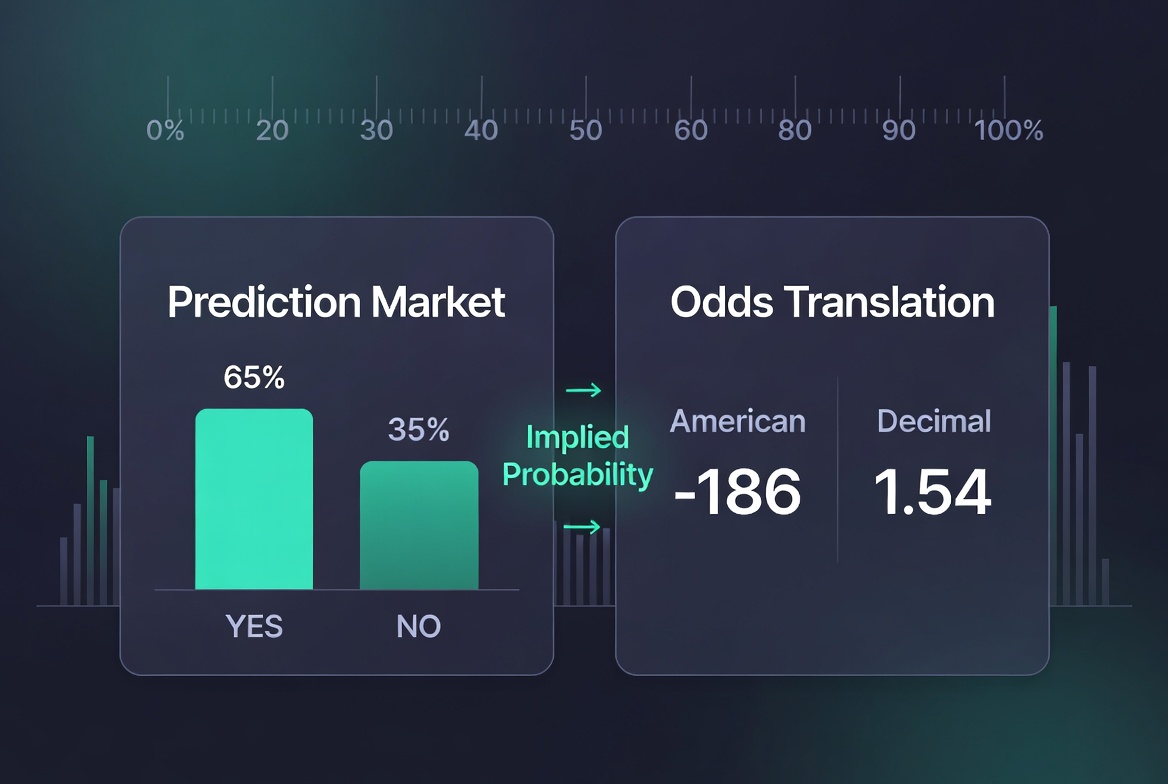
A prediction market contract priced at 65 cents is telling you something specific: the crowd puts the probability at exactly 65%. That single number is the entire pricing system. 1Polymarket Help Center, “What is a Prediction Market,” help.polymarket.com, March 2026
If you have traded stocks, placed a sports bet, or even checked an election forecast, you already understand the core mechanic. Prediction markets express probability as a price between $0.01 and $0.99, where every cent equals one percentage point of likelihood. A contract at $0.80 means an 80% chance. A contract at $0.25 means 25%. No conversion needed.
The challenge is that sports bettors think in American odds, traders think in decimals, and prediction markets speak in cents. This guide bridges those languages. You will see how YES/NO pair pricing works, how to translate PM prices into any odds format you already use, and how that translation skill helps you spot value across platforms.
Price Equals Probability: The One Rule That Unlocks Everything
Prediction market odds work through a simple mechanism: the contract price is the implied probability. 2Kalshi, “How Kalshi Works,” kalshi.com, March 2026 A contract trading at $0.65 on the question “Will the Fed cut rates in June 2026?” means the collective market assigns a 65% chance to that rate cut happening. If the Fed does cut rates, the contract pays $1.00. If it does not, the contract pays $0.00.
The math is transparent. Buy that contract at $0.65, and you stand to gain $0.35 if you are right (the $1.00 payout minus your $0.65 cost). Your maximum loss is $0.65, the exact amount you paid. That $1.00 ceiling and $0.00 floor mean your risk is bounded on both sides, with no margin calls, no hidden leverage, and no scenario where you owe more than your initial stake.This bounded structure is one of the key differences between prediction markets and other trading instruments.
For a full explanation of contract mechanics, see our guide to how prediction markets work.
Pro Tip:
If a prediction market contract costs $0.70, the market is saying there is a 70% chance this event happens. Your job is to decide whether you agree with that number.
YES, NO, and the Spread: How Pair Pricing Works
Every prediction market question creates two contracts: YES and NO. These are two sides of the same coin, and understanding how they pair together is central to reading prediction market contracts. If YES costs $0.65, the NO contract for that same question costs approximately $0.35. The two prices sum to roughly $1.00, because exactly one outcome will pay out. 3Polymarket Documentation, “What is a Prediction Market,” docs.polymarket.com, March 2026
The word “roughly” matters. In practice, YES + NO usually adds up to slightly more than $1.00. That difference is the spread. It represents the cost of trading on that platform, similar to the vig or juice at a sportsbook. A $0.65 YES paired with a $0.36 NO totals $1.01. That extra cent is the platform’s built-in margin.
Market Question | YES Price | NO Price | Combined |
|---|---|---|---|
Fed cuts rates in June 2026? | $0.65 | $0.36 | $1.01 |
Lakers win NBA Championship? | $0.12 | $0.89 | $1.01 |
Bitcoin above $100K by Dec 2026? | $0.55 | $0.46 | $1.01 |
The spread varies by platform and by market. High-volume markets on Polymarket can have spreads as tight as 1 to 2 cents ($1.01 combined). 4DeFi Rate, “The Hidden Tax Inside Your Prediction Market App: March Madness Odds Compared,” defirate.com, March 2026 Lower-volume markets on smaller platforms can see spreads of 5 to 8 cents ($1.05 to $1.08 combined). Checking the YES + NO combined price before you trade tells you exactly how much the platform is extracting.
Expert Tip:
Before buying a contract, add the YES price and the NO price together. If they sum to $1.05 or higher, you are paying a 5%+ spread. Compare that to another platform offering the same market at $1.01 combined. On high-volume trades, the spread difference adds up fast.
The Odds Translation Table: PM Prices in Every Format You Already Know
Prediction market prices are just another way of expressing odds. If you have placed a moneyline bet at a sportsbook, you have already done this math in reverse. The table below translates prediction market contract prices into implied probability, American odds, and decimal odds, with the corresponding NO price for each. 5OddsJam, “Prediction Market to Betting Odds Converter,” oddsjam.com, March 2026
PM Price (YES) | Implied Probability | American Odds | Decimal Odds | PM Price (NO) |
|---|---|---|---|---|
| $0.90 | 90% | -900 | 1.11 | $0.10 |
| $0.75 | 75% | -300 | 1.33 | $0.25 |
| $0.65 | 65% | -186 | 1.54 | $0.35 |
| $0.50 | 50% | +100 | 2.00 | $0.50 |
| $0.35 | 35% | +186 | 2.86 | $0.65 |
| $0.20 | 20% | +400 | 5.00 | $0.80 |
The conversion formulas are straightforward. For contracts priced above $0.50 (favorites), American odds equal the negative of (price times 100) divided by (1 minus the price). For contracts below $0.50 (underdogs), American odds equal (1 minus the price) divided by the price, times 100. 6Prediction Hunt, “Prediction Market Odds Converter,” predictionhunt.com, March 2026 Decimal odds are simply 1 divided by the contract price.
The practical takeaway: a $0.65 PM contract is equivalent to -186 American odds. If a sportsbook is offering -150 on the same event, the sportsbook is giving you a better price (it implies only 60% probability versus the PM’s 65%). That gap is your signal to compare platforms before placing a trade.
For Sports Bettors: Quick Translation Cheat Sheet
Think of PM contract prices as the “implied probability” you already calculate from moneylines. A $0.50 contract = +100 (even money). Above $0.50 = a favorite (negative American odds). Below $0.50 = an underdog (positive American odds). The deeper below $0.50, the bigger the potential payout and the bigger the longshot. If you are comfortable evaluating -200 versus -180 at different sportsbooks, you already have the skill to compare $0.67 versus $0.64 on different prediction markets.For more on applying your sports betting background to prediction markets, see our sports bettor’s guide to prediction markets.
Why Prediction Market Prices Move (and How That Differs From a Sportsbook)
At a traditional sportsbook, a team of oddsmakers sets the opening line. They adjust it based on where the money flows, but the house controls the starting point and the magnitude of changes. Prediction markets work differently. There is no bookmaker. Prices form entirely through supply and demand on an order book, similar to how stock prices form on an exchange. Platforms like Kalshi operate as CFTC-regulated designated contract markets, meaning the exchange infrastructure meets federal standards for transparency and oversight. 7Kalshi, “Trading on Kalshi,” help.kalshi.com, March 2026
When more traders buy YES contracts, the YES price rises. When sellers dominate, the price falls. Both Kalshi and Polymarket use central limit order books (CLOBs) where buyers post bids and sellers post asks. 8Polymarket Documentation, “How Trading Works,” docs.polymarket.com, March 2026 When a bid matches an ask, a trade executes. The spread between the highest bid and lowest ask reflects market liquidity. Tight spreads (one or two cents between the best bid and best ask) mean you can enter and exit positions cheaply.
This structure has a practical consequence: prediction market prices update in seconds when new information emerges. During live events, contract prices swing in real time as traders react to each development. Traditional polls take days to reflect new information. Sportsbooks adjust lines within minutes but often lag behind sharp bettors. Prediction markets close that gap because every participant is incentivized to act on new information immediately.
Warning:
Fast-moving prices during live events can mean wider spreads and more slippage. If you are trading a contract while news is breaking, use limit orders instead of market orders to control the price you pay.
How Sports Bettors Can Spot Value Using Odds Translation
The skill that makes a profitable sports bettor transfers directly to prediction markets: finding prices that do not reflect the true probability. 9DeFi Rate, “The Hidden Tax Inside Your Prediction Market App: March Madness Odds Compared,” defirate.com, March 2026 On a sportsbook, you look for a +150 underdog you believe should be +120. On a prediction market, you look for a $0.40 contract on an event you believe has a 55% chance of occurring.
The translation table from the previous section is your tool for cross-platform comparison. If a contract on Kalshi is priced at $0.65 and a sportsbook lists the same event at -150 (implied 60% probability), the prediction market is pricing the event 5 percentage points higher. Your job is to determine which price is closer to reality. If your research supports the 60% number, the sportsbook offers better value. If you believe 65% or higher is accurate, the PM price is fair. 10Kalshi Fee Schedule, effective February 5, 2026, kalshi.com/docs/kalshi-fee-schedule.pdf
One additional factor to consider: prediction markets also host multiple-outcome markets. Instead of a binary YES/NO, a question like “Who will win the 2028 Presidential Election?” might have 8 to 10 candidates, each priced individually. All outcome prices should sum to approximately $1.00 (plus the platform’s overround). If you spot individual candidates mispriced within that structure, the same value-identification logic applies, just across more options.
Reading the Numbers, Finding the Edge
Prediction market odds are simpler than they first appear. Price equals probability. YES and NO form a pair that sums to approximately $1.00. Every PM price has a direct equivalent in American odds, decimal odds, and implied probability. Once you internalize these translations, you can compare prices across prediction markets and sportsbooks with the same speed you compare lines at DraftKings versus FanDuel.
The edge comes from applying what you already know. If you are a sports bettor, you have spent years identifying mispriced lines. That skill works identically here, with the added advantage that prediction markets cover politics, economics, entertainment, and dozens of other categories where sportsbooks do not operate. Start by reading prices in the format you know best, then build fluency in the PM-native format as you gain experience.
Risk Warning:
Prediction markets involve financial risk. Only trade with money you can afford to lose. Past performance does not guarantee future results. Check your local regulations before trading on any prediction market platform.
New to prediction markets entirely? Start with our complete guide to how prediction markets work for the full foundation.